
Awareness
Creator: Bodalia, Chandra
Description
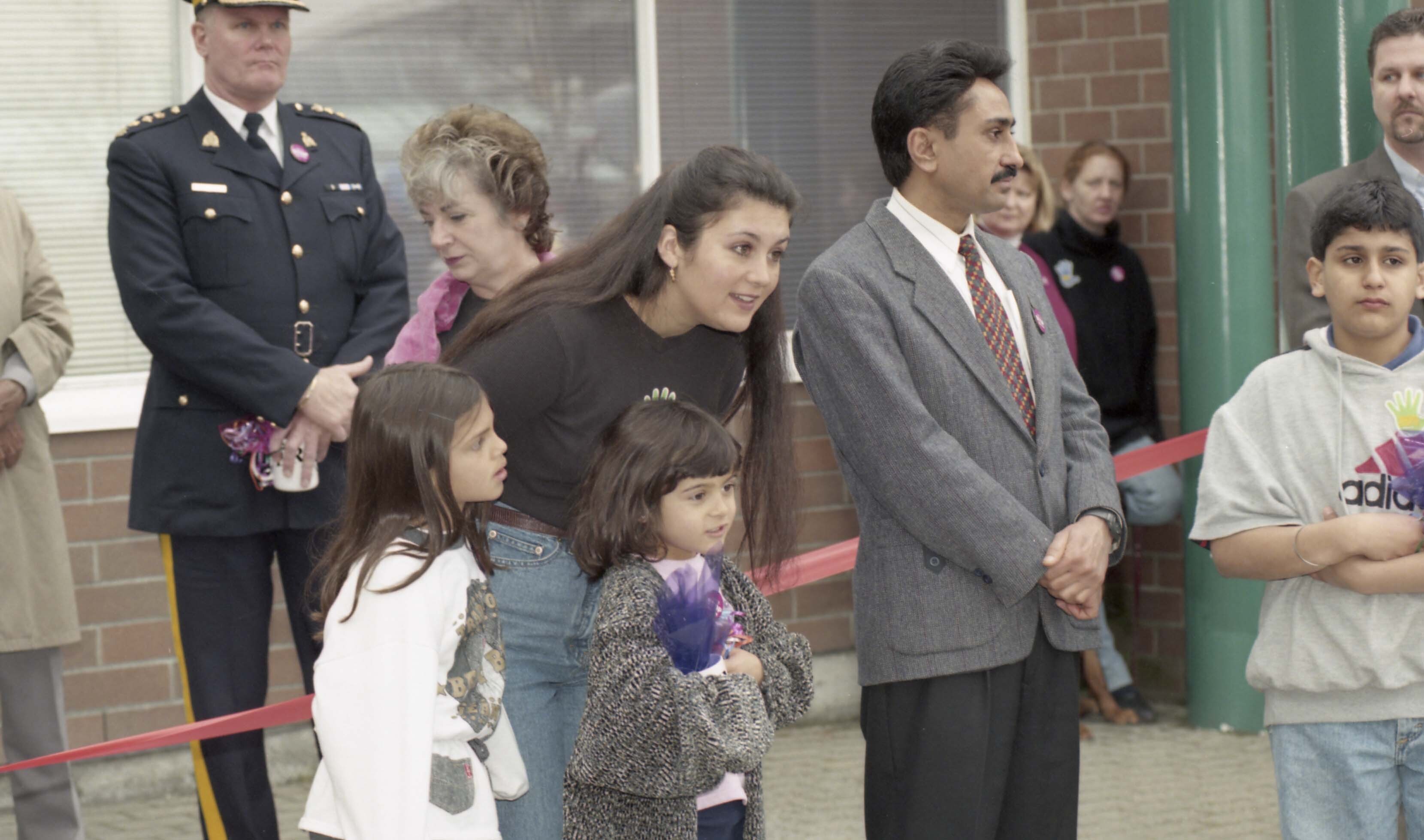
Photograph of Sue Hammell with a group of unidentified individuals at the International Day for the Elimination of Racial Discrimination event, called Eracism, held in Surrey, British Columbia (B.C.).
Sue Hammell is a former Member of the Legislative Assembly for Surrey-Green Timbers, serving multiple terms since 1991. She held key roles, including Minister for Women's Equality, and co-founded the Minerva Foundation for BC Women. Hammell also worked internationally to support female leaders and served as Executive Director of the Surrey Aboriginal Society.
The International Day for the Elimination of Racial Discrimination is guided by the United Nations International Convention on the Elimination of All Forms of Racial Discrimination and recognizes that the injustices and prejudices fueled by racial discrimination take place every day. Observed annually on March 21, it commemorates the day police in Sharpeville, South Africa, opened fire and killed 69 people at a peaceful demonstration against apartheid "pass laws" in 1960. This day serves as a call to action for individuals, organizations, and all levels of government to actively work to eliminate all forms of racial discrimination, injustice, systemic racism and hate.
Sue Hammell is a former Member of the Legislative Assembly for Surrey-Green Timbers, serving multiple terms since 1991. She held key roles, including Minister for Women's Equality, and co-founded the Minerva Foundation for BC Women. Hammell also worked internationally to support female leaders and served as Executive Director of the Surrey Aboriginal Society.
The International Day for the Elimination of Racial Discrimination is guided by the United Nations International Convention on the Elimination of All Forms of Racial Discrimination and recognizes that the injustices and prejudices fueled by racial discrimination take place every day. Observed annually on March 21, it commemorates the day police in Sharpeville, South Africa, opened fire and killed 69 people at a peaceful demonstration against apartheid "pass laws" in 1960. This day serves as a call to action for individuals, organizations, and all levels of government to actively work to eliminate all forms of racial discrimination, injustice, systemic racism and hate.
Creator: Bodalia, Chandra
Description
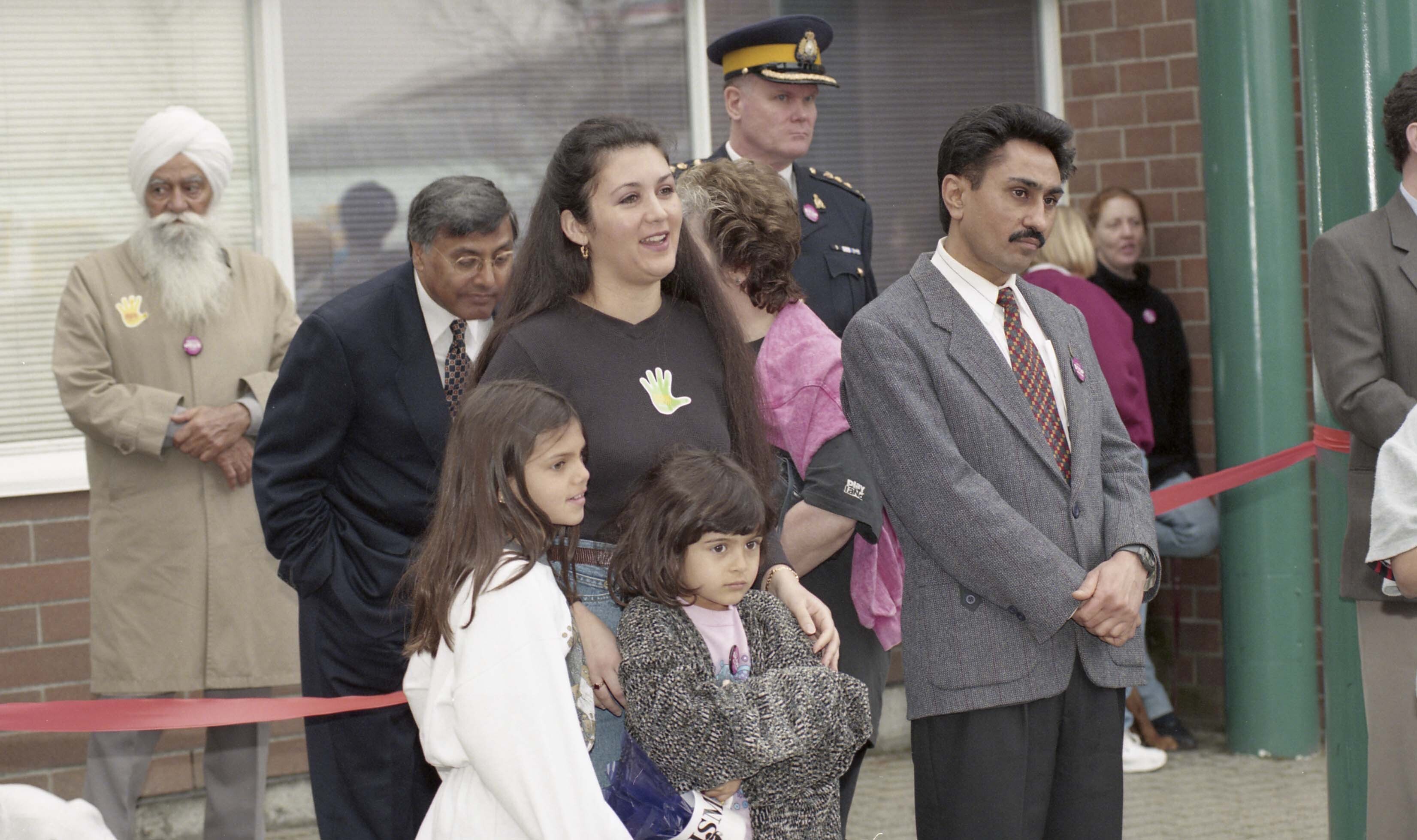
Photograph of Ujjal Dosanjh with a group of unidentified individuals at the International Day for the Elimination of Racial Discrimination event, called Eracism, held in Surrey, British Columbia (B.C.).
Ujjal Dosanjh is a Canadian lawyer, civil rights activist, and politician. Born in Panjab, India in 1947, Dosanjh emigrated to England at the age of 17 and came to Canada four years later, in 1968. He started off at a Vancouver sawmill, but when a back injury hindered his career at the mill, he enrolled at Langara College and completed a degree in political science at Simon Fraser University. He earned a law degree at the University of British Columbia and established a law practice in Vancouver in 1979. First elected as MLA for Vancouver-Kensington in 1991, Dosanjh twice served as Caucus Chair and also chaired the Select Standing Committee on Parliamentary Reform, Ethical Conduct, Standing Orders and Private Bills. Dosanjh was sworn in as British Columbia's 33rd Premier and Canada's first Indo-Canadian Premier on February 24, 2000, serving until 2001. He had previously served as Minister of Government Services and Minister Responsible for Multiculturalism, Human Rights, Sports and Immigration in 1995, and served as Attorney General from August 1995 to February 2000. He was also the leader of the provincial New Democratic Party (NDP) and later served as a Member of Parliament with the Liberal Party. A long time human rights activist, his past community involvements include: South Vancouver Neighbourhood House, MOSAIC, the B.C. Multicultural Society and the B.C. Civil Liberties Association. In 1977 he helped set up the first farm workers' legal information services while he was chair of the Labour Advocacy Research Association. Throughout his career, Dosanjh has been a strong advocate for social justice, healthcare, and public policy issues.
The International Day for the Elimination of Racial Discrimination is guided by the United Nations International Convention on the Elimination of All Forms of Racial Discrimination and recognizes that the injustices and prejudices fueled by racial discrimination take place every day. Observed annually on March 21, it commemorates the day police in Sharpeville, South Africa, opened fire and killed 69 people at a peaceful demonstration against apartheid "pass laws" in 1960. This day serves as a call to action for individuals, organizations, and all levels of government to actively work to eliminate all forms of racial discrimination, injustice, systemic racism and hate.
Ujjal Dosanjh is a Canadian lawyer, civil rights activist, and politician. Born in Panjab, India in 1947, Dosanjh emigrated to England at the age of 17 and came to Canada four years later, in 1968. He started off at a Vancouver sawmill, but when a back injury hindered his career at the mill, he enrolled at Langara College and completed a degree in political science at Simon Fraser University. He earned a law degree at the University of British Columbia and established a law practice in Vancouver in 1979. First elected as MLA for Vancouver-Kensington in 1991, Dosanjh twice served as Caucus Chair and also chaired the Select Standing Committee on Parliamentary Reform, Ethical Conduct, Standing Orders and Private Bills. Dosanjh was sworn in as British Columbia's 33rd Premier and Canada's first Indo-Canadian Premier on February 24, 2000, serving until 2001. He had previously served as Minister of Government Services and Minister Responsible for Multiculturalism, Human Rights, Sports and Immigration in 1995, and served as Attorney General from August 1995 to February 2000. He was also the leader of the provincial New Democratic Party (NDP) and later served as a Member of Parliament with the Liberal Party. A long time human rights activist, his past community involvements include: South Vancouver Neighbourhood House, MOSAIC, the B.C. Multicultural Society and the B.C. Civil Liberties Association. In 1977 he helped set up the first farm workers' legal information services while he was chair of the Labour Advocacy Research Association. Throughout his career, Dosanjh has been a strong advocate for social justice, healthcare, and public policy issues.
The International Day for the Elimination of Racial Discrimination is guided by the United Nations International Convention on the Elimination of All Forms of Racial Discrimination and recognizes that the injustices and prejudices fueled by racial discrimination take place every day. Observed annually on March 21, it commemorates the day police in Sharpeville, South Africa, opened fire and killed 69 people at a peaceful demonstration against apartheid "pass laws" in 1960. This day serves as a call to action for individuals, organizations, and all levels of government to actively work to eliminate all forms of racial discrimination, injustice, systemic racism and hate.
Creator: Bodalia, Chandra
Description
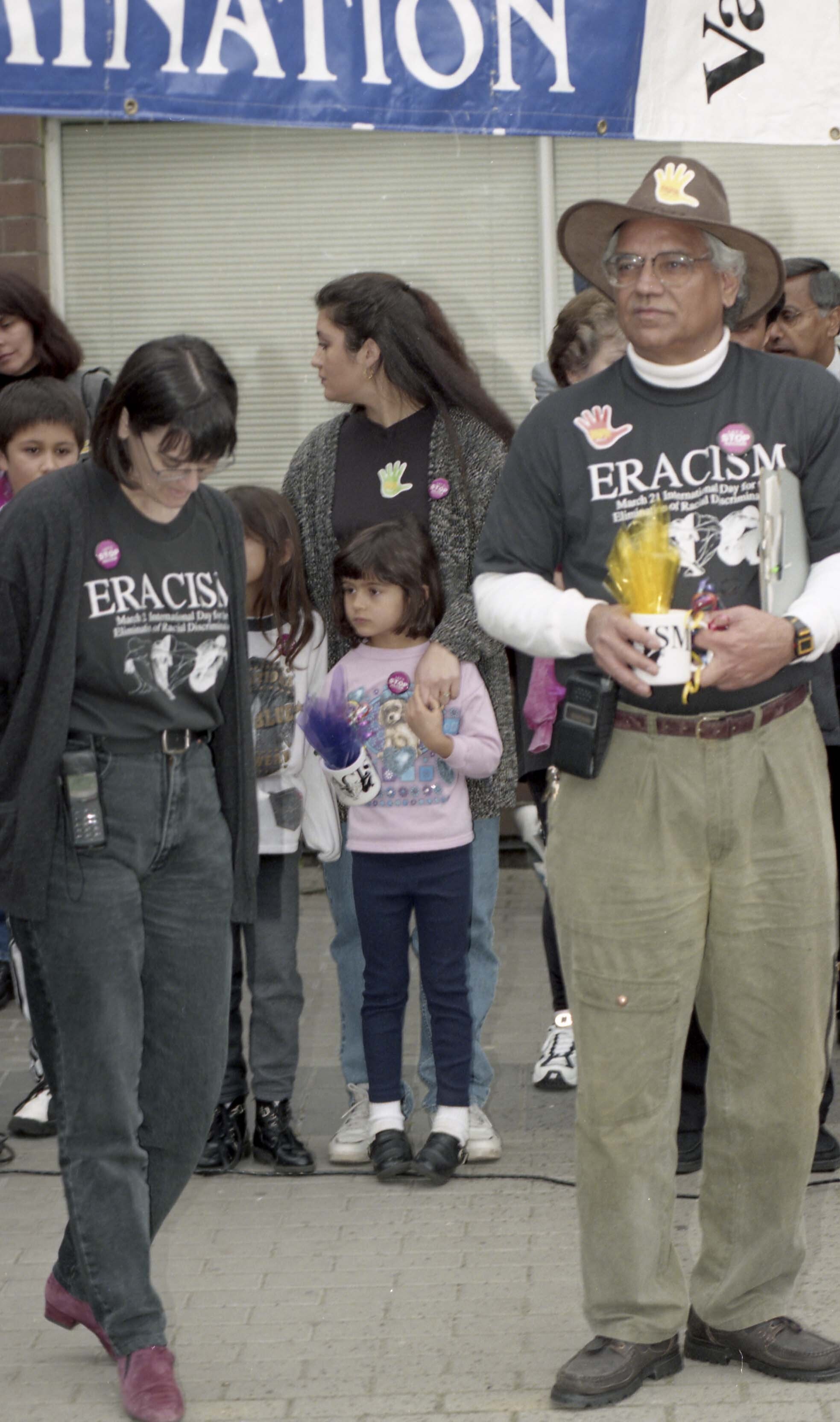
Photograph of Charan Gill with a group of unidentified individuals at the International Day for the Elimination of Racial Discrimination event, called Eracism, held in Surrey, British Columbia (B.C.).
Charan Pal Gill (June 17, 1936 - February 2, 2021), born in Hong Kong, was a social worker, social activist, labour organizer, anti-racism pioneer and a South Asian community leader in British Columbia. Gill relocated to Vancouver, Canada in 1967, where he briefly worked as a berry picker before finding employment in a sawmill in Williams Lake, British Columbia. Due to an injury to his wrist, Gill left the sawmill and after some training began working as a social worker in Prince Rupert. After working for five years as a social worker, Gill became a registered social worker after obtaining his bachelor's degree from the University of British Columbia in 1970. Gill was involved with the Indian People's Association in North America (IPANA) in Vancouver. Founded in Montreal in June 1975, IPANA was a left-wing social group initially focused on generating support for the Naxalite movement in India. In 1979, Gill with IPANA in Vancouver played significant roles in the formation of the Farm Workers Organizing Committee (FWOC). On 6 April 1980, the FWOC transformed into the Canadian Farmworkers Union (CFU). The CFU became the first union in Canada's history centred on farmworkers. Gill was elected CFU founding secretary (by 2004 he also served as secretary and treasurer). He also became the editor of the Farmworker, the CFU's newspaper (published in English and Panjabi). While contributing towards the CFU, Gill pursued postgraduate studies and earned his master's degree in social work in 1983. For much of his professional career he worked for the BC Ministry of Human Resources and Ministry of Social Services and Housing. In November 1980, Gill co-founded the volunteer organization British Columbia Organization to Fight Racism (BCOFR). In 1985 Gill established a new service provider catering to the immediate needs of the South Asian community in British Columbia. The charitable organization was originally known as the Progressive Indo-Canadian Community Services Society and later became the Progressive Intercultural Community Services Society (PICS). Gill served as the organization's chief executive officer until 2017. Gill gradually retired from social work while working with PICS. He also served on the boards of various organizations, including the agriculture cooperative AgSafe (formerly FARSHA) since 1993; Rainbow Community Health Co-operative since 1998; Canadian Agricultural Safety Association (CASA) since 2011; and the BC Non-Profit Housing Association from 2008 to 2012. Gill was the recipient of numerous awards and honours in recognition of his activism and contributions to human rights and workers' rights, such as, the Order of British Columbia (1999) and the Queen's Diamond Jubilee Medal (2012).
The International Day for the Elimination of Racial Discrimination is guided by the United Nations International Convention on the Elimination of All Forms of Racial Discrimination and recognizes that the injustices and prejudices fueled by racial discrimination take place every day. Observed annually on March 21, it commemorates the day police in Sharpeville, South Africa, opened fire and killed 69 people at a peaceful demonstration against apartheid "pass laws" in 1960. This day serves as a call to action for individuals, organizations, and all levels of government to actively work to eliminate all forms of racial discrimination, injustice, systemic racism and hate.
Charan Pal Gill (June 17, 1936 - February 2, 2021), born in Hong Kong, was a social worker, social activist, labour organizer, anti-racism pioneer and a South Asian community leader in British Columbia. Gill relocated to Vancouver, Canada in 1967, where he briefly worked as a berry picker before finding employment in a sawmill in Williams Lake, British Columbia. Due to an injury to his wrist, Gill left the sawmill and after some training began working as a social worker in Prince Rupert. After working for five years as a social worker, Gill became a registered social worker after obtaining his bachelor's degree from the University of British Columbia in 1970. Gill was involved with the Indian People's Association in North America (IPANA) in Vancouver. Founded in Montreal in June 1975, IPANA was a left-wing social group initially focused on generating support for the Naxalite movement in India. In 1979, Gill with IPANA in Vancouver played significant roles in the formation of the Farm Workers Organizing Committee (FWOC). On 6 April 1980, the FWOC transformed into the Canadian Farmworkers Union (CFU). The CFU became the first union in Canada's history centred on farmworkers. Gill was elected CFU founding secretary (by 2004 he also served as secretary and treasurer). He also became the editor of the Farmworker, the CFU's newspaper (published in English and Panjabi). While contributing towards the CFU, Gill pursued postgraduate studies and earned his master's degree in social work in 1983. For much of his professional career he worked for the BC Ministry of Human Resources and Ministry of Social Services and Housing. In November 1980, Gill co-founded the volunteer organization British Columbia Organization to Fight Racism (BCOFR). In 1985 Gill established a new service provider catering to the immediate needs of the South Asian community in British Columbia. The charitable organization was originally known as the Progressive Indo-Canadian Community Services Society and later became the Progressive Intercultural Community Services Society (PICS). Gill served as the organization's chief executive officer until 2017. Gill gradually retired from social work while working with PICS. He also served on the boards of various organizations, including the agriculture cooperative AgSafe (formerly FARSHA) since 1993; Rainbow Community Health Co-operative since 1998; Canadian Agricultural Safety Association (CASA) since 2011; and the BC Non-Profit Housing Association from 2008 to 2012. Gill was the recipient of numerous awards and honours in recognition of his activism and contributions to human rights and workers' rights, such as, the Order of British Columbia (1999) and the Queen's Diamond Jubilee Medal (2012).
The International Day for the Elimination of Racial Discrimination is guided by the United Nations International Convention on the Elimination of All Forms of Racial Discrimination and recognizes that the injustices and prejudices fueled by racial discrimination take place every day. Observed annually on March 21, it commemorates the day police in Sharpeville, South Africa, opened fire and killed 69 people at a peaceful demonstration against apartheid "pass laws" in 1960. This day serves as a call to action for individuals, organizations, and all levels of government to actively work to eliminate all forms of racial discrimination, injustice, systemic racism and hate.
Creator: Bodalia, Chandra
Description
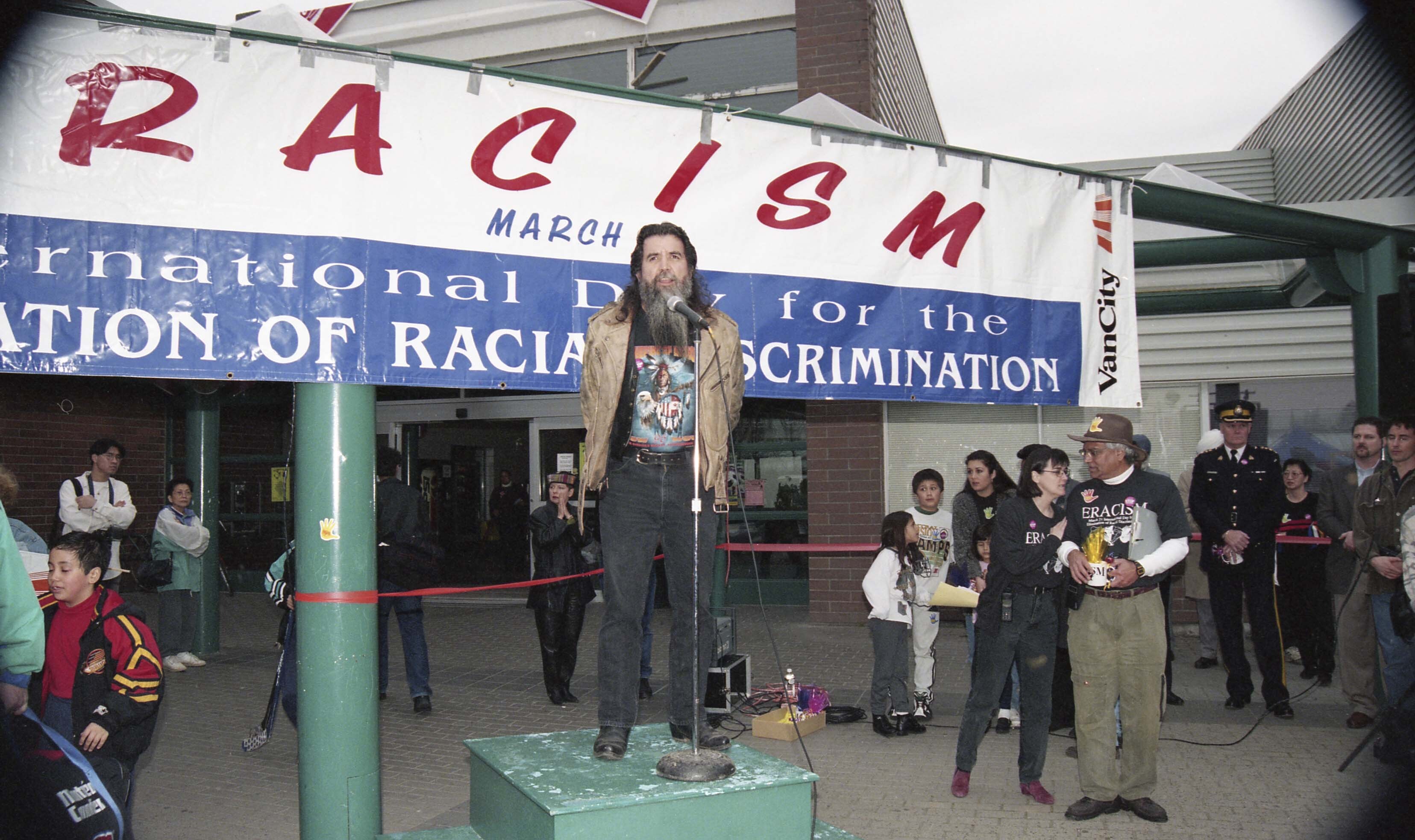
Photograph of an unidentified individual addressing the audience at the International Day for the Elimination of Racial Discrimination event, called Eracism, held in Surrey, British Columbia (B.C.).
The International Day for the Elimination of Racial Discrimination is guided by the United Nations International Convention on the Elimination of All Forms of Racial Discrimination and recognizes that the injustices and prejudices fueled by racial discrimination take place every day. Observed annually on March 21, it commemorates the day police in Sharpeville, South Africa, opened fire and killed 69 people at a peaceful demonstration against apartheid "pass laws" in 1960. This day serves as a call to action for individuals, organizations, and all levels of government to actively work to eliminate all forms of racial discrimination, injustice, systemic racism and hate.
The International Day for the Elimination of Racial Discrimination is guided by the United Nations International Convention on the Elimination of All Forms of Racial Discrimination and recognizes that the injustices and prejudices fueled by racial discrimination take place every day. Observed annually on March 21, it commemorates the day police in Sharpeville, South Africa, opened fire and killed 69 people at a peaceful demonstration against apartheid "pass laws" in 1960. This day serves as a call to action for individuals, organizations, and all levels of government to actively work to eliminate all forms of racial discrimination, injustice, systemic racism and hate.
Creator: Bodalia, Chandra
Description
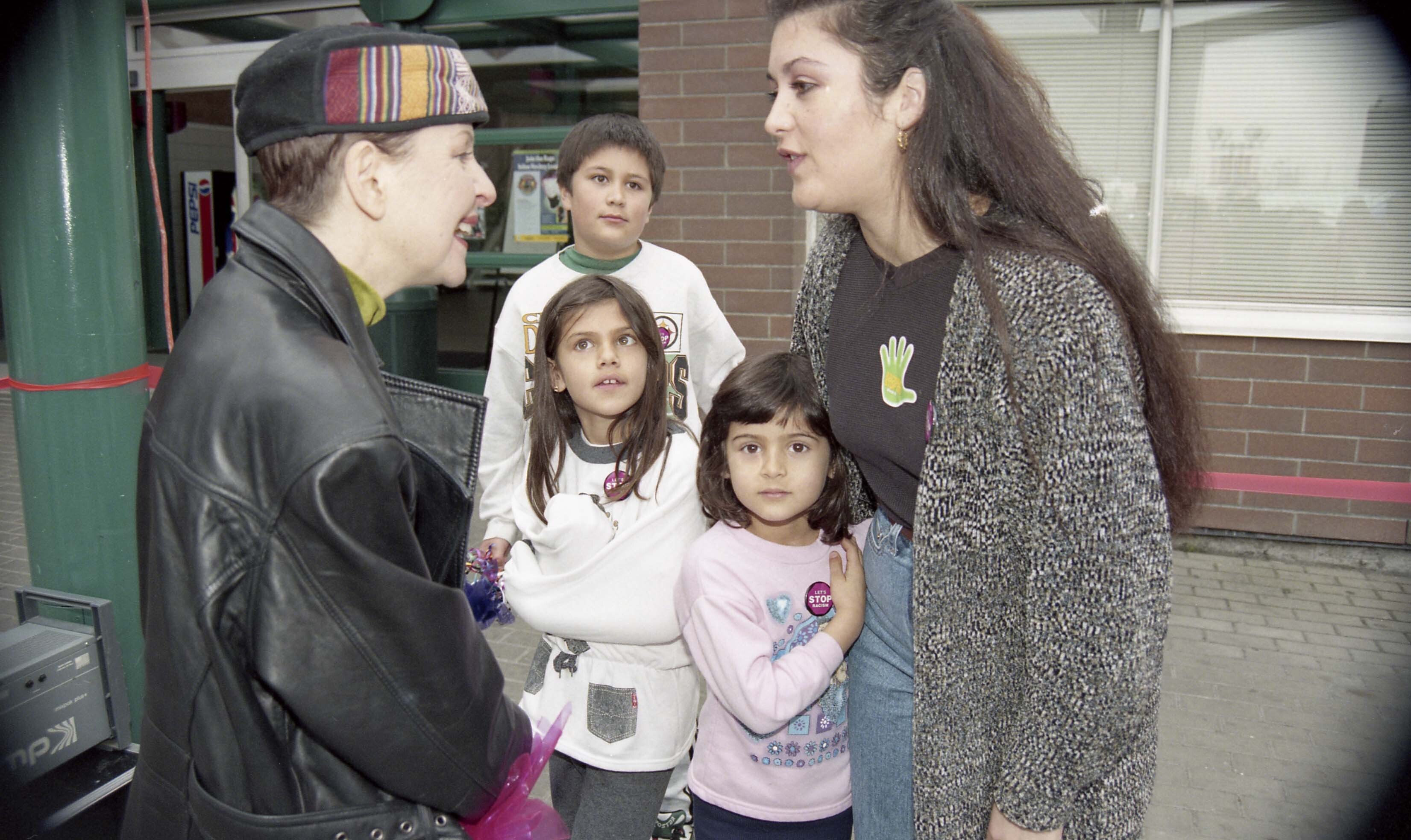
Photograph of Penny Priddy with a group of unidentified individuals at the International Day for the Elimination of Racial Discrimination event, called Eracism, held in Surrey, British Columbia (B.C.).
Penny Priddy is a Canadian politician who served as a Member of the Legislative Assembly for Surrey-Newton from 1991 to 2001. She held several ministerial roles, including Minister of Women's Equality, Minister of Health, and Minister of Education. A trained nurse, she worked extensively in community services, supporting children, families, and people with disabilities. Priddy was also active in the Surrey School Board and various community organizations.
The International Day for the Elimination of Racial Discrimination is guided by the United Nations International Convention on the Elimination of All Forms of Racial Discrimination and recognizes that the injustices and prejudices fueled by racial discrimination take place every day. Observed annually on March 21, it commemorates the day police in Sharpeville, South Africa, opened fire and killed 69 people at a peaceful demonstration against apartheid "pass laws" in 1960. This day serves as a call to action for individuals, organizations, and all levels of government to actively work to eliminate all forms of racial discrimination, injustice, systemic racism and hate.
Penny Priddy is a Canadian politician who served as a Member of the Legislative Assembly for Surrey-Newton from 1991 to 2001. She held several ministerial roles, including Minister of Women's Equality, Minister of Health, and Minister of Education. A trained nurse, she worked extensively in community services, supporting children, families, and people with disabilities. Priddy was also active in the Surrey School Board and various community organizations.
The International Day for the Elimination of Racial Discrimination is guided by the United Nations International Convention on the Elimination of All Forms of Racial Discrimination and recognizes that the injustices and prejudices fueled by racial discrimination take place every day. Observed annually on March 21, it commemorates the day police in Sharpeville, South Africa, opened fire and killed 69 people at a peaceful demonstration against apartheid "pass laws" in 1960. This day serves as a call to action for individuals, organizations, and all levels of government to actively work to eliminate all forms of racial discrimination, injustice, systemic racism and hate.
Creator: Bodalia, Chandra
Description
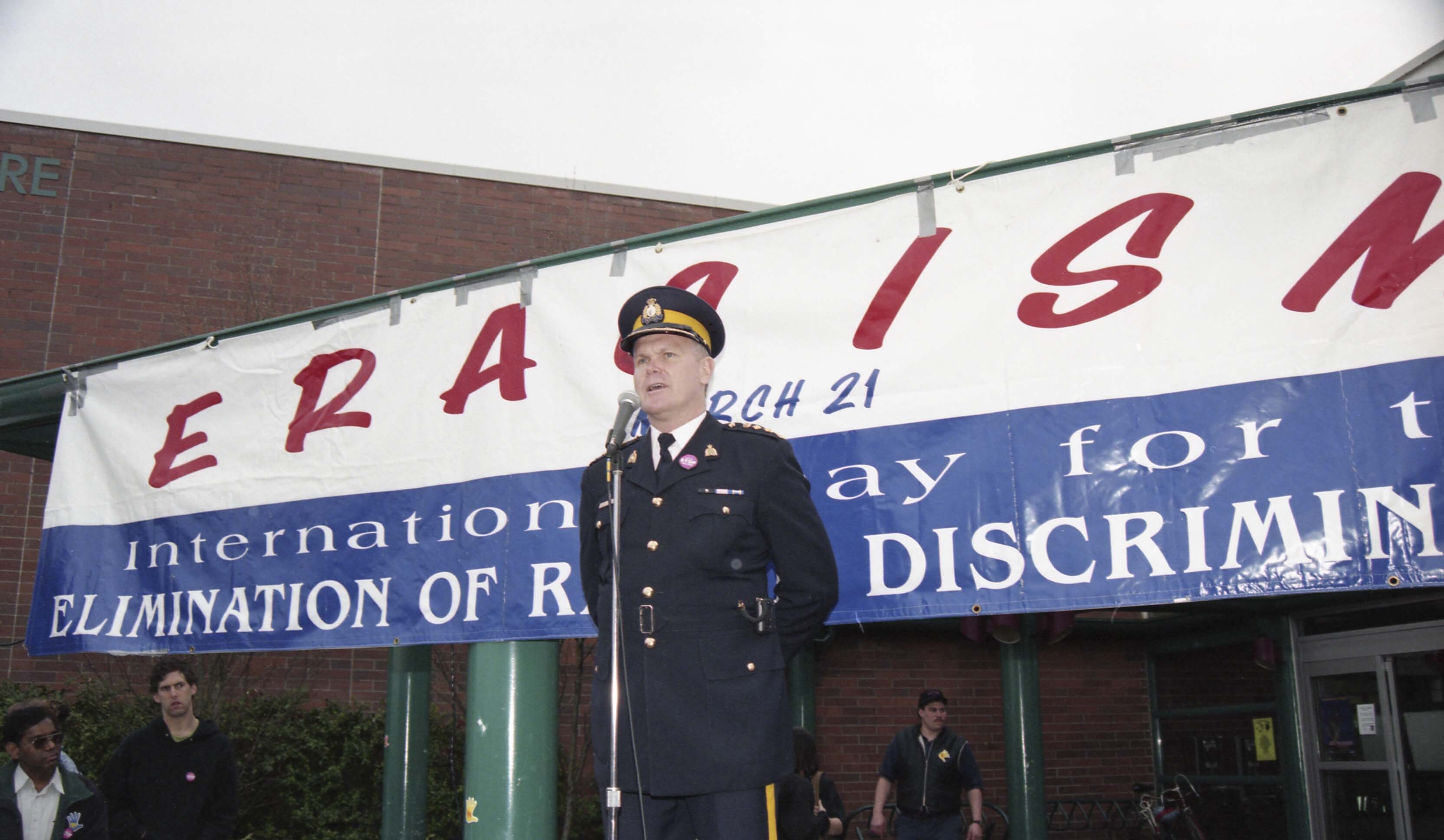
Photograph of an unidentified individual addressing the audience at the International Day for the Elimination of Racial Discrimination event, called Eracism, held in Surrey, British Columbia (B.C.).
The International Day for the Elimination of Racial Discrimination is guided by the United Nations International Convention on the Elimination of All Forms of Racial Discrimination and recognizes that the injustices and prejudices fueled by racial discrimination take place every day. Observed annually on March 21, it commemorates the day police in Sharpeville, South Africa, opened fire and killed 69 people at a peaceful demonstration against apartheid "pass laws" in 1960. This day serves as a call to action for individuals, organizations, and all levels of government to actively work to eliminate all forms of racial discrimination, injustice, systemic racism and hate.
The International Day for the Elimination of Racial Discrimination is guided by the United Nations International Convention on the Elimination of All Forms of Racial Discrimination and recognizes that the injustices and prejudices fueled by racial discrimination take place every day. Observed annually on March 21, it commemorates the day police in Sharpeville, South Africa, opened fire and killed 69 people at a peaceful demonstration against apartheid "pass laws" in 1960. This day serves as a call to action for individuals, organizations, and all levels of government to actively work to eliminate all forms of racial discrimination, injustice, systemic racism and hate.

Creator: Bodalia, Chandra
Description
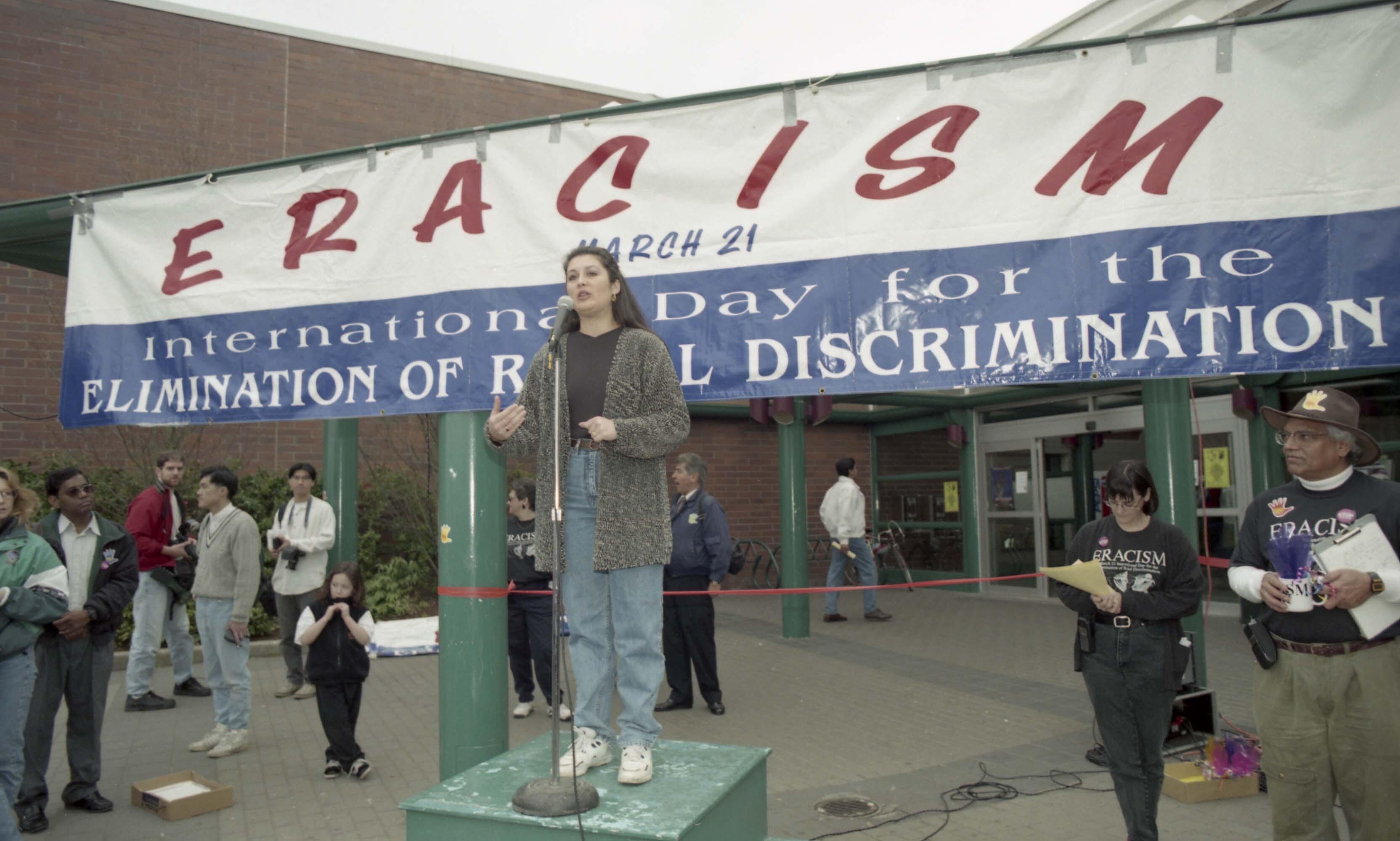
Photograph of an unidentified individual addressing the audience at the International Day for the Elimination of Racial Discrimination event, called Eracism, held in Surrey, British Columbia (B.C.).
The International Day for the Elimination of Racial Discrimination is guided by the United Nations International Convention on the Elimination of All Forms of Racial Discrimination and recognizes that the injustices and prejudices fueled by racial discrimination take place every day. Observed annually on March 21, it commemorates the day police in Sharpeville, South Africa, opened fire and killed 69 people at a peaceful demonstration against apartheid "pass laws" in 1960. This day serves as a call to action for individuals, organizations, and all levels of government to actively work to eliminate all forms of racial discrimination, injustice, systemic racism and hate.
The International Day for the Elimination of Racial Discrimination is guided by the United Nations International Convention on the Elimination of All Forms of Racial Discrimination and recognizes that the injustices and prejudices fueled by racial discrimination take place every day. Observed annually on March 21, it commemorates the day police in Sharpeville, South Africa, opened fire and killed 69 people at a peaceful demonstration against apartheid "pass laws" in 1960. This day serves as a call to action for individuals, organizations, and all levels of government to actively work to eliminate all forms of racial discrimination, injustice, systemic racism and hate.
Creator: Bodalia, Chandra
Description
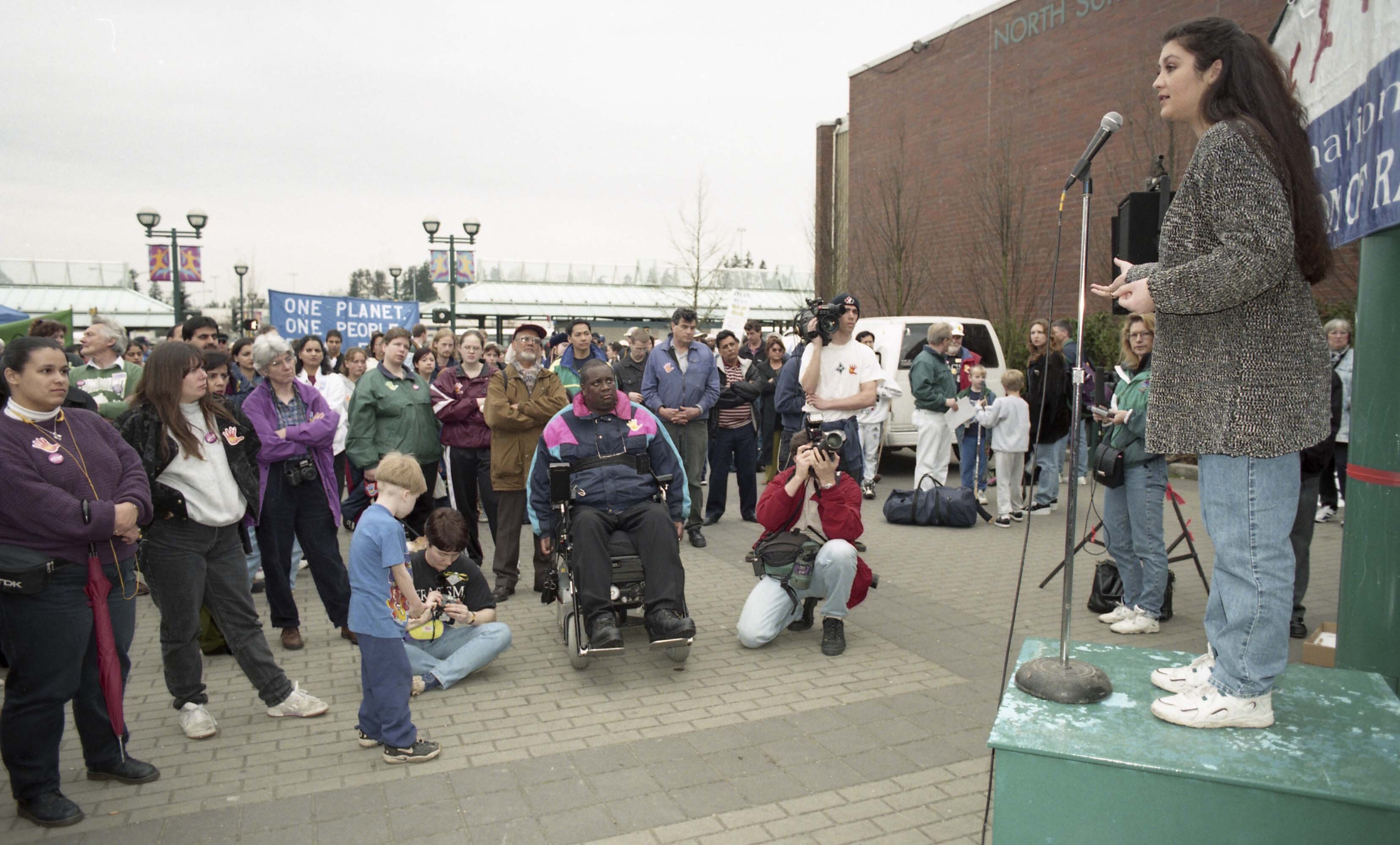
Photograph of an unidentified individual addressing the audience at the International Day for the Elimination of Racial Discrimination event, called Eracism, held in Surrey, British Columbia (B.C.).
The International Day for the Elimination of Racial Discrimination is guided by the United Nations International Convention on the Elimination of All Forms of Racial Discrimination and recognizes that the injustices and prejudices fueled by racial discrimination take place every day. Observed annually on March 21, it commemorates the day police in Sharpeville, South Africa, opened fire and killed 69 people at a peaceful demonstration against apartheid "pass laws" in 1960. This day serves as a call to action for individuals, organizations, and all levels of government to actively work to eliminate all forms of racial discrimination, injustice, systemic racism and hate.
The International Day for the Elimination of Racial Discrimination is guided by the United Nations International Convention on the Elimination of All Forms of Racial Discrimination and recognizes that the injustices and prejudices fueled by racial discrimination take place every day. Observed annually on March 21, it commemorates the day police in Sharpeville, South Africa, opened fire and killed 69 people at a peaceful demonstration against apartheid "pass laws" in 1960. This day serves as a call to action for individuals, organizations, and all levels of government to actively work to eliminate all forms of racial discrimination, injustice, systemic racism and hate.
Creator: Bodalia, Chandra
Description
Photograph of an unidentified individual addressing the audience at the International Day for the Elimination of Racial Discrimination event, called Eracism, held in Surrey, British Columbia (B.C.).
The International Day for the Elimination of Racial Discrimination is guided by the United Nations International Convention on the Elimination of All Forms of Racial Discrimination and recognizes that the injustices and prejudices fueled by racial discrimination take place every day. Observed annually on March 21, it commemorates the day police in Sharpeville, South Africa, opened fire and killed 69 people at a peaceful demonstration against apartheid "pass laws" in 1960. This day serves as a call to action for individuals, organizations, and all levels of government to actively work to eliminate all forms of racial discrimination, injustice, systemic racism and hate.
The International Day for the Elimination of Racial Discrimination is guided by the United Nations International Convention on the Elimination of All Forms of Racial Discrimination and recognizes that the injustices and prejudices fueled by racial discrimination take place every day. Observed annually on March 21, it commemorates the day police in Sharpeville, South Africa, opened fire and killed 69 people at a peaceful demonstration against apartheid "pass laws" in 1960. This day serves as a call to action for individuals, organizations, and all levels of government to actively work to eliminate all forms of racial discrimination, injustice, systemic racism and hate.
Creator: Bodalia, Chandra
Description
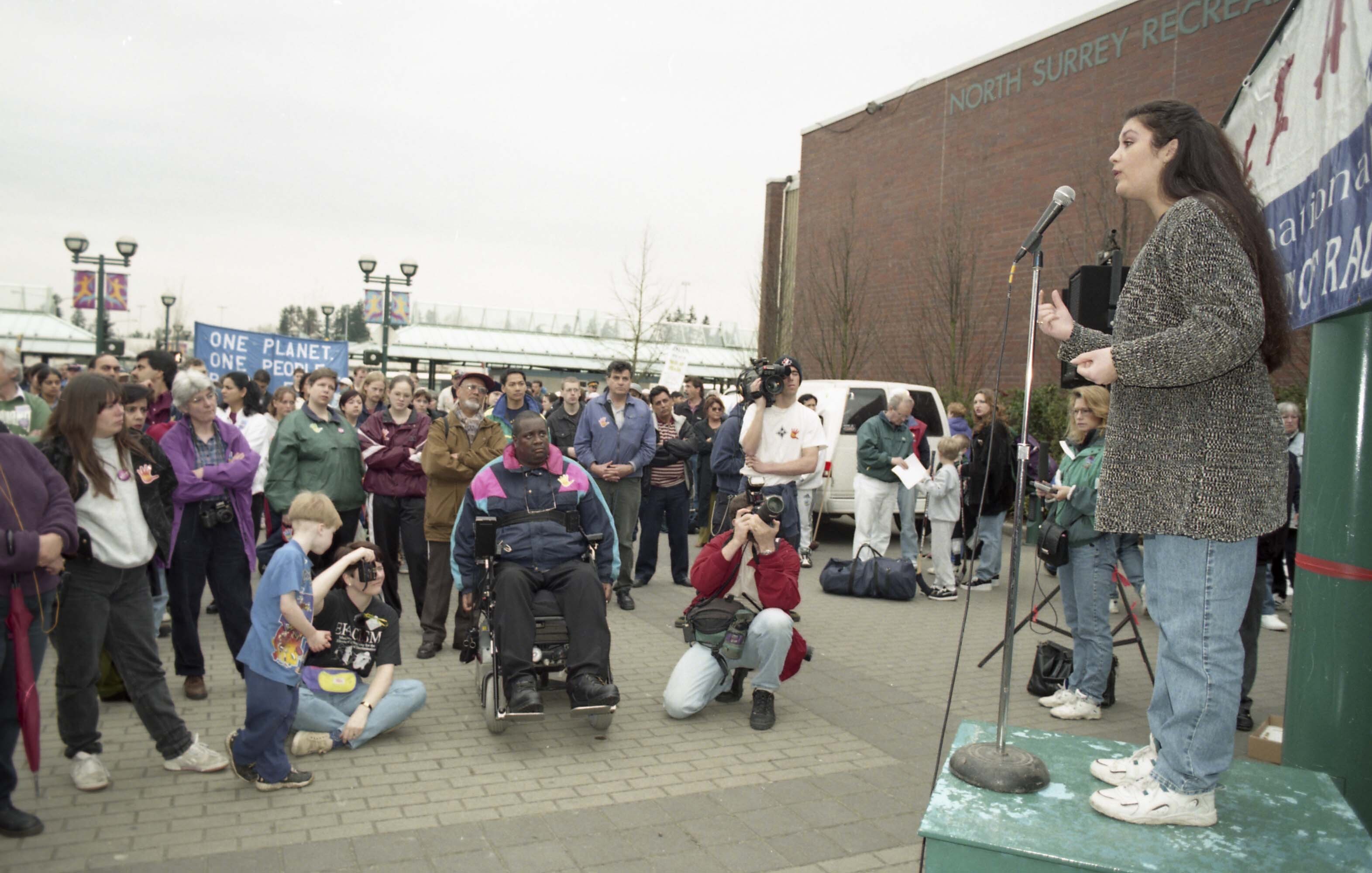
Photograph of an unidentified individual addressing the audience at the International Day for the Elimination of Racial Discrimination event, called Eracism, held in Surrey, British Columbia (B.C.).
The International Day for the Elimination of Racial Discrimination is guided by the United Nations International Convention on the Elimination of All Forms of Racial Discrimination and recognizes that the injustices and prejudices fueled by racial discrimination take place every day. Observed annually on March 21, it commemorates the day police in Sharpeville, South Africa, opened fire and killed 69 people at a peaceful demonstration against apartheid "pass laws" in 1960. This day serves as a call to action for individuals, organizations, and all levels of government to actively work to eliminate all forms of racial discrimination, injustice, systemic racism and hate.
The International Day for the Elimination of Racial Discrimination is guided by the United Nations International Convention on the Elimination of All Forms of Racial Discrimination and recognizes that the injustices and prejudices fueled by racial discrimination take place every day. Observed annually on March 21, it commemorates the day police in Sharpeville, South Africa, opened fire and killed 69 people at a peaceful demonstration against apartheid "pass laws" in 1960. This day serves as a call to action for individuals, organizations, and all levels of government to actively work to eliminate all forms of racial discrimination, injustice, systemic racism and hate.