
Dosanjh, Ujjal
Creator: Bodalia, Chandra
Description
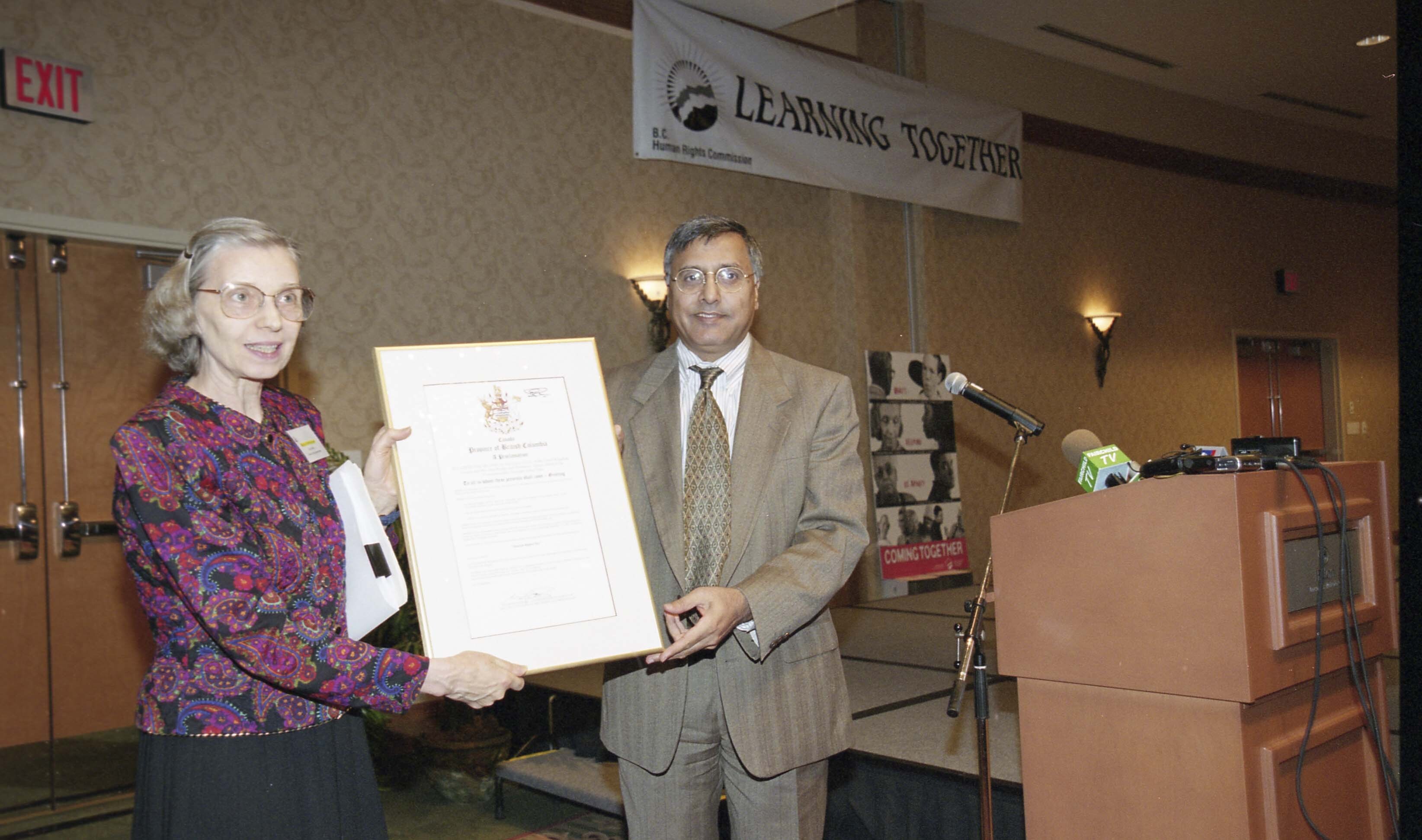
Photograph of Ujjal Dosanjh with an unidentified individual, holding a framed document[?], at the Learning Together event in Vancouver, British Columbia (B.C.). The event was hosted at the Hilton Hotel by the B.C. Human Rights Commission.
Ujjal Dosanjh is a Canadian lawyer, civil rights activist, and politician. Born in Panjab, India in 1947, Dosanjh emigrated to England at the age of 17 and came to Canada four years later, in 1968. He started off at a Vancouver sawmill, but when a back injury hindered his career at the mill, he enrolled at Langara College and completed a degree in political science at Simon Fraser University. He earned a law degree at the University of British Columbia and established a law practice in Vancouver in 1979. First elected as MLA for Vancouver-Kensington in 1991, Dosanjh twice served as Caucus Chair and also chaired the Select Standing Committee on Parliamentary Reform, Ethical Conduct, Standing Orders and Private Bills. Dosanjh was sworn in as British Columbia's 33rd Premier and Canada's first Indo-Canadian Premier on February 24, 2000, serving until 2001. He had previously served as Minister of Government Services and Minister Responsible for Multiculturalism, Human Rights, Sports and Immigration in 1995, and served as Attorney General from August 1995 to February 2000. He was also the leader of the provincial New Democratic Party (NDP) and later served as a Member of Parliament with the Liberal Party. A long time human rights activist, his past community involvements include: South Vancouver Neighbourhood House, MOSAIC, the B.C. Multicultural Society and the B.C. Civil Liberties Association. In 1977 he helped set up the first farm workers' legal information services while he was chair of the Labour Advocacy Research Association. Throughout his career, Dosanjh has been a strong advocate for social justice, healthcare, and public policy issues.
On August 4, 2017 Premier John Horgan along with Attorney General David Eby announced that British Columbia (B.C.) will re-establish the B.C. Human Rights Commission to address inequality and discrimination. In 2018, changes to B.C.'s Human Rights Code established the Office of the Human Rights Commissioner as an independent office of the Legislature and the Commissioner as the first independent Human Rights Commissioner in B.C.'s history. Under the Code, the Commissioner is responsible for promoting and protecting human rights in British Columbia. BC's Office of the Human Rights Commissioner exists to address the root causes of inequality, discrimination, and injustice in B.C. by shifting laws, policies, practices and cultures. They do this work through education, research, advocacy, inquiry and monitoring.
Ujjal Dosanjh is a Canadian lawyer, civil rights activist, and politician. Born in Panjab, India in 1947, Dosanjh emigrated to England at the age of 17 and came to Canada four years later, in 1968. He started off at a Vancouver sawmill, but when a back injury hindered his career at the mill, he enrolled at Langara College and completed a degree in political science at Simon Fraser University. He earned a law degree at the University of British Columbia and established a law practice in Vancouver in 1979. First elected as MLA for Vancouver-Kensington in 1991, Dosanjh twice served as Caucus Chair and also chaired the Select Standing Committee on Parliamentary Reform, Ethical Conduct, Standing Orders and Private Bills. Dosanjh was sworn in as British Columbia's 33rd Premier and Canada's first Indo-Canadian Premier on February 24, 2000, serving until 2001. He had previously served as Minister of Government Services and Minister Responsible for Multiculturalism, Human Rights, Sports and Immigration in 1995, and served as Attorney General from August 1995 to February 2000. He was also the leader of the provincial New Democratic Party (NDP) and later served as a Member of Parliament with the Liberal Party. A long time human rights activist, his past community involvements include: South Vancouver Neighbourhood House, MOSAIC, the B.C. Multicultural Society and the B.C. Civil Liberties Association. In 1977 he helped set up the first farm workers' legal information services while he was chair of the Labour Advocacy Research Association. Throughout his career, Dosanjh has been a strong advocate for social justice, healthcare, and public policy issues.
On August 4, 2017 Premier John Horgan along with Attorney General David Eby announced that British Columbia (B.C.) will re-establish the B.C. Human Rights Commission to address inequality and discrimination. In 2018, changes to B.C.'s Human Rights Code established the Office of the Human Rights Commissioner as an independent office of the Legislature and the Commissioner as the first independent Human Rights Commissioner in B.C.'s history. Under the Code, the Commissioner is responsible for promoting and protecting human rights in British Columbia. BC's Office of the Human Rights Commissioner exists to address the root causes of inequality, discrimination, and injustice in B.C. by shifting laws, policies, practices and cultures. They do this work through education, research, advocacy, inquiry and monitoring.
Creator: Bodalia, Chandra
Description
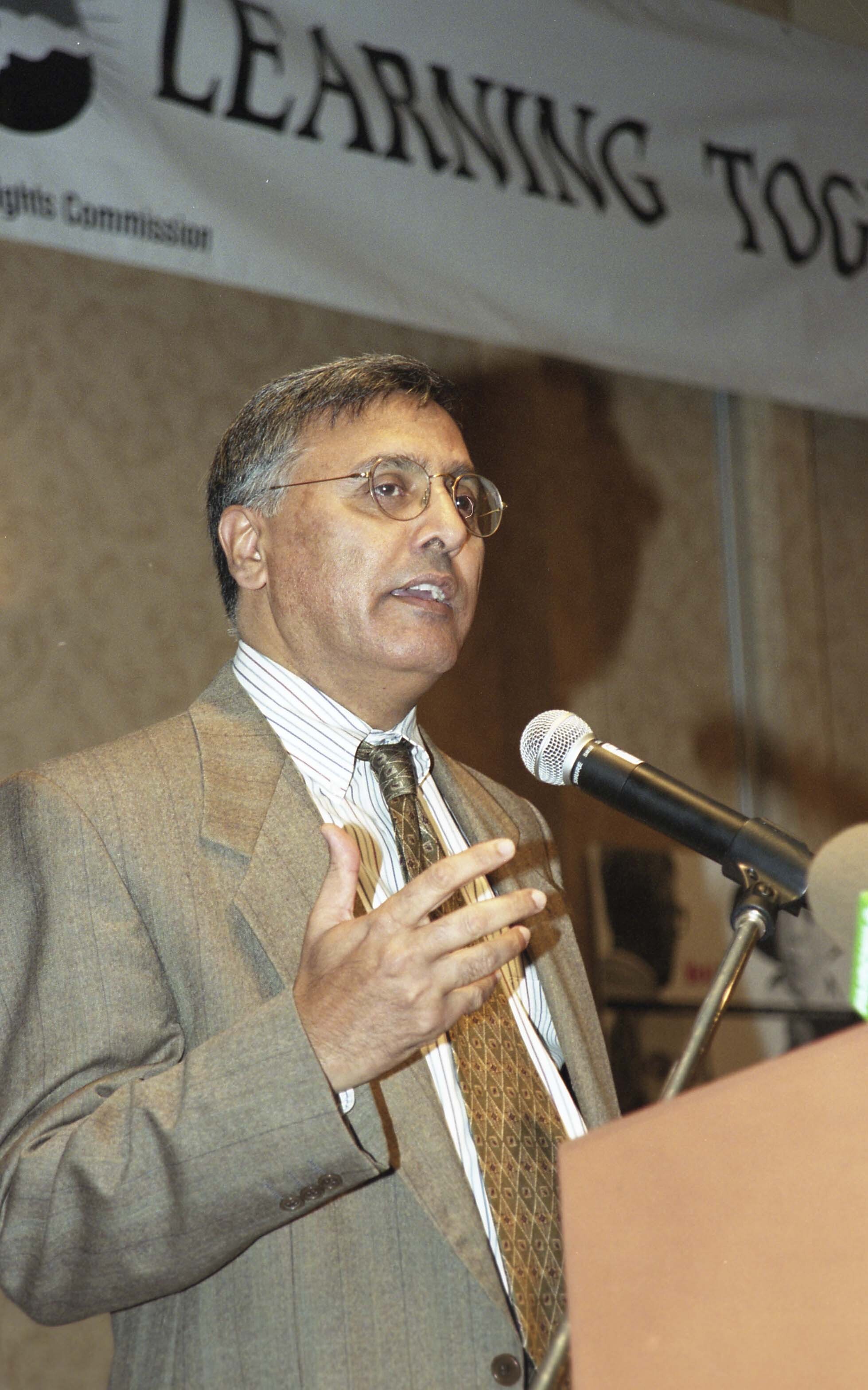
Photograph of Ujjal Dosanjh addressing the audience at the Learning Together event in Vancouver, British Columbia (B.C.). The event was hosted at the Hilton Hotel by the B.C. Human Rights Commission.
Ujjal Dosanjh is a Canadian lawyer, civil rights activist, and politician. Born in Panjab, India in 1947, Dosanjh emigrated to England at the age of 17 and came to Canada four years later, in 1968. He started off at a Vancouver sawmill, but when a back injury hindered his career at the mill, he enrolled at Langara College and completed a degree in political science at Simon Fraser University. He earned a law degree at the University of British Columbia and established a law practice in Vancouver in 1979. First elected as MLA for Vancouver-Kensington in 1991, Dosanjh twice served as Caucus Chair and also chaired the Select Standing Committee on Parliamentary Reform, Ethical Conduct, Standing Orders and Private Bills. Dosanjh was sworn in as British Columbia's 33rd Premier and Canada's first Indo-Canadian Premier on February 24, 2000, serving until 2001. He had previously served as Minister of Government Services and Minister Responsible for Multiculturalism, Human Rights, Sports and Immigration in 1995, and served as Attorney General from August 1995 to February 2000. He was also the leader of the provincial New Democratic Party (NDP) and later served as a Member of Parliament with the Liberal Party. A long time human rights activist, his past community involvements include: South Vancouver Neighbourhood House, MOSAIC, the B.C. Multicultural Society and the B.C. Civil Liberties Association. In 1977 he helped set up the first farm workers' legal information services while he was chair of the Labour Advocacy Research Association. Throughout his career, Dosanjh has been a strong advocate for social justice, healthcare, and public policy issues.
On August 4, 2017 Premier John Horgan along with Attorney General David Eby announced that British Columbia (B.C.) will re-establish the B.C. Human Rights Commission to address inequality and discrimination. In 2018, changes to B.C.'s Human Rights Code established the Office of the Human Rights Commissioner as an independent office of the Legislature and the Commissioner as the first independent Human Rights Commissioner in B.C.'s history. Under the Code, the Commissioner is responsible for promoting and protecting human rights in British Columbia. BC's Office of the Human Rights Commissioner exists to address the root causes of inequality, discrimination, and injustice in B.C. by shifting laws, policies, practices and cultures. They do this work through education, research, advocacy, inquiry and monitoring.
Ujjal Dosanjh is a Canadian lawyer, civil rights activist, and politician. Born in Panjab, India in 1947, Dosanjh emigrated to England at the age of 17 and came to Canada four years later, in 1968. He started off at a Vancouver sawmill, but when a back injury hindered his career at the mill, he enrolled at Langara College and completed a degree in political science at Simon Fraser University. He earned a law degree at the University of British Columbia and established a law practice in Vancouver in 1979. First elected as MLA for Vancouver-Kensington in 1991, Dosanjh twice served as Caucus Chair and also chaired the Select Standing Committee on Parliamentary Reform, Ethical Conduct, Standing Orders and Private Bills. Dosanjh was sworn in as British Columbia's 33rd Premier and Canada's first Indo-Canadian Premier on February 24, 2000, serving until 2001. He had previously served as Minister of Government Services and Minister Responsible for Multiculturalism, Human Rights, Sports and Immigration in 1995, and served as Attorney General from August 1995 to February 2000. He was also the leader of the provincial New Democratic Party (NDP) and later served as a Member of Parliament with the Liberal Party. A long time human rights activist, his past community involvements include: South Vancouver Neighbourhood House, MOSAIC, the B.C. Multicultural Society and the B.C. Civil Liberties Association. In 1977 he helped set up the first farm workers' legal information services while he was chair of the Labour Advocacy Research Association. Throughout his career, Dosanjh has been a strong advocate for social justice, healthcare, and public policy issues.
On August 4, 2017 Premier John Horgan along with Attorney General David Eby announced that British Columbia (B.C.) will re-establish the B.C. Human Rights Commission to address inequality and discrimination. In 2018, changes to B.C.'s Human Rights Code established the Office of the Human Rights Commissioner as an independent office of the Legislature and the Commissioner as the first independent Human Rights Commissioner in B.C.'s history. Under the Code, the Commissioner is responsible for promoting and protecting human rights in British Columbia. BC's Office of the Human Rights Commissioner exists to address the root causes of inequality, discrimination, and injustice in B.C. by shifting laws, policies, practices and cultures. They do this work through education, research, advocacy, inquiry and monitoring.
Creator: Bodalia, Chandra
Description
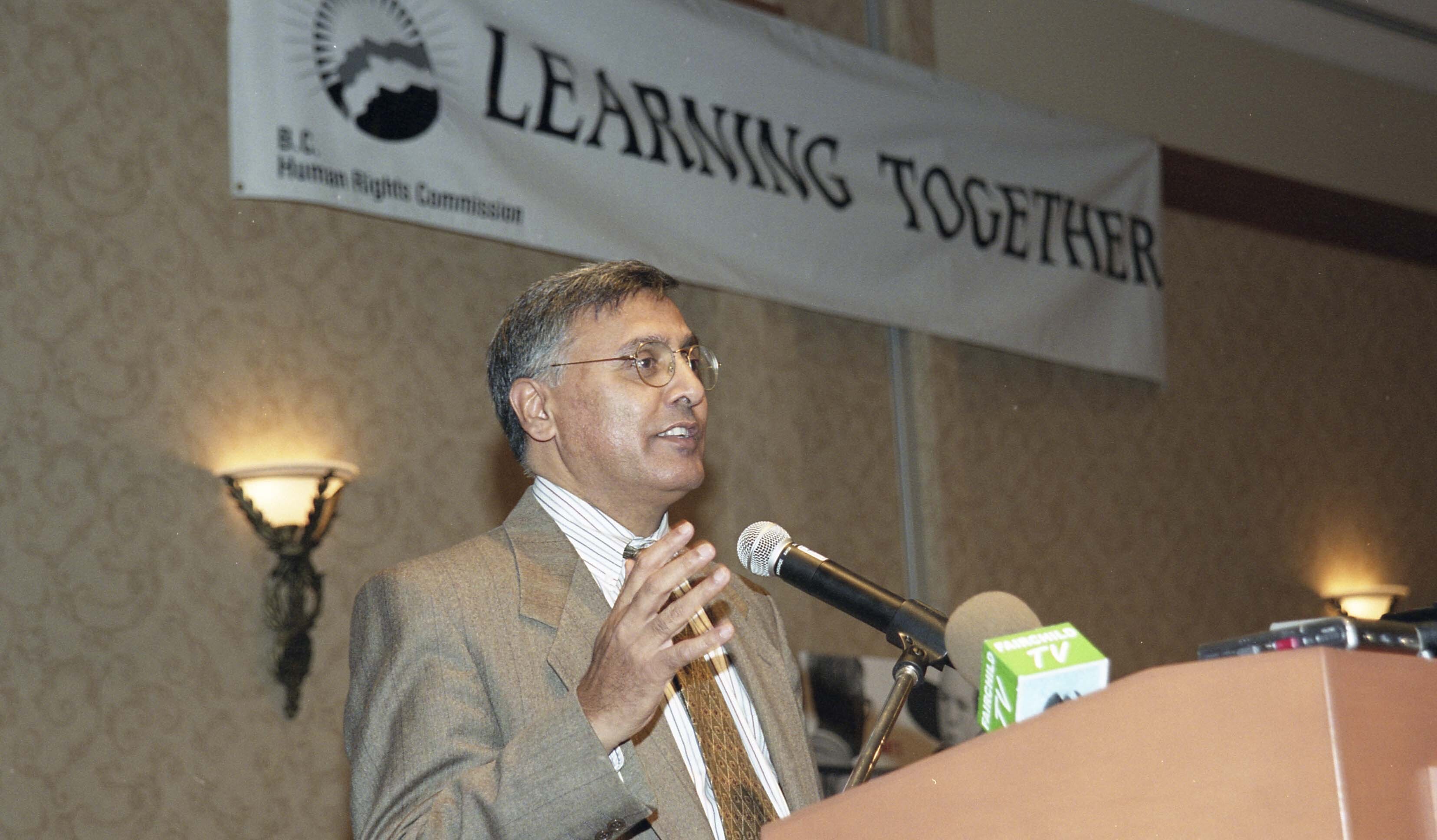
Photograph of Ujjal Dosanjh addressing the audience at the Learning Together event in Vancouver, British Columbia (B.C.). The event was hosted at the Hilton Hotel by the B.C. Human Rights Commission.
Ujjal Dosanjh is a Canadian lawyer, civil rights activist, and politician. Born in Panjab, India in 1947, Dosanjh emigrated to England at the age of 17 and came to Canada four years later, in 1968. He started off at a Vancouver sawmill, but when a back injury hindered his career at the mill, he enrolled at Langara College and completed a degree in political science at Simon Fraser University. He earned a law degree at the University of British Columbia and established a law practice in Vancouver in 1979. First elected as MLA for Vancouver-Kensington in 1991, Dosanjh twice served as Caucus Chair and also chaired the Select Standing Committee on Parliamentary Reform, Ethical Conduct, Standing Orders and Private Bills. Dosanjh was sworn in as British Columbia's 33rd Premier and Canada's first Indo-Canadian Premier on February 24, 2000, serving until 2001. He had previously served as Minister of Government Services and Minister Responsible for Multiculturalism, Human Rights, Sports and Immigration in 1995, and served as Attorney General from August 1995 to February 2000. He was also the leader of the provincial New Democratic Party (NDP) and later served as a Member of Parliament with the Liberal Party. A long time human rights activist, his past community involvements include: South Vancouver Neighbourhood House, MOSAIC, the B.C. Multicultural Society and the B.C. Civil Liberties Association. In 1977 he helped set up the first farm workers' legal information services while he was chair of the Labour Advocacy Research Association. Throughout his career, Dosanjh has been a strong advocate for social justice, healthcare, and public policy issues.
On August 4, 2017 Premier John Horgan along with Attorney General David Eby announced that British Columbia (B.C.) will re-establish the B.C. Human Rights Commission to address inequality and discrimination. In 2018, changes to B.C.'s Human Rights Code established the Office of the Human Rights Commissioner as an independent office of the Legislature and the Commissioner as the first independent Human Rights Commissioner in B.C.'s history. Under the Code, the Commissioner is responsible for promoting and protecting human rights in British Columbia. BC's Office of the Human Rights Commissioner exists to address the root causes of inequality, discrimination, and injustice in B.C. by shifting laws, policies, practices and cultures. They do this work through education, research, advocacy, inquiry and monitoring.
Ujjal Dosanjh is a Canadian lawyer, civil rights activist, and politician. Born in Panjab, India in 1947, Dosanjh emigrated to England at the age of 17 and came to Canada four years later, in 1968. He started off at a Vancouver sawmill, but when a back injury hindered his career at the mill, he enrolled at Langara College and completed a degree in political science at Simon Fraser University. He earned a law degree at the University of British Columbia and established a law practice in Vancouver in 1979. First elected as MLA for Vancouver-Kensington in 1991, Dosanjh twice served as Caucus Chair and also chaired the Select Standing Committee on Parliamentary Reform, Ethical Conduct, Standing Orders and Private Bills. Dosanjh was sworn in as British Columbia's 33rd Premier and Canada's first Indo-Canadian Premier on February 24, 2000, serving until 2001. He had previously served as Minister of Government Services and Minister Responsible for Multiculturalism, Human Rights, Sports and Immigration in 1995, and served as Attorney General from August 1995 to February 2000. He was also the leader of the provincial New Democratic Party (NDP) and later served as a Member of Parliament with the Liberal Party. A long time human rights activist, his past community involvements include: South Vancouver Neighbourhood House, MOSAIC, the B.C. Multicultural Society and the B.C. Civil Liberties Association. In 1977 he helped set up the first farm workers' legal information services while he was chair of the Labour Advocacy Research Association. Throughout his career, Dosanjh has been a strong advocate for social justice, healthcare, and public policy issues.
On August 4, 2017 Premier John Horgan along with Attorney General David Eby announced that British Columbia (B.C.) will re-establish the B.C. Human Rights Commission to address inequality and discrimination. In 2018, changes to B.C.'s Human Rights Code established the Office of the Human Rights Commissioner as an independent office of the Legislature and the Commissioner as the first independent Human Rights Commissioner in B.C.'s history. Under the Code, the Commissioner is responsible for promoting and protecting human rights in British Columbia. BC's Office of the Human Rights Commissioner exists to address the root causes of inequality, discrimination, and injustice in B.C. by shifting laws, policies, practices and cultures. They do this work through education, research, advocacy, inquiry and monitoring.
Creator: Bodalia, Chandra
Description
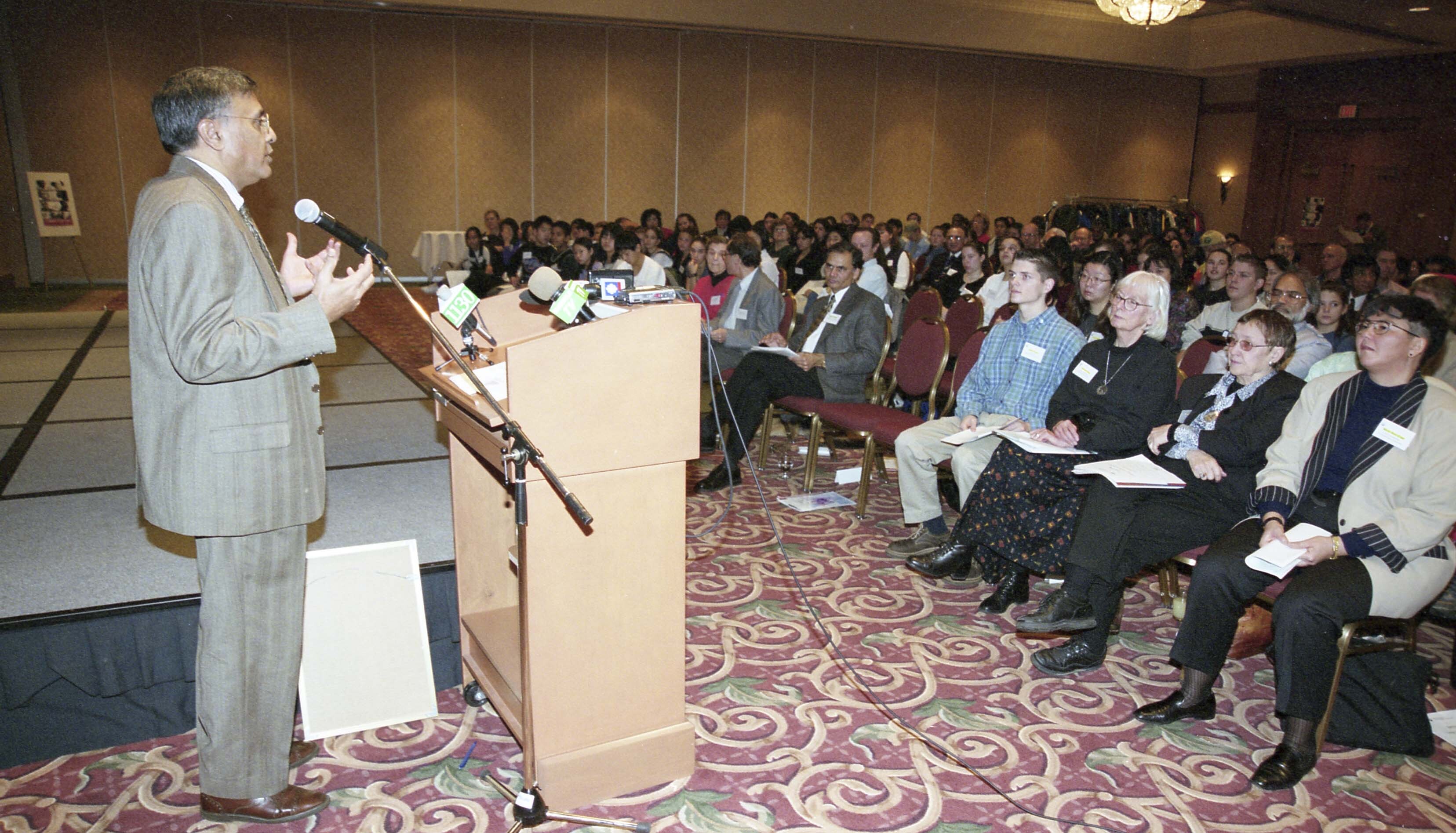
Photograph of Ujjal Dosanjh addressing the audience at the Learning Together event in Vancouver, British Columbia (B.C.). The event was hosted at the Hilton Hotel by the B.C. Human Rights Commission.
Ujjal Dosanjh is a Canadian lawyer, civil rights activist, and politician. Born in Panjab, India in 1947, Dosanjh emigrated to England at the age of 17 and came to Canada four years later, in 1968. He started off at a Vancouver sawmill, but when a back injury hindered his career at the mill, he enrolled at Langara College and completed a degree in political science at Simon Fraser University. He earned a law degree at the University of British Columbia and established a law practice in Vancouver in 1979. First elected as MLA for Vancouver-Kensington in 1991, Dosanjh twice served as Caucus Chair and also chaired the Select Standing Committee on Parliamentary Reform, Ethical Conduct, Standing Orders and Private Bills. Dosanjh was sworn in as British Columbia's 33rd Premier and Canada's first Indo-Canadian Premier on February 24, 2000, serving until 2001. He had previously served as Minister of Government Services and Minister Responsible for Multiculturalism, Human Rights, Sports and Immigration in 1995, and served as Attorney General from August 1995 to February 2000. He was also the leader of the provincial New Democratic Party (NDP) and later served as a Member of Parliament with the Liberal Party. A long time human rights activist, his past community involvements include: South Vancouver Neighbourhood House, MOSAIC, the B.C. Multicultural Society and the B.C. Civil Liberties Association. In 1977 he helped set up the first farm workers' legal information services while he was chair of the Labour Advocacy Research Association. Throughout his career, Dosanjh has been a strong advocate for social justice, healthcare, and public policy issues.
On August 4, 2017 Premier John Horgan along with Attorney General David Eby announced that British Columbia (B.C.) will re-establish the B.C. Human Rights Commission to address inequality and discrimination. In 2018, changes to B.C.'s Human Rights Code established the Office of the Human Rights Commissioner as an independent office of the Legislature and the Commissioner as the first independent Human Rights Commissioner in B.C.'s history. Under the Code, the Commissioner is responsible for promoting and protecting human rights in British Columbia. BC's Office of the Human Rights Commissioner exists to address the root causes of inequality, discrimination, and injustice in B.C. by shifting laws, policies, practices and cultures. They do this work through education, research, advocacy, inquiry and monitoring.
Ujjal Dosanjh is a Canadian lawyer, civil rights activist, and politician. Born in Panjab, India in 1947, Dosanjh emigrated to England at the age of 17 and came to Canada four years later, in 1968. He started off at a Vancouver sawmill, but when a back injury hindered his career at the mill, he enrolled at Langara College and completed a degree in political science at Simon Fraser University. He earned a law degree at the University of British Columbia and established a law practice in Vancouver in 1979. First elected as MLA for Vancouver-Kensington in 1991, Dosanjh twice served as Caucus Chair and also chaired the Select Standing Committee on Parliamentary Reform, Ethical Conduct, Standing Orders and Private Bills. Dosanjh was sworn in as British Columbia's 33rd Premier and Canada's first Indo-Canadian Premier on February 24, 2000, serving until 2001. He had previously served as Minister of Government Services and Minister Responsible for Multiculturalism, Human Rights, Sports and Immigration in 1995, and served as Attorney General from August 1995 to February 2000. He was also the leader of the provincial New Democratic Party (NDP) and later served as a Member of Parliament with the Liberal Party. A long time human rights activist, his past community involvements include: South Vancouver Neighbourhood House, MOSAIC, the B.C. Multicultural Society and the B.C. Civil Liberties Association. In 1977 he helped set up the first farm workers' legal information services while he was chair of the Labour Advocacy Research Association. Throughout his career, Dosanjh has been a strong advocate for social justice, healthcare, and public policy issues.
On August 4, 2017 Premier John Horgan along with Attorney General David Eby announced that British Columbia (B.C.) will re-establish the B.C. Human Rights Commission to address inequality and discrimination. In 2018, changes to B.C.'s Human Rights Code established the Office of the Human Rights Commissioner as an independent office of the Legislature and the Commissioner as the first independent Human Rights Commissioner in B.C.'s history. Under the Code, the Commissioner is responsible for promoting and protecting human rights in British Columbia. BC's Office of the Human Rights Commissioner exists to address the root causes of inequality, discrimination, and injustice in B.C. by shifting laws, policies, practices and cultures. They do this work through education, research, advocacy, inquiry and monitoring.
Creator: Bodalia, Chandra
Description
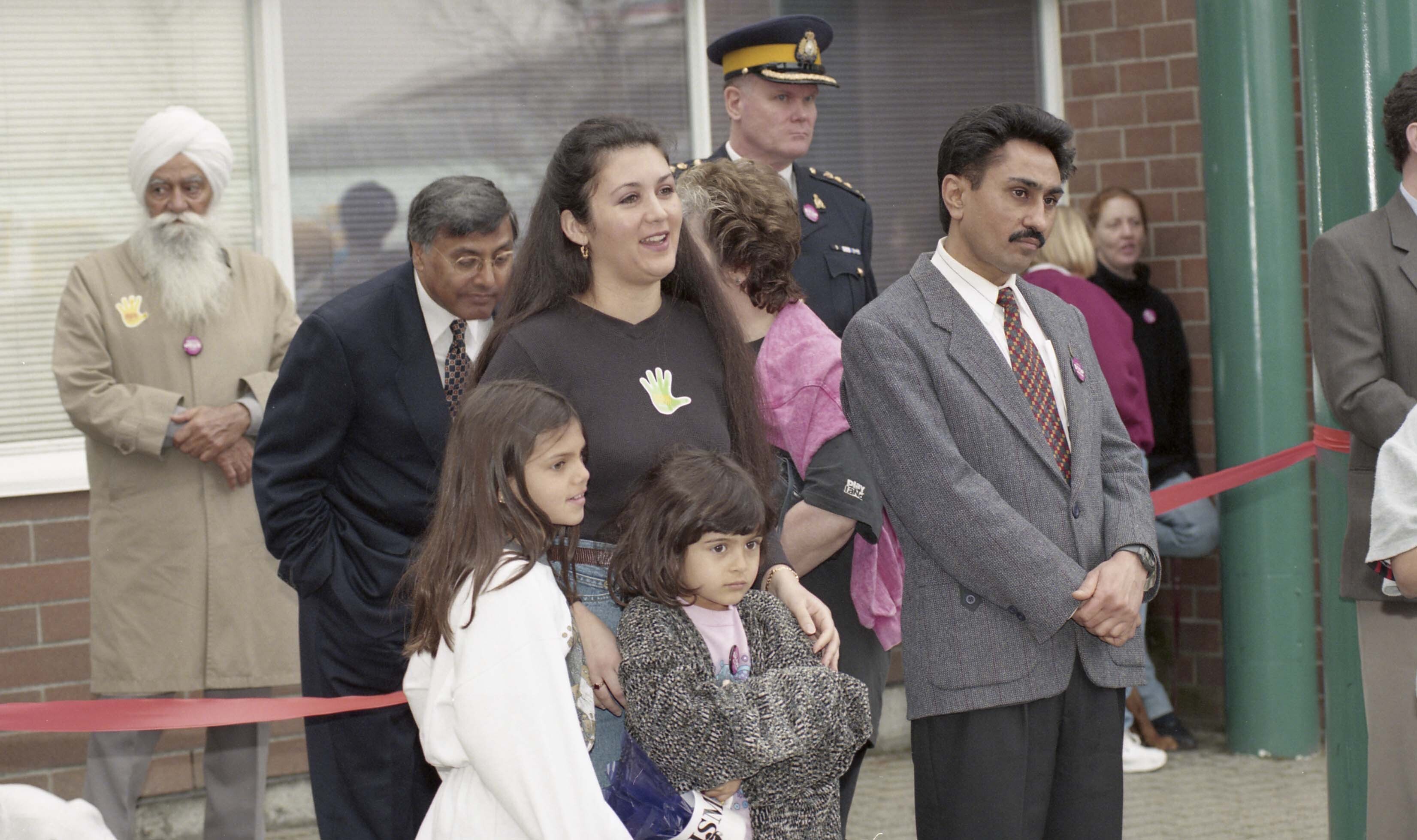
Photograph of Ujjal Dosanjh with a group of unidentified individuals at the International Day for the Elimination of Racial Discrimination event, called Eracism, held in Surrey, British Columbia (B.C.).
Ujjal Dosanjh is a Canadian lawyer, civil rights activist, and politician. Born in Panjab, India in 1947, Dosanjh emigrated to England at the age of 17 and came to Canada four years later, in 1968. He started off at a Vancouver sawmill, but when a back injury hindered his career at the mill, he enrolled at Langara College and completed a degree in political science at Simon Fraser University. He earned a law degree at the University of British Columbia and established a law practice in Vancouver in 1979. First elected as MLA for Vancouver-Kensington in 1991, Dosanjh twice served as Caucus Chair and also chaired the Select Standing Committee on Parliamentary Reform, Ethical Conduct, Standing Orders and Private Bills. Dosanjh was sworn in as British Columbia's 33rd Premier and Canada's first Indo-Canadian Premier on February 24, 2000, serving until 2001. He had previously served as Minister of Government Services and Minister Responsible for Multiculturalism, Human Rights, Sports and Immigration in 1995, and served as Attorney General from August 1995 to February 2000. He was also the leader of the provincial New Democratic Party (NDP) and later served as a Member of Parliament with the Liberal Party. A long time human rights activist, his past community involvements include: South Vancouver Neighbourhood House, MOSAIC, the B.C. Multicultural Society and the B.C. Civil Liberties Association. In 1977 he helped set up the first farm workers' legal information services while he was chair of the Labour Advocacy Research Association. Throughout his career, Dosanjh has been a strong advocate for social justice, healthcare, and public policy issues.
The International Day for the Elimination of Racial Discrimination is guided by the United Nations International Convention on the Elimination of All Forms of Racial Discrimination and recognizes that the injustices and prejudices fueled by racial discrimination take place every day. Observed annually on March 21, it commemorates the day police in Sharpeville, South Africa, opened fire and killed 69 people at a peaceful demonstration against apartheid "pass laws" in 1960. This day serves as a call to action for individuals, organizations, and all levels of government to actively work to eliminate all forms of racial discrimination, injustice, systemic racism and hate.
Ujjal Dosanjh is a Canadian lawyer, civil rights activist, and politician. Born in Panjab, India in 1947, Dosanjh emigrated to England at the age of 17 and came to Canada four years later, in 1968. He started off at a Vancouver sawmill, but when a back injury hindered his career at the mill, he enrolled at Langara College and completed a degree in political science at Simon Fraser University. He earned a law degree at the University of British Columbia and established a law practice in Vancouver in 1979. First elected as MLA for Vancouver-Kensington in 1991, Dosanjh twice served as Caucus Chair and also chaired the Select Standing Committee on Parliamentary Reform, Ethical Conduct, Standing Orders and Private Bills. Dosanjh was sworn in as British Columbia's 33rd Premier and Canada's first Indo-Canadian Premier on February 24, 2000, serving until 2001. He had previously served as Minister of Government Services and Minister Responsible for Multiculturalism, Human Rights, Sports and Immigration in 1995, and served as Attorney General from August 1995 to February 2000. He was also the leader of the provincial New Democratic Party (NDP) and later served as a Member of Parliament with the Liberal Party. A long time human rights activist, his past community involvements include: South Vancouver Neighbourhood House, MOSAIC, the B.C. Multicultural Society and the B.C. Civil Liberties Association. In 1977 he helped set up the first farm workers' legal information services while he was chair of the Labour Advocacy Research Association. Throughout his career, Dosanjh has been a strong advocate for social justice, healthcare, and public policy issues.
The International Day for the Elimination of Racial Discrimination is guided by the United Nations International Convention on the Elimination of All Forms of Racial Discrimination and recognizes that the injustices and prejudices fueled by racial discrimination take place every day. Observed annually on March 21, it commemorates the day police in Sharpeville, South Africa, opened fire and killed 69 people at a peaceful demonstration against apartheid "pass laws" in 1960. This day serves as a call to action for individuals, organizations, and all levels of government to actively work to eliminate all forms of racial discrimination, injustice, systemic racism and hate.
Creator: Bodalia, Chandra
Description
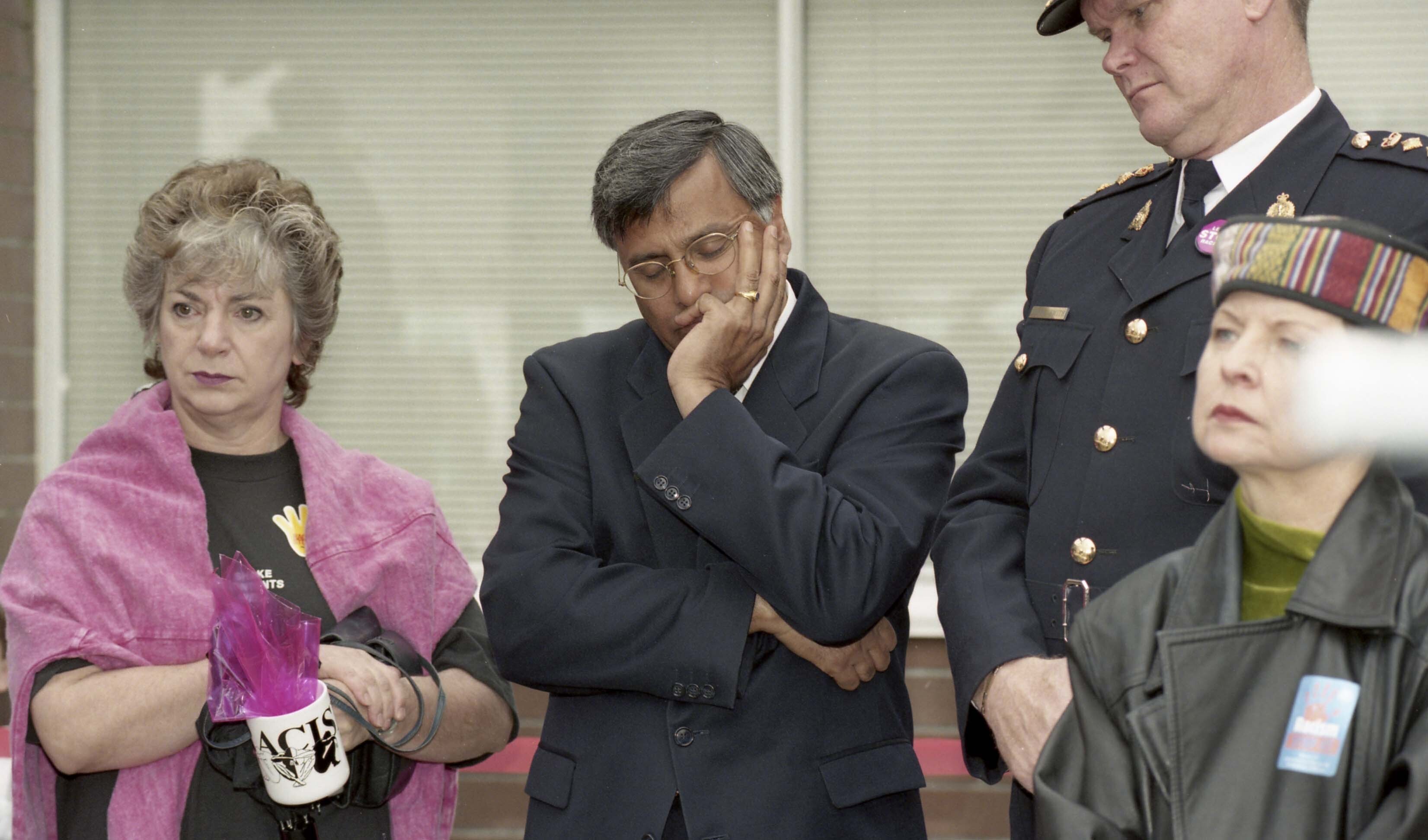
Photograph of Sue Hammell, Ujjal Dosanjh and Penny Priddy with an unidentified individual at the International Day for the Elimination of Racial Discrimination event, called Eracism, held in Surrey, British Columbia (B.C.).
Sue Hammell is a former Member of the Legislative Assembly for Surrey-Green Timbers, serving multiple terms since 1991. She held key roles, including Minister for Women's Equality, and co-founded the Minerva Foundation for BC Women. Hammell also worked internationally to support female leaders and served as Executive Director of the Surrey Aboriginal Society.
Ujjal Dosanjh is a Canadian lawyer, civil rights activist, and politician. Born in Panjab, India in 1947, Dosanjh emigrated to England at the age of 17 and came to Canada four years later, in 1968. He started off at a Vancouver sawmill, but when a back injury hindered his career at the mill, he enrolled at Langara College and completed a degree in political science at Simon Fraser University. He earned a law degree at the University of British Columbia and established a law practice in Vancouver in 1979. First elected as MLA for Vancouver-Kensington in 1991, Dosanjh twice served as Caucus Chair and also chaired the Select Standing Committee on Parliamentary Reform, Ethical Conduct, Standing Orders and Private Bills. Dosanjh was sworn in as British Columbia's 33rd Premier and Canada's first Indo-Canadian Premier on February 24, 2000, serving until 2001. He had previously served as Minister of Government Services and Minister Responsible for Multiculturalism, Human Rights, Sports and Immigration in 1995, and served as Attorney General from August 1995 to February 2000. He was also the leader of the provincial New Democratic Party (NDP) and later served as a Member of Parliament with the Liberal Party. A long time human rights activist, his past community involvements include: South Vancouver Neighbourhood House, MOSAIC, the B.C. Multicultural Society and the B.C. Civil Liberties Association. In 1977 he helped set up the first farm workers' legal information services while he was chair of the Labour Advocacy Research Association. Throughout his career, Dosanjh has been a strong advocate for social justice, healthcare, and public policy issues.
Penny Priddy is a Canadian politician who served as a Member of the Legislative Assembly for Surrey-Newton from 1991 to 2001. She held several ministerial roles, including Minister of Women's Equality, Minister of Health, and Minister of Education. A trained nurse, she worked extensively in community services, supporting children, families, and people with disabilities. Priddy was also active in the Surrey School Board and various community organizations.
The International Day for the Elimination of Racial Discrimination is guided by the United Nations International Convention on the Elimination of All Forms of Racial Discrimination and recognizes that the injustices and prejudices fueled by racial discrimination take place every day. Observed annually on March 21, it commemorates the day police in Sharpeville, South Africa, opened fire and killed 69 people at a peaceful demonstration against apartheid "pass laws" in 1960. This day serves as a call to action for individuals, organizations, and all levels of government to actively work to eliminate all forms of racial discrimination, injustice, systemic racism and hate.
Sue Hammell is a former Member of the Legislative Assembly for Surrey-Green Timbers, serving multiple terms since 1991. She held key roles, including Minister for Women's Equality, and co-founded the Minerva Foundation for BC Women. Hammell also worked internationally to support female leaders and served as Executive Director of the Surrey Aboriginal Society.
Ujjal Dosanjh is a Canadian lawyer, civil rights activist, and politician. Born in Panjab, India in 1947, Dosanjh emigrated to England at the age of 17 and came to Canada four years later, in 1968. He started off at a Vancouver sawmill, but when a back injury hindered his career at the mill, he enrolled at Langara College and completed a degree in political science at Simon Fraser University. He earned a law degree at the University of British Columbia and established a law practice in Vancouver in 1979. First elected as MLA for Vancouver-Kensington in 1991, Dosanjh twice served as Caucus Chair and also chaired the Select Standing Committee on Parliamentary Reform, Ethical Conduct, Standing Orders and Private Bills. Dosanjh was sworn in as British Columbia's 33rd Premier and Canada's first Indo-Canadian Premier on February 24, 2000, serving until 2001. He had previously served as Minister of Government Services and Minister Responsible for Multiculturalism, Human Rights, Sports and Immigration in 1995, and served as Attorney General from August 1995 to February 2000. He was also the leader of the provincial New Democratic Party (NDP) and later served as a Member of Parliament with the Liberal Party. A long time human rights activist, his past community involvements include: South Vancouver Neighbourhood House, MOSAIC, the B.C. Multicultural Society and the B.C. Civil Liberties Association. In 1977 he helped set up the first farm workers' legal information services while he was chair of the Labour Advocacy Research Association. Throughout his career, Dosanjh has been a strong advocate for social justice, healthcare, and public policy issues.
Penny Priddy is a Canadian politician who served as a Member of the Legislative Assembly for Surrey-Newton from 1991 to 2001. She held several ministerial roles, including Minister of Women's Equality, Minister of Health, and Minister of Education. A trained nurse, she worked extensively in community services, supporting children, families, and people with disabilities. Priddy was also active in the Surrey School Board and various community organizations.
The International Day for the Elimination of Racial Discrimination is guided by the United Nations International Convention on the Elimination of All Forms of Racial Discrimination and recognizes that the injustices and prejudices fueled by racial discrimination take place every day. Observed annually on March 21, it commemorates the day police in Sharpeville, South Africa, opened fire and killed 69 people at a peaceful demonstration against apartheid "pass laws" in 1960. This day serves as a call to action for individuals, organizations, and all levels of government to actively work to eliminate all forms of racial discrimination, injustice, systemic racism and hate.
Member of
Creator: Bodalia, Chandra
Description
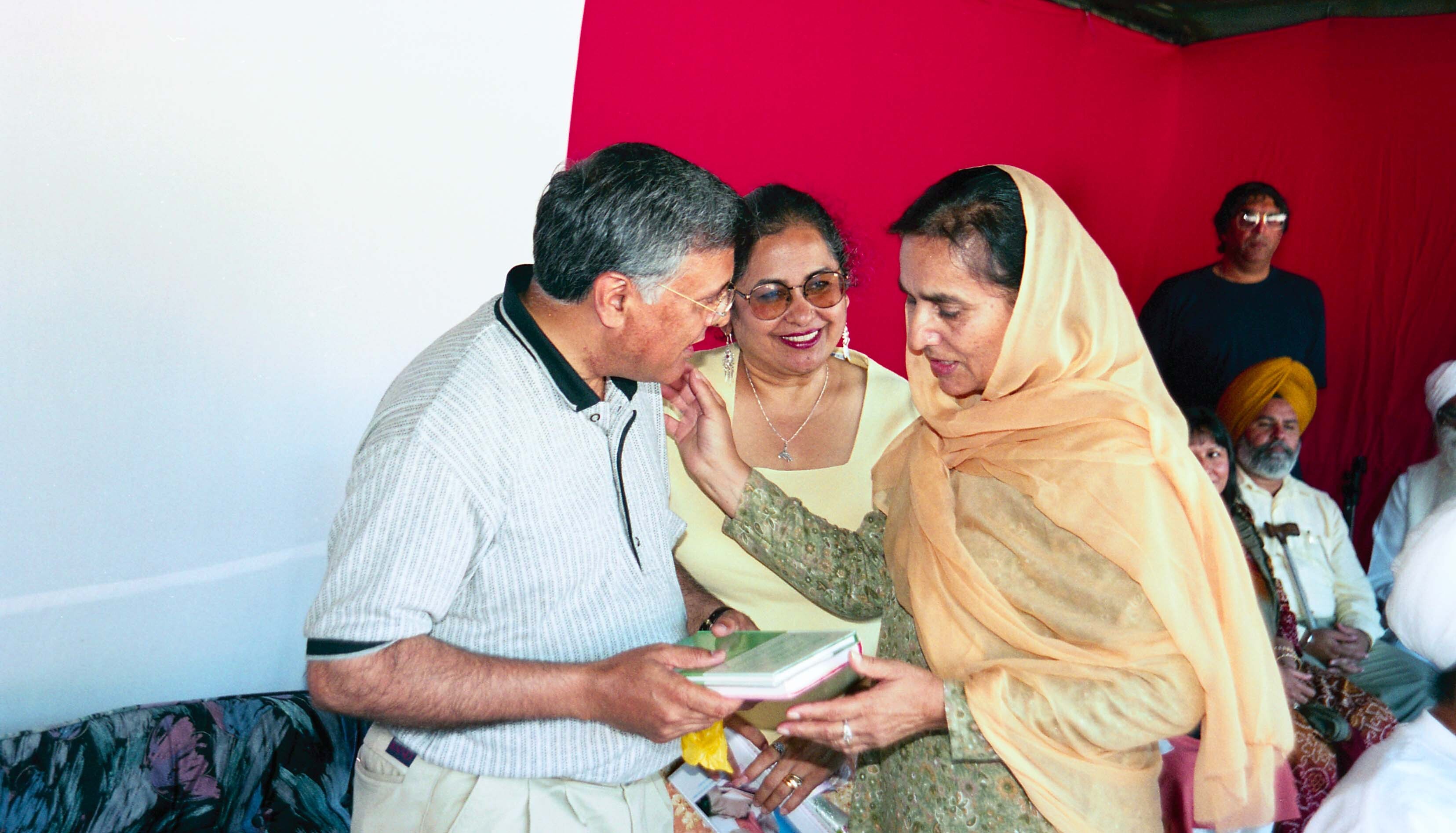
Photograph of Ujjal Dosanjh presenting a book[?] to an unidentified individual, as his wife, Raminder Dosanjh, stands behind them at the Ghadri Babe Mela organised by Professor Mohan Singh Memorial Foundation (Canada) in Bear Creek, Surrey, British Columbia (B.C.).
Ujjal Dosanjh is a Canadian lawyer, civil rights activist, and politician. Born in Panjab, India in 1947, Dosanjh emigrated to England at the age of 17 and came to Canada four years later, in 1968. He started off at a Vancouver sawmill, but when a back injury hindered his career at the mill, he enrolled at Langara College and completed a degree in political science at Simon Fraser University. He earned a law degree at the University of British Columbia and established a law practice in Vancouver in 1979. First elected as MLA for Vancouver-Kensington in 1991, Dosanjh twice served as Caucus Chair and also chaired the Select Standing Committee on Parliamentary Reform, Ethical Conduct, Standing Orders and Private Bills. Dosanjh was sworn in as British Columbia's 33rd Premier and Canada's first Indo-Canadian Premier on February 24, 2000, serving until 2001. He had previously served as Minister of Government Services and Minister Responsible for Multiculturalism, Human Rights, Sports and Immigration in 1995, and served as Attorney General from August 1995 to February 2000. He was also the leader of the provincial New Democratic Party (NDP) and later served as a Member of Parliament with the Liberal Party. A long time human rights activist, his past community involvements include: South Vancouver Neighbourhood House, MOSAIC, the B.C. Multicultural Society and the B.C. Civil Liberties Association. In 1977 he helped set up the first farm workers' legal information services while he was chair of the Labour Advocacy Research Association. Throughout his career, Dosanjh has been a strong advocate for social justice, healthcare, and public policy issues.
Raminder Dosanjh is a Canadian educator and community activist, recognized for her contributions to women's rights and social services. After immigrating to Canada in 1970, she co-founded the India Mahila Association, focusing on supporting South Asian women facing domestic challenges and advocating for their empowerment. Dosanjh has also been involved with organizations such as MOSAIC Immigrant Services Centre and the Vancouver Multicultural Society, contributing to immigrant integration and multicultural initiatives. In recognition of her decades-long service, she received the Lifetime Achievement Award at the 2023 Shakti Awards.
Mela Ghadri Babeyan Da is an annual cultural and commemorative event held in both Punjab, India, and Surrey, Canada, to honor the legacy of the Ghadar Party and the Punjabi revolutionaries who contributed to India's struggle for independence. The event highlights the historical significance of the Ghadar movement through educational talks, literature, and cultural performances that reflect the spirit of resistance, justice, and community pride. The mela serves as a platform to inform and engage the public—especially younger generations—about the sacrifices of Ghadri Babey (revolutionary elders), the global scope of the movement, and its roots in Punjab. It also emphasizes Punjabi language, culture, and political awareness, encouraging ongoing dialogue about identity, activism, and heritage in the diaspora.
The Professor Mohan Singh Memorial Foundation is a cultural organization dedicated to promoting Punjabi literature, history, and heritage. Named after renowned Punjabi poet Professor Mohan Singh, the foundation operates in both Punjab (India) and Canada, organizing events such as poetry festivals and historical commemorations. It aims to preserve the legacy of Punjabi thinkers and revolutionaries while engaging communities, especially youth, in cultural and educational initiatives.
Ujjal Dosanjh is a Canadian lawyer, civil rights activist, and politician. Born in Panjab, India in 1947, Dosanjh emigrated to England at the age of 17 and came to Canada four years later, in 1968. He started off at a Vancouver sawmill, but when a back injury hindered his career at the mill, he enrolled at Langara College and completed a degree in political science at Simon Fraser University. He earned a law degree at the University of British Columbia and established a law practice in Vancouver in 1979. First elected as MLA for Vancouver-Kensington in 1991, Dosanjh twice served as Caucus Chair and also chaired the Select Standing Committee on Parliamentary Reform, Ethical Conduct, Standing Orders and Private Bills. Dosanjh was sworn in as British Columbia's 33rd Premier and Canada's first Indo-Canadian Premier on February 24, 2000, serving until 2001. He had previously served as Minister of Government Services and Minister Responsible for Multiculturalism, Human Rights, Sports and Immigration in 1995, and served as Attorney General from August 1995 to February 2000. He was also the leader of the provincial New Democratic Party (NDP) and later served as a Member of Parliament with the Liberal Party. A long time human rights activist, his past community involvements include: South Vancouver Neighbourhood House, MOSAIC, the B.C. Multicultural Society and the B.C. Civil Liberties Association. In 1977 he helped set up the first farm workers' legal information services while he was chair of the Labour Advocacy Research Association. Throughout his career, Dosanjh has been a strong advocate for social justice, healthcare, and public policy issues.
Raminder Dosanjh is a Canadian educator and community activist, recognized for her contributions to women's rights and social services. After immigrating to Canada in 1970, she co-founded the India Mahila Association, focusing on supporting South Asian women facing domestic challenges and advocating for their empowerment. Dosanjh has also been involved with organizations such as MOSAIC Immigrant Services Centre and the Vancouver Multicultural Society, contributing to immigrant integration and multicultural initiatives. In recognition of her decades-long service, she received the Lifetime Achievement Award at the 2023 Shakti Awards.
Mela Ghadri Babeyan Da is an annual cultural and commemorative event held in both Punjab, India, and Surrey, Canada, to honor the legacy of the Ghadar Party and the Punjabi revolutionaries who contributed to India's struggle for independence. The event highlights the historical significance of the Ghadar movement through educational talks, literature, and cultural performances that reflect the spirit of resistance, justice, and community pride. The mela serves as a platform to inform and engage the public—especially younger generations—about the sacrifices of Ghadri Babey (revolutionary elders), the global scope of the movement, and its roots in Punjab. It also emphasizes Punjabi language, culture, and political awareness, encouraging ongoing dialogue about identity, activism, and heritage in the diaspora.
The Professor Mohan Singh Memorial Foundation is a cultural organization dedicated to promoting Punjabi literature, history, and heritage. Named after renowned Punjabi poet Professor Mohan Singh, the foundation operates in both Punjab (India) and Canada, organizing events such as poetry festivals and historical commemorations. It aims to preserve the legacy of Punjabi thinkers and revolutionaries while engaging communities, especially youth, in cultural and educational initiatives.
Member of
Creator: Chandra Bodalia
Description
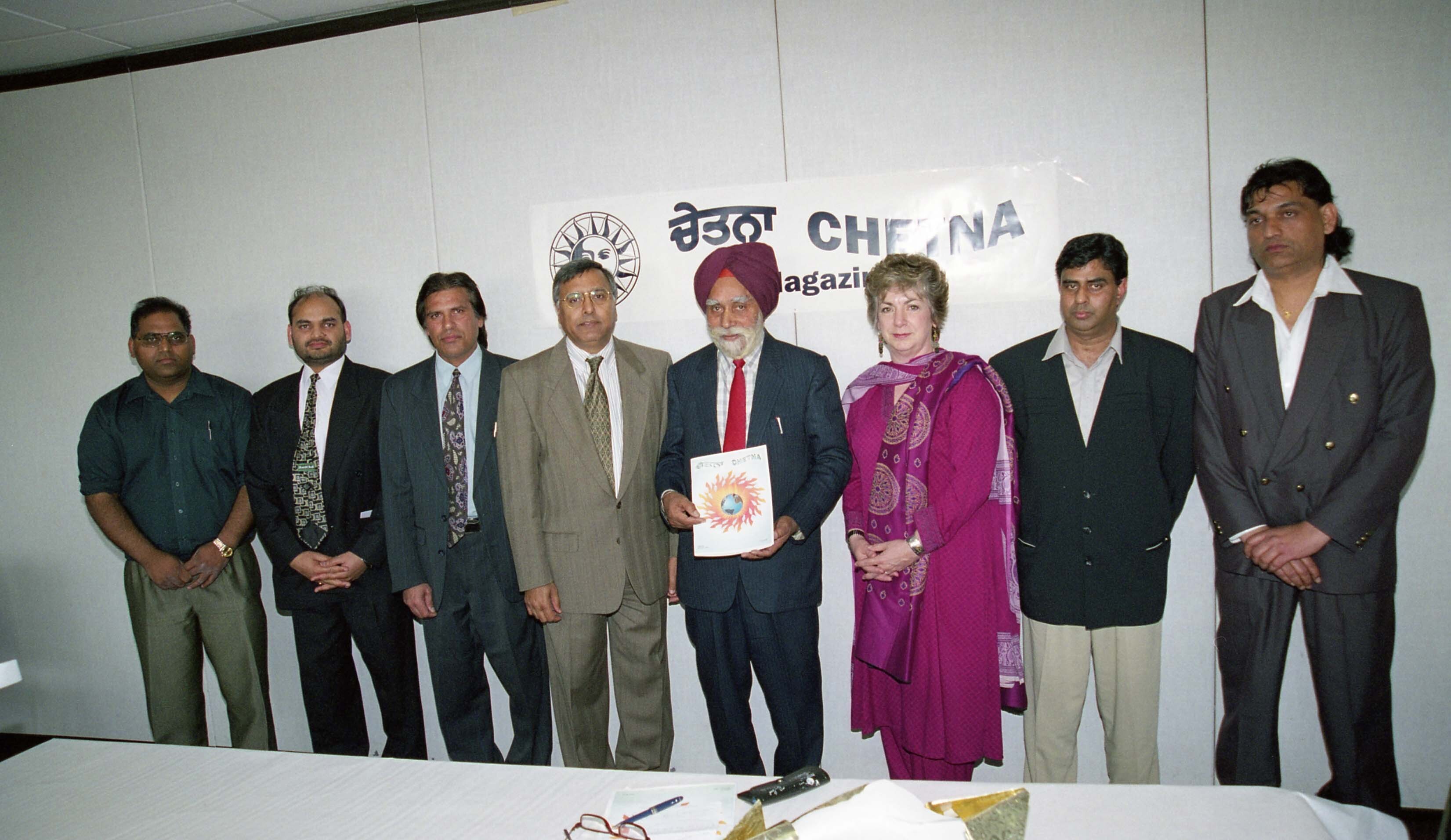
Photograph of a group of unidentified individuals and political figures, such as, Ujjal Dosanjh and Sue Hammel, at a launch[?] event for Chetna Magazine in Vancouver, British Columbia.
Ujjal Dosanjh is a Canadian lawyer, civil rights activist, and politician. Born in Panjab, India in 1947, Dosanjh emigrated to England at the age of 17 and came to Canada four years later, in 1968. He started off at a Vancouver sawmill, but when a back injury hindered his career at the mill, he enrolled at Langara College and completed a degree in political science at Simon Fraser University. He earned a law degree at the University of British Columbia and established a law practice in Vancouver in 1979. First elected as MLA for Vancouver-Kensington in 1991, Dosanjh twice served as Caucus Chair and also chaired the Select Standing Committee on Parliamentary Reform, Ethical Conduct, Standing Orders and Private Bills. Dosanjh was sworn in as British Columbia's 33rd Premier and Canada's first Indo-Canadian Premier on February 24, 2000, serving until 2001. He had previously served as Minister of Government Services and Minister Responsible for Multiculturalism, Human Rights, Sports and Immigration in 1995, and served as Attorney General from August 1995 to February 2000. He was also the leader of the provincial New Democratic Party (NDP) and later served as a Member of Parliament with the Liberal Party. A long time human rights activist, his past community involvements include: South Vancouver Neighbourhood House, MOSAIC, the B.C. Multicultural Society and the B.C. Civil Liberties Association. In 1977 he helped set up the first farm workers' legal information services while he was chair of the Labour Advocacy Research Association. Throughout his career, Dosanjh has been a strong advocate for social justice, healthcare, and public policy issues.
Sue Hammell is a former Member of the Legislative Assembly for Surrey-Green Timbers, serving multiple terms since 1991. She held key roles, including Minister for Women's Equality, and co-founded the Minerva Foundation for BC Women. Hammell also worked internationally to support female leaders and served as Executive Director of the Surrey Aboriginal Society.
Ujjal Dosanjh is a Canadian lawyer, civil rights activist, and politician. Born in Panjab, India in 1947, Dosanjh emigrated to England at the age of 17 and came to Canada four years later, in 1968. He started off at a Vancouver sawmill, but when a back injury hindered his career at the mill, he enrolled at Langara College and completed a degree in political science at Simon Fraser University. He earned a law degree at the University of British Columbia and established a law practice in Vancouver in 1979. First elected as MLA for Vancouver-Kensington in 1991, Dosanjh twice served as Caucus Chair and also chaired the Select Standing Committee on Parliamentary Reform, Ethical Conduct, Standing Orders and Private Bills. Dosanjh was sworn in as British Columbia's 33rd Premier and Canada's first Indo-Canadian Premier on February 24, 2000, serving until 2001. He had previously served as Minister of Government Services and Minister Responsible for Multiculturalism, Human Rights, Sports and Immigration in 1995, and served as Attorney General from August 1995 to February 2000. He was also the leader of the provincial New Democratic Party (NDP) and later served as a Member of Parliament with the Liberal Party. A long time human rights activist, his past community involvements include: South Vancouver Neighbourhood House, MOSAIC, the B.C. Multicultural Society and the B.C. Civil Liberties Association. In 1977 he helped set up the first farm workers' legal information services while he was chair of the Labour Advocacy Research Association. Throughout his career, Dosanjh has been a strong advocate for social justice, healthcare, and public policy issues.
Sue Hammell is a former Member of the Legislative Assembly for Surrey-Green Timbers, serving multiple terms since 1991. She held key roles, including Minister for Women's Equality, and co-founded the Minerva Foundation for BC Women. Hammell also worked internationally to support female leaders and served as Executive Director of the Surrey Aboriginal Society.
Member of
Creator: Chandra Bodalia
Description
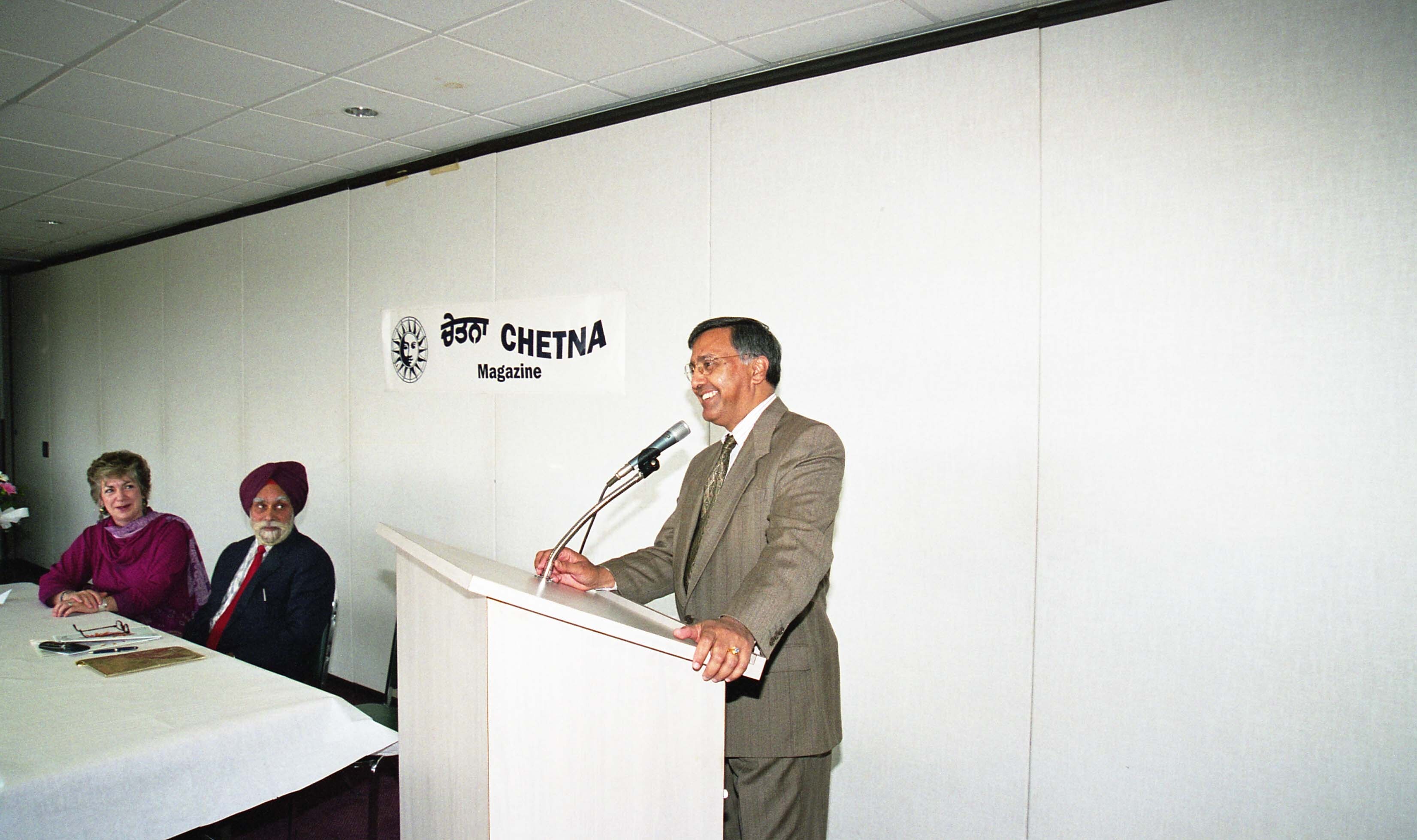
Photograph of Ujjal Dosanjh delivering a speech at a launch[?] event for Chetna Magazine in Vancouver, British Columbia.
Ujjal Dosanjh is a Canadian lawyer, civil rights activist, and politician. Born in Panjab, India in 1947, Dosanjh emigrated to England at the age of 17 and came to Canada four years later, in 1968. He started off at a Vancouver sawmill, but when a back injury hindered his career at the mill, he enrolled at Langara College and completed a degree in political science at Simon Fraser University. He earned a law degree at the University of British Columbia and established a law practice in Vancouver in 1979. First elected as MLA for Vancouver-Kensington in 1991, Dosanjh twice served as Caucus Chair and also chaired the Select Standing Committee on Parliamentary Reform, Ethical Conduct, Standing Orders and Private Bills. Dosanjh was sworn in as British Columbia's 33rd Premier and Canada's first Indo-Canadian Premier on February 24, 2000, serving until 2001. He had previously served as Minister of Government Services and Minister Responsible for Multiculturalism, Human Rights, Sports and Immigration in 1995, and served as Attorney General from August 1995 to February 2000. He was also the leader of the provincial New Democratic Party (NDP) and later served as a Member of Parliament with the Liberal Party. A long time human rights activist, his past community involvements include: South Vancouver Neighbourhood House, MOSAIC, the B.C. Multicultural Society and the B.C. Civil Liberties Association. In 1977 he helped set up the first farm workers' legal information services while he was chair of the Labour Advocacy Research Association. Throughout his career, Dosanjh has been a strong advocate for social justice, healthcare, and public policy issues.
Ujjal Dosanjh is a Canadian lawyer, civil rights activist, and politician. Born in Panjab, India in 1947, Dosanjh emigrated to England at the age of 17 and came to Canada four years later, in 1968. He started off at a Vancouver sawmill, but when a back injury hindered his career at the mill, he enrolled at Langara College and completed a degree in political science at Simon Fraser University. He earned a law degree at the University of British Columbia and established a law practice in Vancouver in 1979. First elected as MLA for Vancouver-Kensington in 1991, Dosanjh twice served as Caucus Chair and also chaired the Select Standing Committee on Parliamentary Reform, Ethical Conduct, Standing Orders and Private Bills. Dosanjh was sworn in as British Columbia's 33rd Premier and Canada's first Indo-Canadian Premier on February 24, 2000, serving until 2001. He had previously served as Minister of Government Services and Minister Responsible for Multiculturalism, Human Rights, Sports and Immigration in 1995, and served as Attorney General from August 1995 to February 2000. He was also the leader of the provincial New Democratic Party (NDP) and later served as a Member of Parliament with the Liberal Party. A long time human rights activist, his past community involvements include: South Vancouver Neighbourhood House, MOSAIC, the B.C. Multicultural Society and the B.C. Civil Liberties Association. In 1977 he helped set up the first farm workers' legal information services while he was chair of the Labour Advocacy Research Association. Throughout his career, Dosanjh has been a strong advocate for social justice, healthcare, and public policy issues.
Member of
Creator: Chandra Bodalia
Description
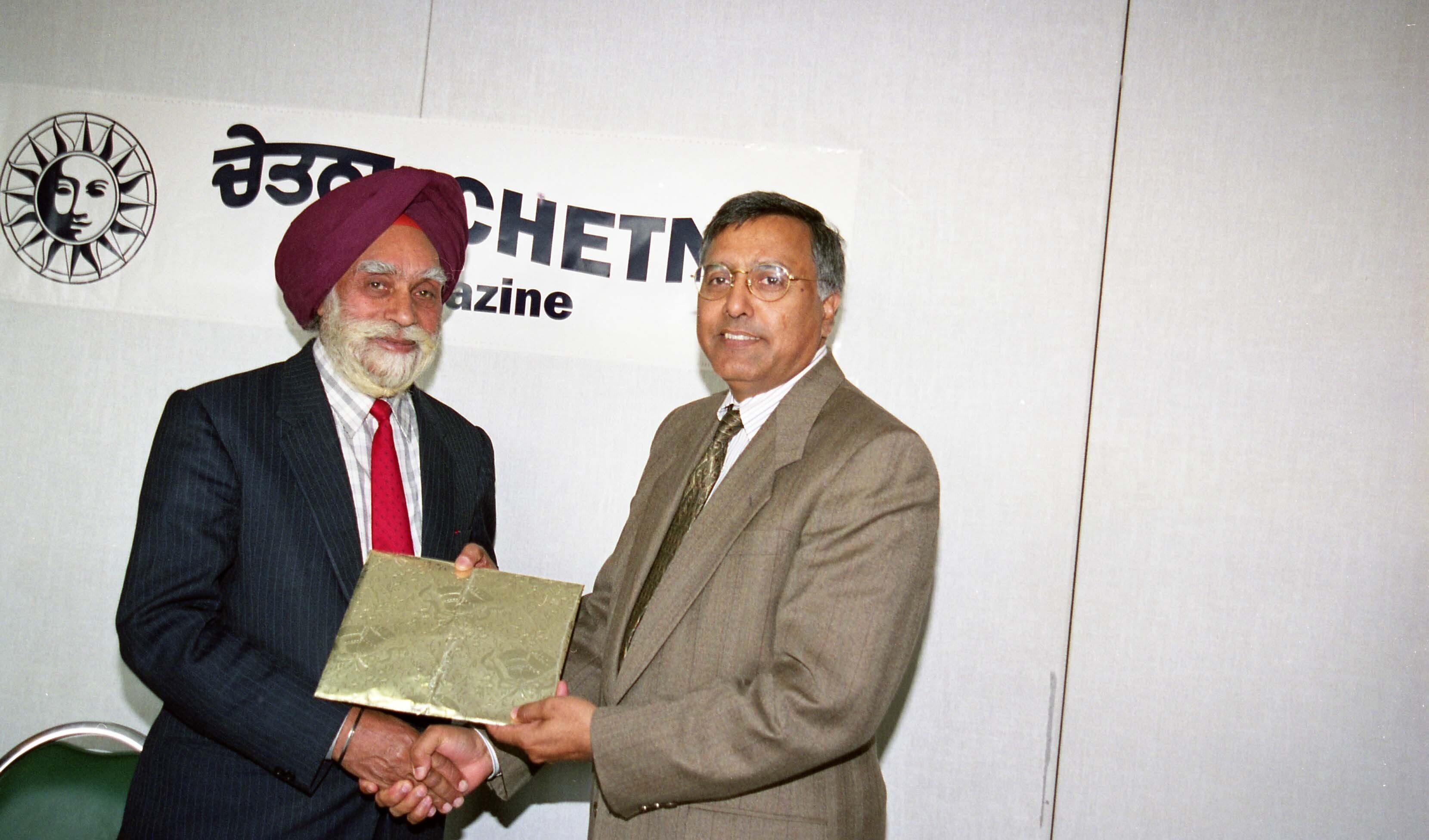
Photograph of Ujjal Dosanjh with an unidentified Sikh man at the launch[?] event of Chetna Magazine in Vancouver, British Columbia.
Ujjal Dosanjh is a Canadian lawyer, civil rights activist, and politician. Born in Panjab, India in 1947, Dosanjh emigrated to England at the age of 17 and came to Canada four years later, in 1968. He started off at a Vancouver sawmill, but when a back injury hindered his career at the mill, he enrolled at Langara College and completed a degree in political science at Simon Fraser University. He earned a law degree at the University of British Columbia and established a law practice in Vancouver in 1979. First elected as MLA for Vancouver-Kensington in 1991, Dosanjh twice served as Caucus Chair and also chaired the Select Standing Committee on Parliamentary Reform, Ethical Conduct, Standing Orders and Private Bills. Dosanjh was sworn in as British Columbia's 33rd Premier and Canada's first Indo-Canadian Premier on February 24, 2000, serving until 2001. He had previously served as Minister of Government Services and Minister Responsible for Multiculturalism, Human Rights, Sports and Immigration in 1995, and served as Attorney General from August 1995 to February 2000. He was also the leader of the provincial New Democratic Party (NDP) and later served as a Member of Parliament with the Liberal Party. A long time human rights activist, his past community involvements include: South Vancouver Neighbourhood House, MOSAIC, the B.C. Multicultural Society and the B.C. Civil Liberties Association. In 1977 he helped set up the first farm workers' legal information services while he was chair of the Labour Advocacy Research Association. Throughout his career, Dosanjh has been a strong advocate for social justice, healthcare, and public policy issues.
Ujjal Dosanjh is a Canadian lawyer, civil rights activist, and politician. Born in Panjab, India in 1947, Dosanjh emigrated to England at the age of 17 and came to Canada four years later, in 1968. He started off at a Vancouver sawmill, but when a back injury hindered his career at the mill, he enrolled at Langara College and completed a degree in political science at Simon Fraser University. He earned a law degree at the University of British Columbia and established a law practice in Vancouver in 1979. First elected as MLA for Vancouver-Kensington in 1991, Dosanjh twice served as Caucus Chair and also chaired the Select Standing Committee on Parliamentary Reform, Ethical Conduct, Standing Orders and Private Bills. Dosanjh was sworn in as British Columbia's 33rd Premier and Canada's first Indo-Canadian Premier on February 24, 2000, serving until 2001. He had previously served as Minister of Government Services and Minister Responsible for Multiculturalism, Human Rights, Sports and Immigration in 1995, and served as Attorney General from August 1995 to February 2000. He was also the leader of the provincial New Democratic Party (NDP) and later served as a Member of Parliament with the Liberal Party. A long time human rights activist, his past community involvements include: South Vancouver Neighbourhood House, MOSAIC, the B.C. Multicultural Society and the B.C. Civil Liberties Association. In 1977 he helped set up the first farm workers' legal information services while he was chair of the Labour Advocacy Research Association. Throughout his career, Dosanjh has been a strong advocate for social justice, healthcare, and public policy issues.