
Still Image
Resource expressed through line, shape, shading, etc., intended to be perceived visually as a still image or images in two dimensions.
Authority Sources
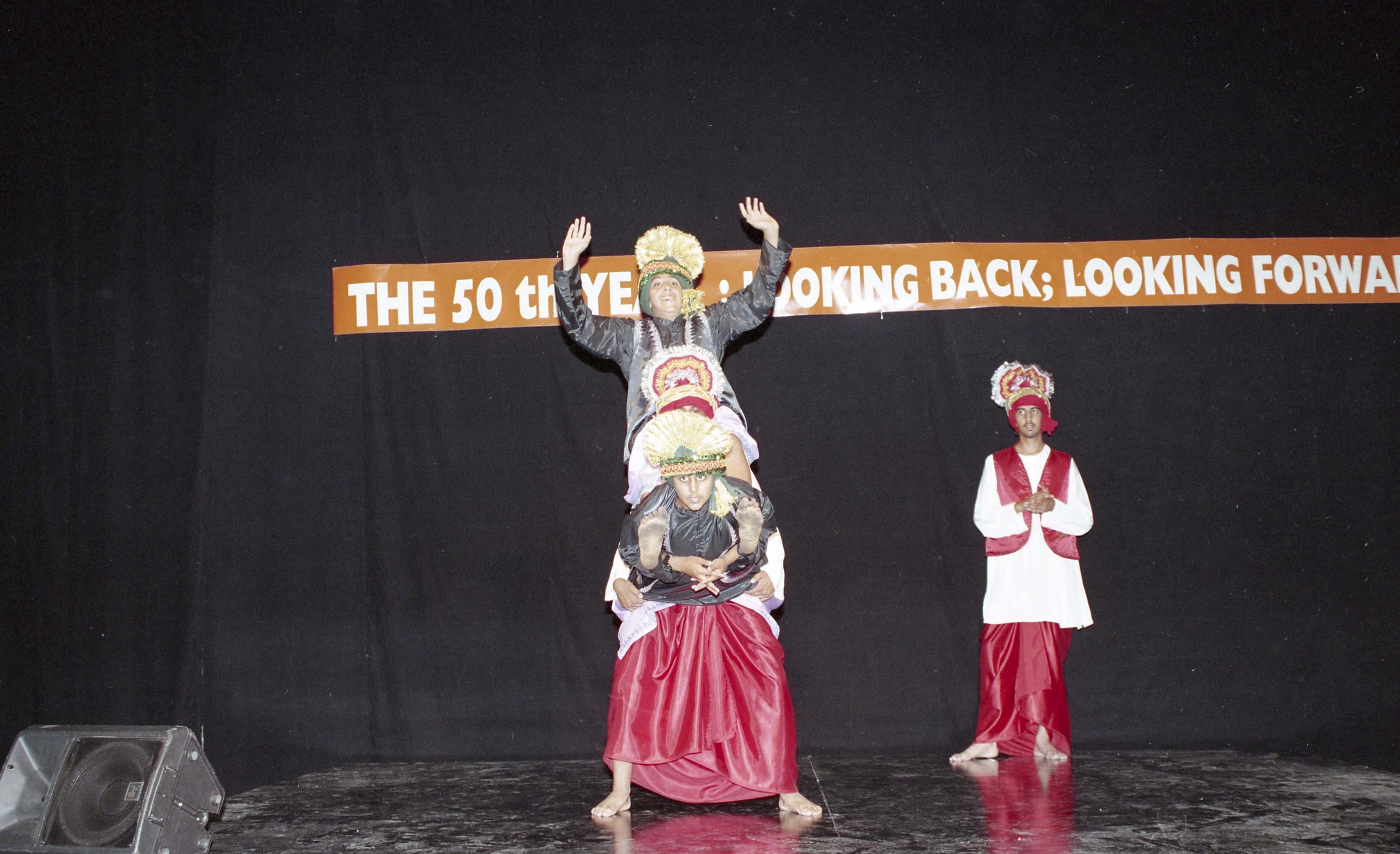
Creator: Chandra Bodalia
Description
Photograph of a group of unidentified individuals performing bhangra at an event organized by the South Asian Network for Secularism and Democracy (SANSAD). The event was called The 50th Year: Looking Back; Looking Forward, celebrating the 50th anniversary of the independence of India from colonial rule.
Bhangra is a folk dance and music form that originated from Punjab, India. It originated as a folk dance celebrated during the time of the harvest. It's traditionally danced to the dhol instrument, a large drum, accompanied by boliyan, short sets of lyrics that describe scenes or stories from Punjab.
The South Asian Network for Secularism and Democracy (SANSAD) is an organization of the South Asian diaspora based in British Columbia, Canada. It comprises people with origin in Bangladesh, India, Nepal, Pakistan, and Sri Lanka. The mission of SANSAD is to develop a secular democratic South Asian diaspora in Canada. SANSAD has grown out of a North American organization, called Non-Resident Indians for Secularism and Democracy (NRISAD) that was established in 1993. The Vancouver branch of the organization recognized through its practice that the concerns of NRISAD in regard to minorities and human rights were not specifically Indian but South Asian and had to be reformulated for the South Asian diaspora as a whole. This was realized with the formation of SANSAD in Vancouver in 2000.
Bhangra is a folk dance and music form that originated from Punjab, India. It originated as a folk dance celebrated during the time of the harvest. It's traditionally danced to the dhol instrument, a large drum, accompanied by boliyan, short sets of lyrics that describe scenes or stories from Punjab.
The South Asian Network for Secularism and Democracy (SANSAD) is an organization of the South Asian diaspora based in British Columbia, Canada. It comprises people with origin in Bangladesh, India, Nepal, Pakistan, and Sri Lanka. The mission of SANSAD is to develop a secular democratic South Asian diaspora in Canada. SANSAD has grown out of a North American organization, called Non-Resident Indians for Secularism and Democracy (NRISAD) that was established in 1993. The Vancouver branch of the organization recognized through its practice that the concerns of NRISAD in regard to minorities and human rights were not specifically Indian but South Asian and had to be reformulated for the South Asian diaspora as a whole. This was realized with the formation of SANSAD in Vancouver in 2000.
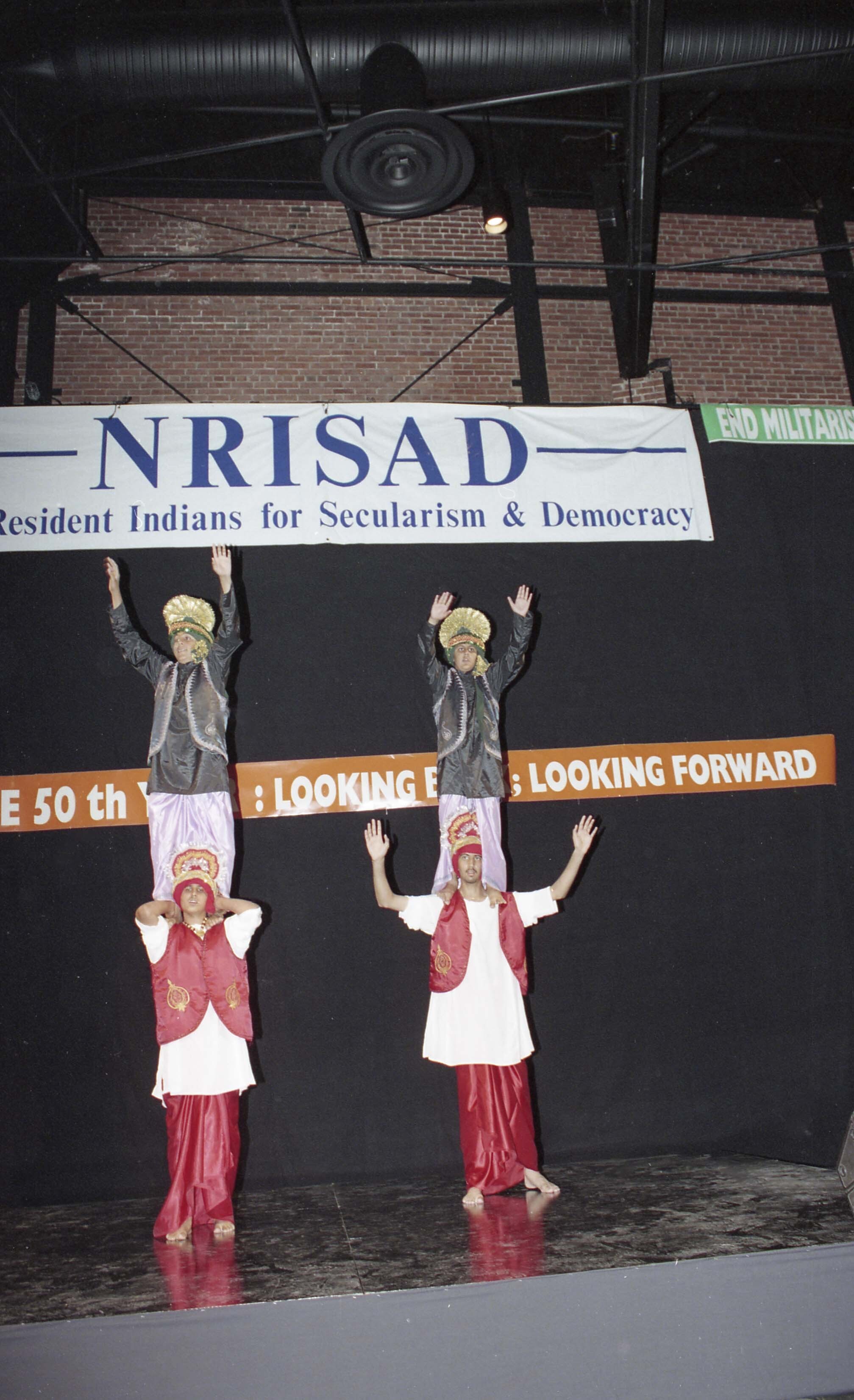
Creator: Chandra Bodalia
Description
Photograph of a group of unidentified individuals performing bhangra at an event organized by the South Asian Network for Secularism and Democracy (SANSAD). The event was called The 50th Year: Looking Back; Looking Forward, celebrating the 50th anniversary of the independence of India from colonial rule.
Bhangra is a folk dance and music form that originated from Punjab, India. It originated as a folk dance celebrated during the time of the harvest. It's traditionally danced to the dhol instrument, a large drum, accompanied by boliyan, short sets of lyrics that describe scenes or stories from Punjab.
The South Asian Network for Secularism and Democracy (SANSAD) is an organization of the South Asian diaspora based in British Columbia, Canada. It comprises people with origin in Bangladesh, India, Nepal, Pakistan, and Sri Lanka. The mission of SANSAD is to develop a secular democratic South Asian diaspora in Canada. SANSAD has grown out of a North American organization, called Non-Resident Indians for Secularism and Democracy (NRISAD) that was established in 1993. The Vancouver branch of the organization recognized through its practice that the concerns of NRISAD in regard to minorities and human rights were not specifically Indian but South Asian and had to be reformulated for the South Asian diaspora as a whole. This was realized with the formation of SANSAD in Vancouver in 2000.
Bhangra is a folk dance and music form that originated from Punjab, India. It originated as a folk dance celebrated during the time of the harvest. It's traditionally danced to the dhol instrument, a large drum, accompanied by boliyan, short sets of lyrics that describe scenes or stories from Punjab.
The South Asian Network for Secularism and Democracy (SANSAD) is an organization of the South Asian diaspora based in British Columbia, Canada. It comprises people with origin in Bangladesh, India, Nepal, Pakistan, and Sri Lanka. The mission of SANSAD is to develop a secular democratic South Asian diaspora in Canada. SANSAD has grown out of a North American organization, called Non-Resident Indians for Secularism and Democracy (NRISAD) that was established in 1993. The Vancouver branch of the organization recognized through its practice that the concerns of NRISAD in regard to minorities and human rights were not specifically Indian but South Asian and had to be reformulated for the South Asian diaspora as a whole. This was realized with the formation of SANSAD in Vancouver in 2000.
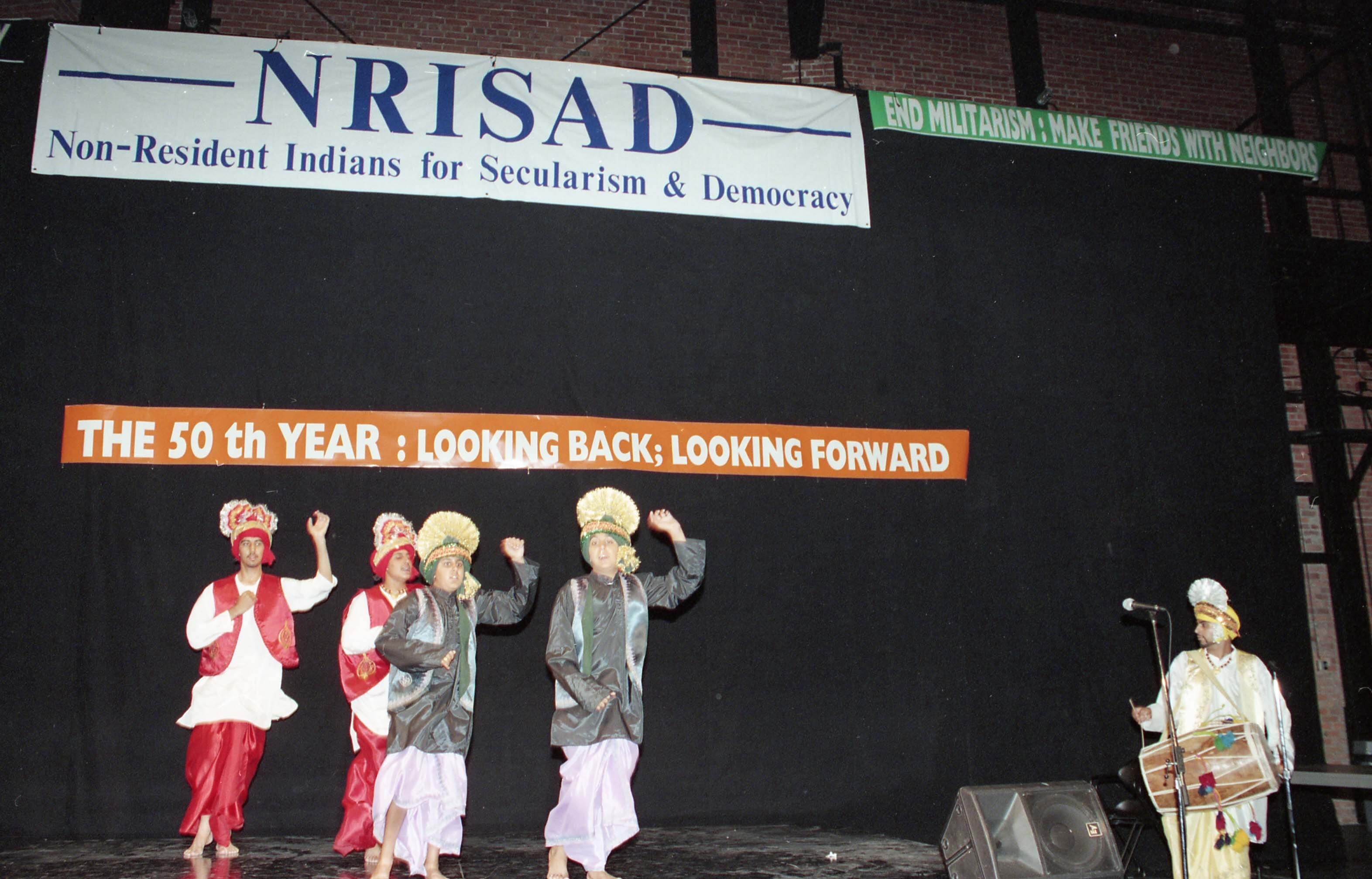
Creator: Chandra Bodalia
Description
Photograph of a group of unidentified individuals performing bhangra at an event organized by the South Asian Network for Secularism and Democracy (SANSAD). The event was called The 50th Year: Looking Back; Looking Forward, celebrating the 50th anniversary of the independence of India from colonial rule.
Bhangra is a folk dance and music form that originated from Punjab, India. It originated as a folk dance celebrated during the time of the harvest. It's traditionally danced to the dhol instrument, a large drum, accompanied by boliyan, short sets of lyrics that describe scenes or stories from Punjab.
The South Asian Network for Secularism and Democracy (SANSAD) is an organization of the South Asian diaspora based in British Columbia, Canada. It comprises people with origin in Bangladesh, India, Nepal, Pakistan, and Sri Lanka. The mission of SANSAD is to develop a secular democratic South Asian diaspora in Canada. SANSAD has grown out of a North American organization, called Non-Resident Indians for Secularism and Democracy (NRISAD) that was established in 1993. The Vancouver branch of the organization recognized through its practice that the concerns of NRISAD in regard to minorities and human rights were not specifically Indian but South Asian and had to be reformulated for the South Asian diaspora as a whole. This was realized with the formation of SANSAD in Vancouver in 2000.
Bhangra is a folk dance and music form that originated from Punjab, India. It originated as a folk dance celebrated during the time of the harvest. It's traditionally danced to the dhol instrument, a large drum, accompanied by boliyan, short sets of lyrics that describe scenes or stories from Punjab.
The South Asian Network for Secularism and Democracy (SANSAD) is an organization of the South Asian diaspora based in British Columbia, Canada. It comprises people with origin in Bangladesh, India, Nepal, Pakistan, and Sri Lanka. The mission of SANSAD is to develop a secular democratic South Asian diaspora in Canada. SANSAD has grown out of a North American organization, called Non-Resident Indians for Secularism and Democracy (NRISAD) that was established in 1993. The Vancouver branch of the organization recognized through its practice that the concerns of NRISAD in regard to minorities and human rights were not specifically Indian but South Asian and had to be reformulated for the South Asian diaspora as a whole. This was realized with the formation of SANSAD in Vancouver in 2000.
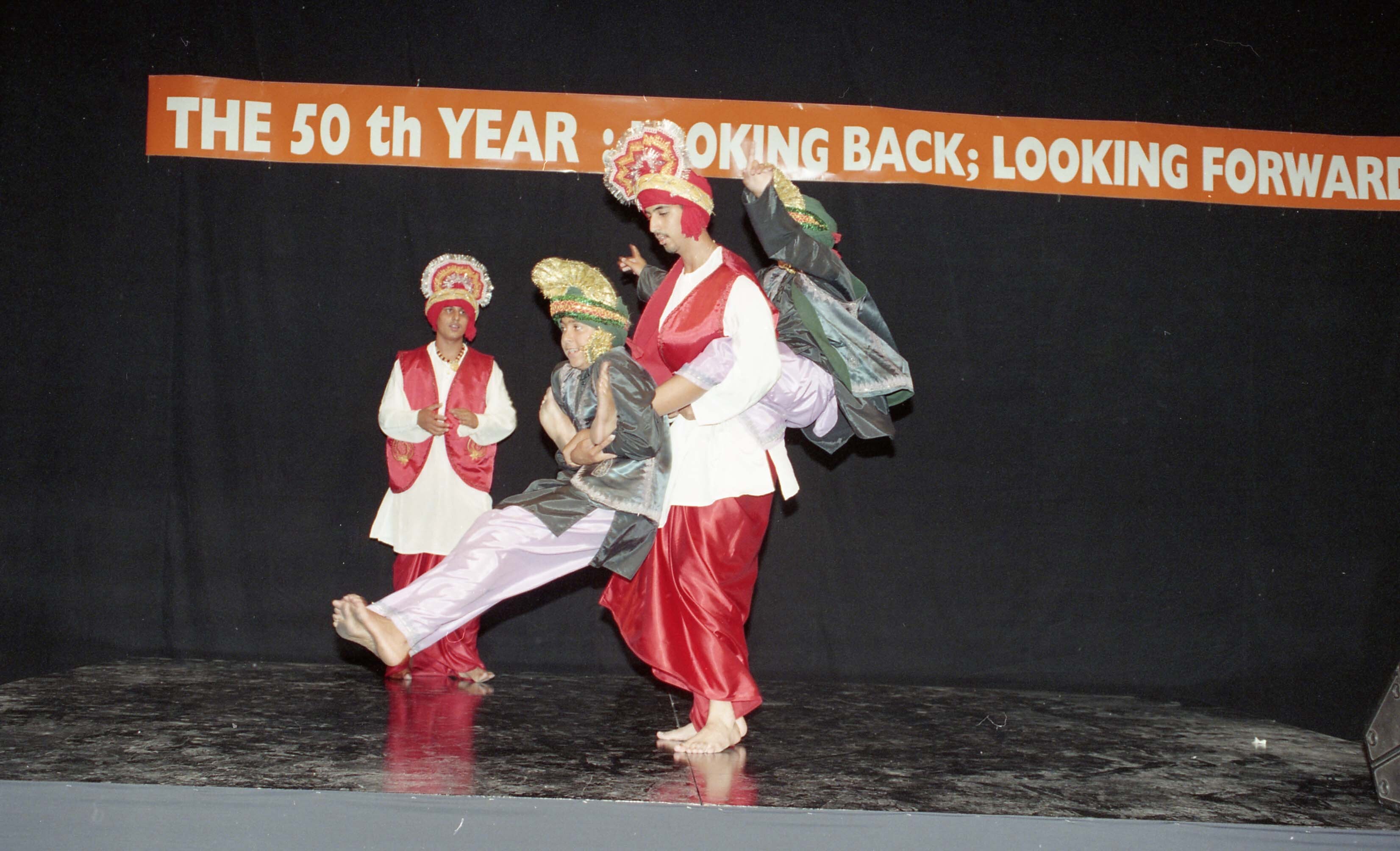
Creator: Chandra Bodalia
Description
Photograph of a group of unidentified individuals performing bhangra at an event organized by the South Asian Network for Secularism and Democracy (SANSAD). The event was called The 50th Year: Looking Back; Looking Forward, celebrating the 50th anniversary of the independence of India from colonial rule.
Bhangra is a folk dance and music form that originated from Punjab, India. It originated as a folk dance celebrated during the time of the harvest. It's traditionally danced to the dhol instrument, a large drum, accompanied by boliyan, short sets of lyrics that describe scenes or stories from Punjab.
The South Asian Network for Secularism and Democracy (SANSAD) is an organization of the South Asian diaspora based in British Columbia, Canada. It comprises people with origin in Bangladesh, India, Nepal, Pakistan, and Sri Lanka. The mission of SANSAD is to develop a secular democratic South Asian diaspora in Canada. SANSAD has grown out of a North American organization, called Non-Resident Indians for Secularism and Democracy (NRISAD) that was established in 1993. The Vancouver branch of the organization recognized through its practice that the concerns of NRISAD in regard to minorities and human rights were not specifically Indian but South Asian and had to be reformulated for the South Asian diaspora as a whole. This was realized with the formation of SANSAD in Vancouver in 2000.
Bhangra is a folk dance and music form that originated from Punjab, India. It originated as a folk dance celebrated during the time of the harvest. It's traditionally danced to the dhol instrument, a large drum, accompanied by boliyan, short sets of lyrics that describe scenes or stories from Punjab.
The South Asian Network for Secularism and Democracy (SANSAD) is an organization of the South Asian diaspora based in British Columbia, Canada. It comprises people with origin in Bangladesh, India, Nepal, Pakistan, and Sri Lanka. The mission of SANSAD is to develop a secular democratic South Asian diaspora in Canada. SANSAD has grown out of a North American organization, called Non-Resident Indians for Secularism and Democracy (NRISAD) that was established in 1993. The Vancouver branch of the organization recognized through its practice that the concerns of NRISAD in regard to minorities and human rights were not specifically Indian but South Asian and had to be reformulated for the South Asian diaspora as a whole. This was realized with the formation of SANSAD in Vancouver in 2000.
Creator: Chandra Bodalia
Description
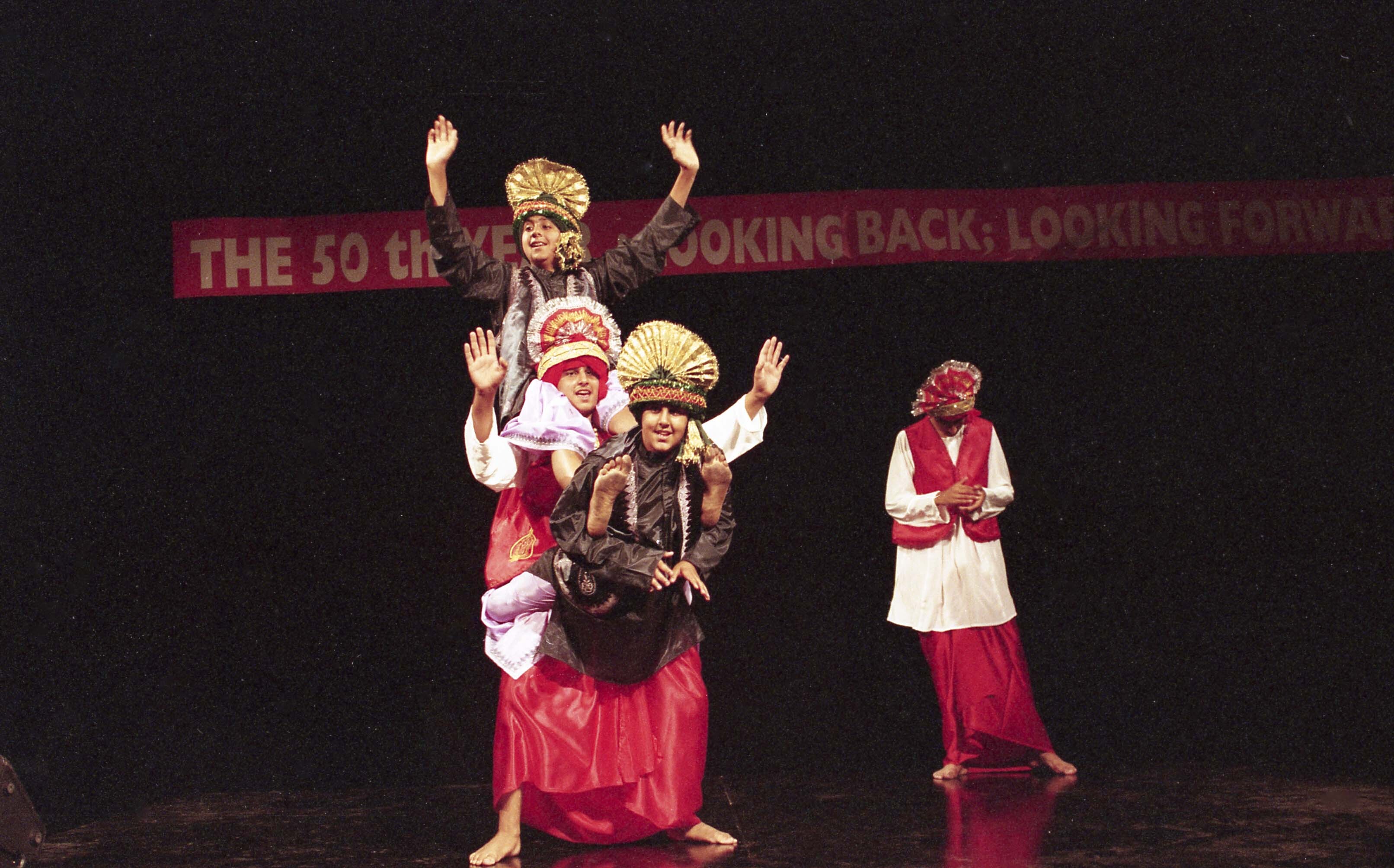
Photograph of a group of unidentified individuals performing bhangra at an event organized by the South Asian Network for Secularism and Democracy (SANSAD). The event was called The 50th Year: Looking Back; Looking Forward, celebrating the 50th anniversary of the independence of India from colonial rule.
Bhangra is a folk dance and music form that originated from Punjab, India. It originated as a folk dance celebrated during the time of the harvest. It's traditionally danced to the dhol instrument, a large drum, accompanied by boliyan, short sets of lyrics that describe scenes or stories from Punjab.
The South Asian Network for Secularism and Democracy (SANSAD) is an organization of the South Asian diaspora based in British Columbia, Canada. It comprises people with origin in Bangladesh, India, Nepal, Pakistan, and Sri Lanka. The mission of SANSAD is to develop a secular democratic South Asian diaspora in Canada. SANSAD has grown out of a North American organization, called Non-Resident Indians for Secularism and Democracy (NRISAD) that was established in 1993. The Vancouver branch of the organization recognized through its practice that the concerns of NRISAD in regard to minorities and human rights were not specifically Indian but South Asian and had to be reformulated for the South Asian diaspora as a whole. This was realized with the formation of SANSAD in Vancouver in 2000.
Bhangra is a folk dance and music form that originated from Punjab, India. It originated as a folk dance celebrated during the time of the harvest. It's traditionally danced to the dhol instrument, a large drum, accompanied by boliyan, short sets of lyrics that describe scenes or stories from Punjab.
The South Asian Network for Secularism and Democracy (SANSAD) is an organization of the South Asian diaspora based in British Columbia, Canada. It comprises people with origin in Bangladesh, India, Nepal, Pakistan, and Sri Lanka. The mission of SANSAD is to develop a secular democratic South Asian diaspora in Canada. SANSAD has grown out of a North American organization, called Non-Resident Indians for Secularism and Democracy (NRISAD) that was established in 1993. The Vancouver branch of the organization recognized through its practice that the concerns of NRISAD in regard to minorities and human rights were not specifically Indian but South Asian and had to be reformulated for the South Asian diaspora as a whole. This was realized with the formation of SANSAD in Vancouver in 2000.
Creator: Chandra Bodalia
Description
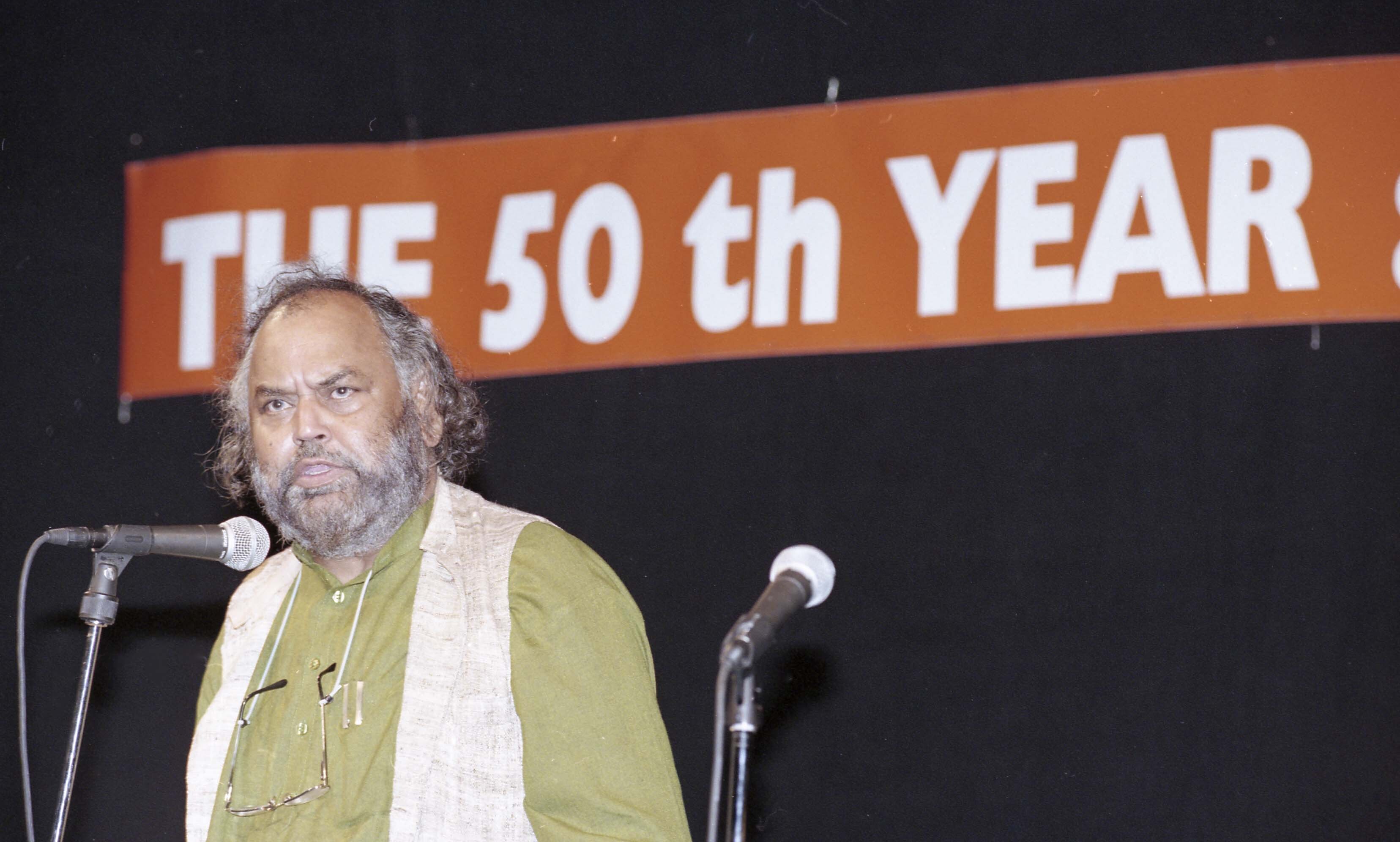
Photograph of Hari Sharma addressing the audience at an event organized by the South Asian Network for Secularism and Democracy (SANSAD). The event was called The 50th Year: Looking Back; Looking Forward, celebrating the 50th anniversary of the independence of India from colonial rule.
Hari Prakash Sharma (1934-2010) was a sociologist and Marxist scholar, who was born at Dadri in Uttar Pradesh, India. Sharma earned his BA from Agra University in 1954, and an MA in Social Work from Delhi University in 1960. In 1963, Sharma moved to the US to further his education. He received an MS in Social Work from Case Western Reserve University in 1964 and a PhD in Rural Sociology from Cornell University in 1968. He taught briefly at the University of California, Los Angeles before accepting a position at SFU. Sharma joined the Department of Political Science, Sociology, and Anthropology at Simon Fraser University in 1968 and taught until his retirement in 1999 when he was honoured by the university as Professor Emeritus. During 1971-72, Sharma was a founding member of and contributor to the Georgia Straight Collective, which produced a publication for radical and alternative views. In 1973, he went to Amnesty International in London and the Commission of Jurists in Geneva and made a written representation to the UN Human Rights Commission in an effort to publicize the condition of more than 30,000 political prisoners in Indian jails. In 1974, Sharma and his comrade Gautam Appa of the London School of Economics organized a petition of international scholars to protest the treatment of political prisoners in India, which he handed to the Indian Consulate in Vancouver, BC on August 15 of the same year. Sharma was a founder of the Indian People's Association in North America (IPANA) on June 25, 1975 and British Columbia Organization to Fight Racism (BCOFR). In 1989, Sharma united groups of the South Asian community to form the Komagata Maru Historical Society. The society united the community, and as a result of its activities, the government installed a commemorative plaque in Vancouver in 1989. Following the attack on the Babri Masjid mosque in December 1992, Hari Sharma became the prime mover in the formation of a North American organization dedicated to the defence of minority rights in India, also known as Non-Resident Indians for Secularism and Democracy (NRISAD). Under Sharma's leadership, NRISAD evolved into the South Asian Network for Secularism and Democracy (SANSAD) in 2000. It pursued the same quest as its predecessors for peace and democracy based secularism, human rights, and social justice. In September 1999, Sharma travelled to Montréal to join the founding of the International South Asia Forum (INSAF), a coalition of individuals and organizations dedicated to the promotion of peace and social justice in South Asia. He became its first President and organized the Second Conference in Vancouver in August 2001. In addition to his academic work and political activism, Hari Sharma was an accomplished literary writer and self-taught photographer.
The South Asian Network for Secularism and Democracy (SANSAD) is an organization of the South Asian diaspora based in British Columbia, Canada. It comprises people with origin in Bangladesh, India, Nepal, Pakistan, and Sri Lanka. The mission of SANSAD is to develop a secular democratic South Asian diaspora in Canada. SANSAD has grown out of a North American organization, called Non-Resident Indians for Secularism and Democracy (NRISAD) that was established in 1993. The Vancouver branch of the organization recognized through its practice that the concerns of NRISAD in regard to minorities and human rights were not specifically Indian but South Asian and had to be reformulated for the South Asian diaspora as a whole. This was realized with the formation of SANSAD in Vancouver in 2000.
Hari Prakash Sharma (1934-2010) was a sociologist and Marxist scholar, who was born at Dadri in Uttar Pradesh, India. Sharma earned his BA from Agra University in 1954, and an MA in Social Work from Delhi University in 1960. In 1963, Sharma moved to the US to further his education. He received an MS in Social Work from Case Western Reserve University in 1964 and a PhD in Rural Sociology from Cornell University in 1968. He taught briefly at the University of California, Los Angeles before accepting a position at SFU. Sharma joined the Department of Political Science, Sociology, and Anthropology at Simon Fraser University in 1968 and taught until his retirement in 1999 when he was honoured by the university as Professor Emeritus. During 1971-72, Sharma was a founding member of and contributor to the Georgia Straight Collective, which produced a publication for radical and alternative views. In 1973, he went to Amnesty International in London and the Commission of Jurists in Geneva and made a written representation to the UN Human Rights Commission in an effort to publicize the condition of more than 30,000 political prisoners in Indian jails. In 1974, Sharma and his comrade Gautam Appa of the London School of Economics organized a petition of international scholars to protest the treatment of political prisoners in India, which he handed to the Indian Consulate in Vancouver, BC on August 15 of the same year. Sharma was a founder of the Indian People's Association in North America (IPANA) on June 25, 1975 and British Columbia Organization to Fight Racism (BCOFR). In 1989, Sharma united groups of the South Asian community to form the Komagata Maru Historical Society. The society united the community, and as a result of its activities, the government installed a commemorative plaque in Vancouver in 1989. Following the attack on the Babri Masjid mosque in December 1992, Hari Sharma became the prime mover in the formation of a North American organization dedicated to the defence of minority rights in India, also known as Non-Resident Indians for Secularism and Democracy (NRISAD). Under Sharma's leadership, NRISAD evolved into the South Asian Network for Secularism and Democracy (SANSAD) in 2000. It pursued the same quest as its predecessors for peace and democracy based secularism, human rights, and social justice. In September 1999, Sharma travelled to Montréal to join the founding of the International South Asia Forum (INSAF), a coalition of individuals and organizations dedicated to the promotion of peace and social justice in South Asia. He became its first President and organized the Second Conference in Vancouver in August 2001. In addition to his academic work and political activism, Hari Sharma was an accomplished literary writer and self-taught photographer.
The South Asian Network for Secularism and Democracy (SANSAD) is an organization of the South Asian diaspora based in British Columbia, Canada. It comprises people with origin in Bangladesh, India, Nepal, Pakistan, and Sri Lanka. The mission of SANSAD is to develop a secular democratic South Asian diaspora in Canada. SANSAD has grown out of a North American organization, called Non-Resident Indians for Secularism and Democracy (NRISAD) that was established in 1993. The Vancouver branch of the organization recognized through its practice that the concerns of NRISAD in regard to minorities and human rights were not specifically Indian but South Asian and had to be reformulated for the South Asian diaspora as a whole. This was realized with the formation of SANSAD in Vancouver in 2000.
Creator: Chandra Bodalia
Description
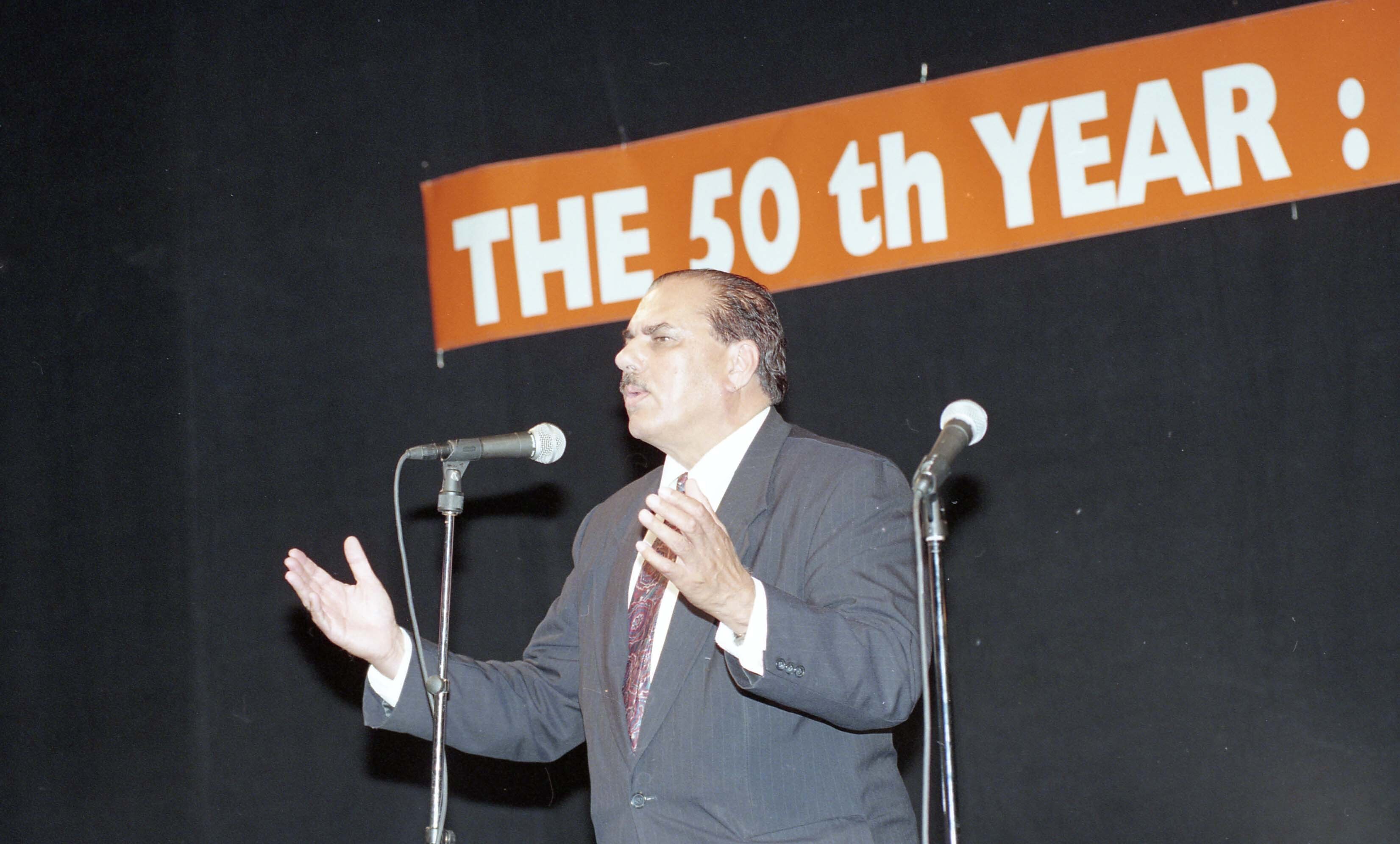
Photograph of Riasat Ali Khan addressing the audience at an event organized by the South Asian Network for Secularism and Democracy (SANSAD). The event was called The 50th Year: Looking Back; Looking Forward, celebrating the 50th anniversary of the independence of India from colonial rule.
Riasat Ali Khan was born in India, but his family shifted to Pakistan after independence. Khan immigrated to Canada in 1959, working in the correctional services. Khan was a prominent leader of the Pakistani-Canadian community in Vancouver, British Columbia (B.C.). Khan was the founder of the Pakistan-Canada Association, which opened the first mosque in 1963, the Al Jamia Masjid in Vancouver, B.C. He served as the head of the B.C. Immigrant Services Society. Khan was also a board member of the B.C. Cancer Society and a delegate to the Committee for Racial Justice.
The South Asian Network for Secularism and Democracy (SANSAD) is an organization of the South Asian diaspora based in British Columbia, Canada. It comprises people with origin in Bangladesh, India, Nepal, Pakistan, and Sri Lanka. The mission of SANSAD is to develop a secular democratic South Asian diaspora in Canada. SANSAD has grown out of a North American organization, called Non-Resident Indians for Secularism and Democracy (NRISAD) that was established in 1993. The Vancouver branch of the organization recognized through its practice that the concerns of NRISAD in regard to minorities and human rights were not specifically Indian but South Asian and had to be reformulated for the South Asian diaspora as a whole. This was realized with the formation of SANSAD in Vancouver in 2000.
Riasat Ali Khan was born in India, but his family shifted to Pakistan after independence. Khan immigrated to Canada in 1959, working in the correctional services. Khan was a prominent leader of the Pakistani-Canadian community in Vancouver, British Columbia (B.C.). Khan was the founder of the Pakistan-Canada Association, which opened the first mosque in 1963, the Al Jamia Masjid in Vancouver, B.C. He served as the head of the B.C. Immigrant Services Society. Khan was also a board member of the B.C. Cancer Society and a delegate to the Committee for Racial Justice.
The South Asian Network for Secularism and Democracy (SANSAD) is an organization of the South Asian diaspora based in British Columbia, Canada. It comprises people with origin in Bangladesh, India, Nepal, Pakistan, and Sri Lanka. The mission of SANSAD is to develop a secular democratic South Asian diaspora in Canada. SANSAD has grown out of a North American organization, called Non-Resident Indians for Secularism and Democracy (NRISAD) that was established in 1993. The Vancouver branch of the organization recognized through its practice that the concerns of NRISAD in regard to minorities and human rights were not specifically Indian but South Asian and had to be reformulated for the South Asian diaspora as a whole. This was realized with the formation of SANSAD in Vancouver in 2000.
Creator: Chandra Bodalia
Description
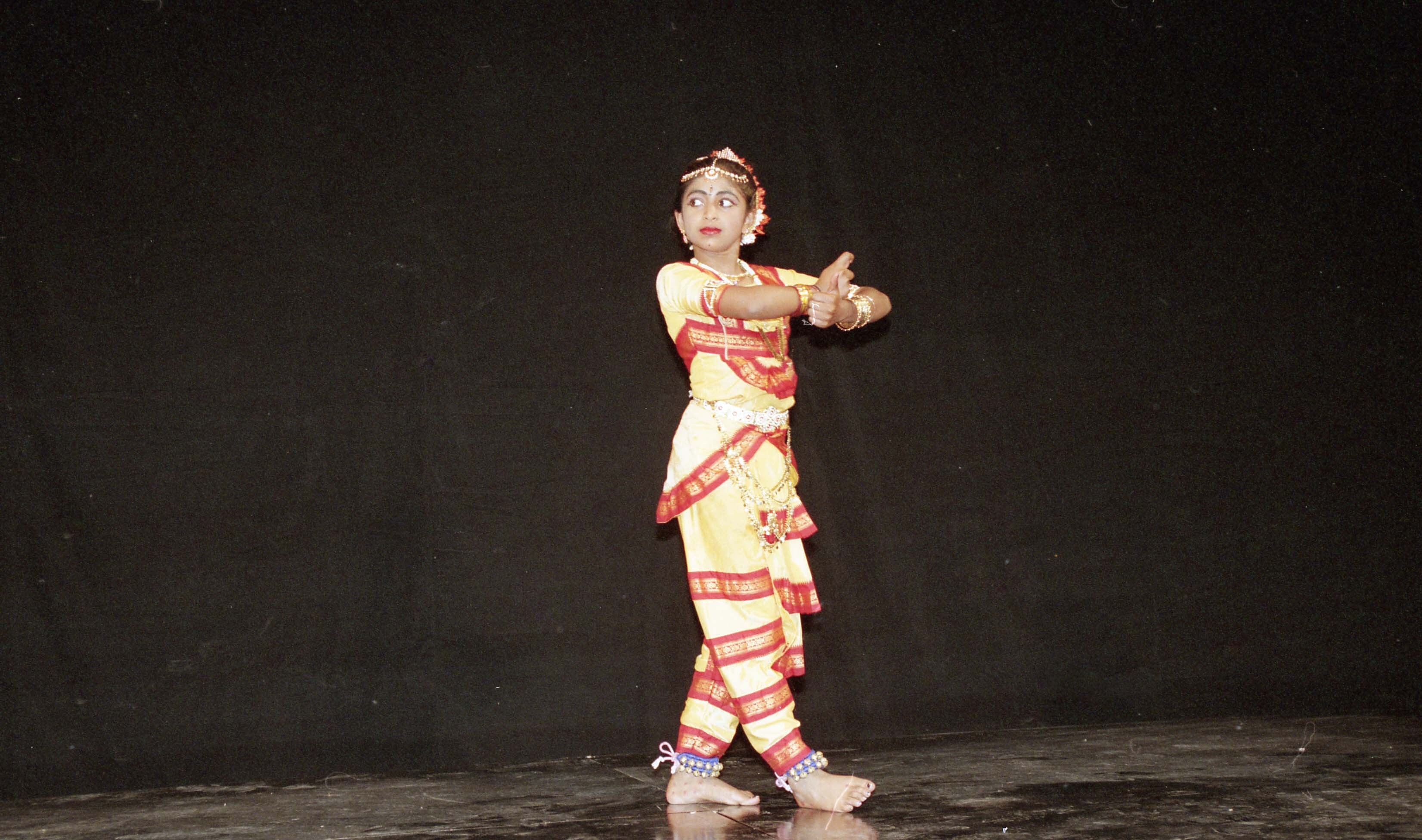
Photograph of an unidentified individual performing bharatanatyam at an event organized by the South Asian Network for Secularism and Democracy (SANSAD). The event was called The 50th Year: Looking Back; Looking Forward, celebrating the 50th anniversary of the independence of India from colonial rule.
Bharatanatyam, a classical dance style of India, is indigenous to the Tamil Nadu region and prevalent in southern India. Bharatanatyam serves the expression of Hindu religious themes and devotions. Bharatanatyam was originally performed exclusively by female temple dancers and was not brought to the stage for public performance until about 1930. A vital tradition of Bharatanatyam is a graduation performance, called Arangetram, in which graduates showcase their talents.
The South Asian Network for Secularism and Democracy (SANSAD) is an organization of the South Asian diaspora based in British Columbia, Canada. It comprises people with origin in Bangladesh, India, Nepal, Pakistan, and Sri Lanka. The mission of SANSAD is to develop a secular democratic South Asian diaspora in Canada. SANSAD has grown out of a North American organization, called Non-Resident Indians for Secularism and Democracy (NRISAD) that was established in 1993. The Vancouver branch of the organization recognized through its practice that the concerns of NRISAD in regard to minorities and human rights were not specifically Indian but South Asian and had to be reformulated for the South Asian diaspora as a whole. This was realized with the formation of SANSAD in Vancouver in 2000.
Bharatanatyam, a classical dance style of India, is indigenous to the Tamil Nadu region and prevalent in southern India. Bharatanatyam serves the expression of Hindu religious themes and devotions. Bharatanatyam was originally performed exclusively by female temple dancers and was not brought to the stage for public performance until about 1930. A vital tradition of Bharatanatyam is a graduation performance, called Arangetram, in which graduates showcase their talents.
The South Asian Network for Secularism and Democracy (SANSAD) is an organization of the South Asian diaspora based in British Columbia, Canada. It comprises people with origin in Bangladesh, India, Nepal, Pakistan, and Sri Lanka. The mission of SANSAD is to develop a secular democratic South Asian diaspora in Canada. SANSAD has grown out of a North American organization, called Non-Resident Indians for Secularism and Democracy (NRISAD) that was established in 1993. The Vancouver branch of the organization recognized through its practice that the concerns of NRISAD in regard to minorities and human rights were not specifically Indian but South Asian and had to be reformulated for the South Asian diaspora as a whole. This was realized with the formation of SANSAD in Vancouver in 2000.
Creator: Chandra Bodalia
Description
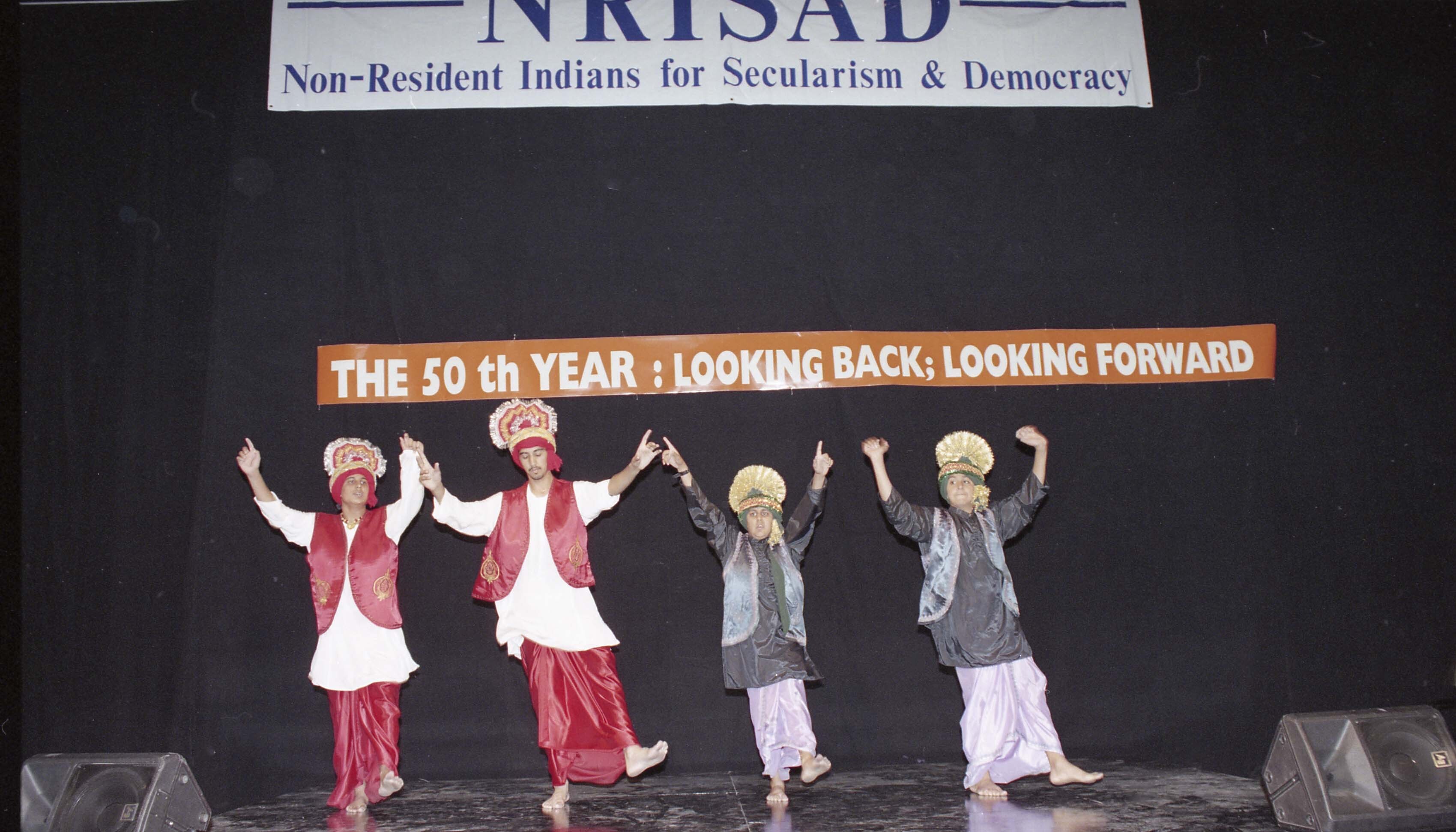
Photograph of a group of unidentified individuals performing bhangra at an event organized by the South Asian Network for Secularism and Democracy (SANSAD). The event was called The 50th Year: Looking Back; Looking Forward, celebrating the 50th anniversary of the independence of India from colonial rule.
Bhangra is a folk dance and music form that originated from Punjab, India. It originated as a folk dance celebrated during the time of the harvest. It's traditionally danced to the dhol instrument, a large drum, accompanied by boliyan, short sets of lyrics that describe scenes or stories from Punjab.
The South Asian Network for Secularism and Democracy (SANSAD) is an organization of the South Asian diaspora based in British Columbia, Canada. It comprises people with origin in Bangladesh, India, Nepal, Pakistan, and Sri Lanka. The mission of SANSAD is to develop a secular democratic South Asian diaspora in Canada. SANSAD has grown out of a North American organization, called Non-Resident Indians for Secularism and Democracy (NRISAD) that was established in 1993. The Vancouver branch of the organization recognized through its practice that the concerns of NRISAD in regard to minorities and human rights were not specifically Indian but South Asian and had to be reformulated for the South Asian diaspora as a whole. This was realized with the formation of SANSAD in Vancouver in 2000.
Bhangra is a folk dance and music form that originated from Punjab, India. It originated as a folk dance celebrated during the time of the harvest. It's traditionally danced to the dhol instrument, a large drum, accompanied by boliyan, short sets of lyrics that describe scenes or stories from Punjab.
The South Asian Network for Secularism and Democracy (SANSAD) is an organization of the South Asian diaspora based in British Columbia, Canada. It comprises people with origin in Bangladesh, India, Nepal, Pakistan, and Sri Lanka. The mission of SANSAD is to develop a secular democratic South Asian diaspora in Canada. SANSAD has grown out of a North American organization, called Non-Resident Indians for Secularism and Democracy (NRISAD) that was established in 1993. The Vancouver branch of the organization recognized through its practice that the concerns of NRISAD in regard to minorities and human rights were not specifically Indian but South Asian and had to be reformulated for the South Asian diaspora as a whole. This was realized with the formation of SANSAD in Vancouver in 2000.
Creator: Chandra Bodalia
Description
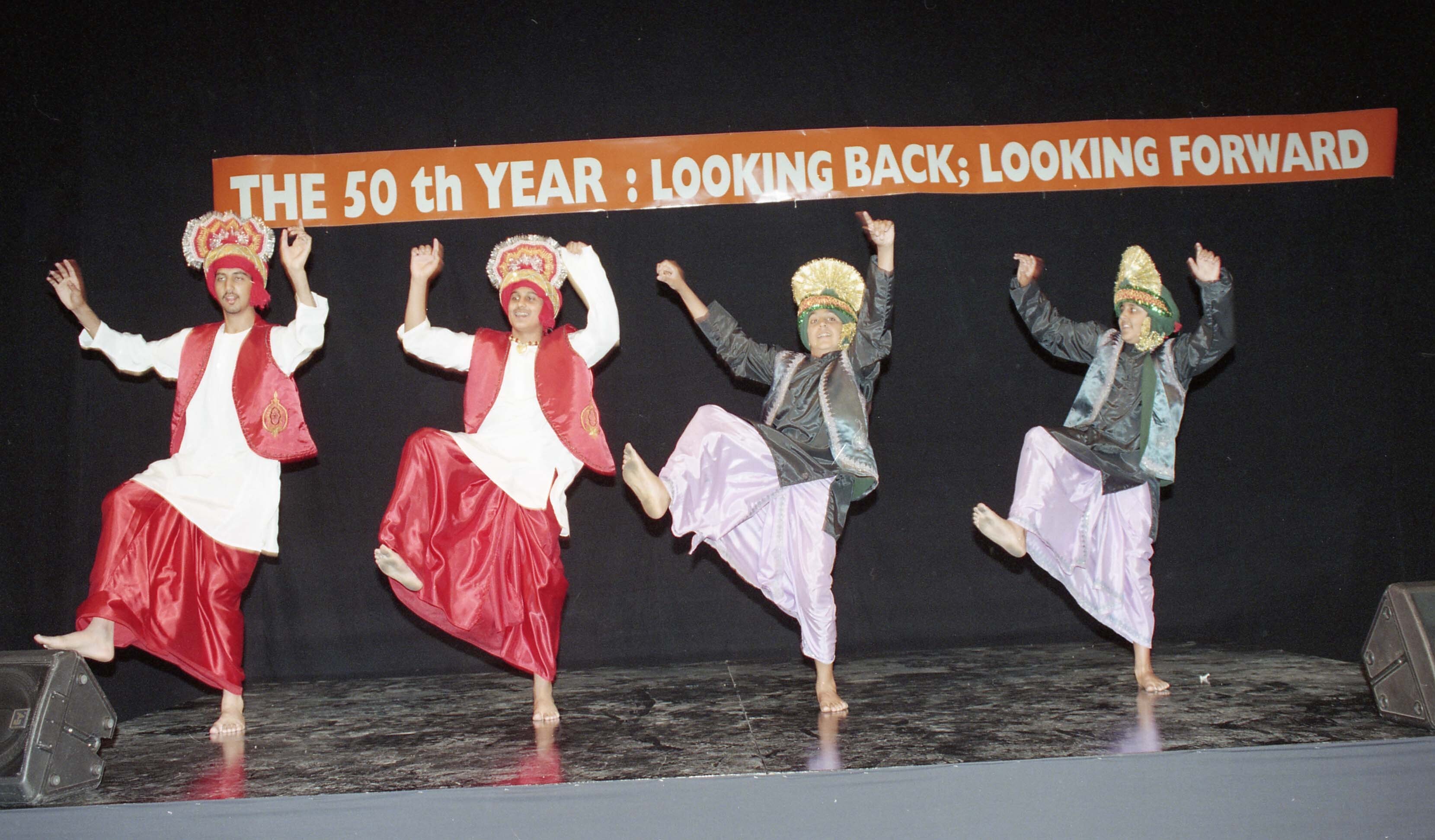
Photograph of a group of unidentified individuals performing bhangra at an event organized by the South Asian Network for Secularism and Democracy (SANSAD). The event was called The 50th Year: Looking Back; Looking Forward, celebrating the 50th anniversary of the independence of India from colonial rule.
Bhangra is a folk dance and music form that originated from Punjab, India. It originated as a folk dance celebrated during the time of the harvest. It's traditionally danced to the dhol instrument, a large drum, accompanied by boliyan, short sets of lyrics that describe scenes or stories from Punjab.
The South Asian Network for Secularism and Democracy (SANSAD) is an organization of the South Asian diaspora based in British Columbia, Canada. It comprises people with origin in Bangladesh, India, Nepal, Pakistan, and Sri Lanka. The mission of SANSAD is to develop a secular democratic South Asian diaspora in Canada. SANSAD has grown out of a North American organization, called Non-Resident Indians for Secularism and Democracy (NRISAD) that was established in 1993. The Vancouver branch of the organization recognized through its practice that the concerns of NRISAD in regard to minorities and human rights were not specifically Indian but South Asian and had to be reformulated for the South Asian diaspora as a whole. This was realized with the formation of SANSAD in Vancouver in 2000.
Bhangra is a folk dance and music form that originated from Punjab, India. It originated as a folk dance celebrated during the time of the harvest. It's traditionally danced to the dhol instrument, a large drum, accompanied by boliyan, short sets of lyrics that describe scenes or stories from Punjab.
The South Asian Network for Secularism and Democracy (SANSAD) is an organization of the South Asian diaspora based in British Columbia, Canada. It comprises people with origin in Bangladesh, India, Nepal, Pakistan, and Sri Lanka. The mission of SANSAD is to develop a secular democratic South Asian diaspora in Canada. SANSAD has grown out of a North American organization, called Non-Resident Indians for Secularism and Democracy (NRISAD) that was established in 1993. The Vancouver branch of the organization recognized through its practice that the concerns of NRISAD in regard to minorities and human rights were not specifically Indian but South Asian and had to be reformulated for the South Asian diaspora as a whole. This was realized with the formation of SANSAD in Vancouver in 2000.