
Nishan Sahib
Member of
Creator: Bodalia, Chandra
Description
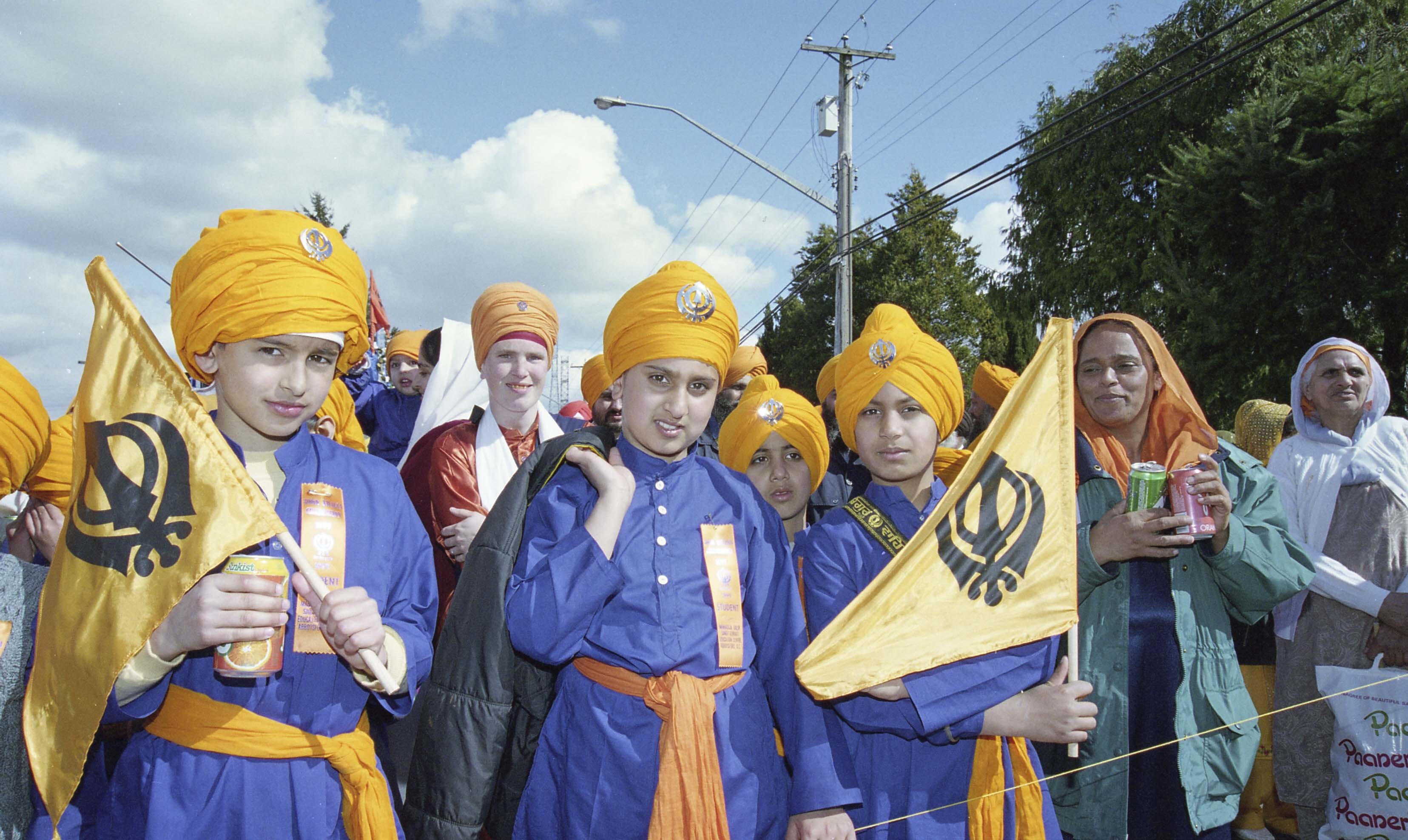
Photograph of a group of unidentified individuals, with a few individuals holding flags, at the Vaisakhi Nagar Kirtan held in Surrey, British Columbia (B.C.).
The Nishan Sahib is a Sikh holy triangular flag made of cotton or silk cloth, with a tassel at its end. The word, Nishan means symbol, and the flag is hoisted on a tall flagpole, outside most Gurdwaras (temples). The flagpole itself is covered with fabric, and ends with a two-edged dagger (khanda) on top. The emblem on the flag, which depicts a double-edged sword called a khanda (☬) in the centre, a chakkar which is circular, and flanked by two single-edged swords, or kirpans. A traditional symbol of the Khalsa Panth, the Nishan Sahib can be seen from far away, signifying the presence of Khalsa in the neighbourhood.
Vaisakhi is one of the most important festivals in Sikhi, marking the formation of the Khalsa in 1699 by the tenth guru, Guru Gobind Singh Ji. It is a time of renewal, gratitude, and unity, celebrated with processions, prayers, and acts of service. Beyond its significance in Sikh history, Vaisakhi is also a harvest festival in Punjab, observed with joy and thanksgiving. Additionally, Vaisakhi holds special significance for Hindus, as it marks the beginning of the solar new year and is celebrated in various regions of India under different names, such as Pohela Boishakh in Bengal and Puthandu in Tamil Nadu.
The Nishan Sahib is a Sikh holy triangular flag made of cotton or silk cloth, with a tassel at its end. The word, Nishan means symbol, and the flag is hoisted on a tall flagpole, outside most Gurdwaras (temples). The flagpole itself is covered with fabric, and ends with a two-edged dagger (khanda) on top. The emblem on the flag, which depicts a double-edged sword called a khanda (☬) in the centre, a chakkar which is circular, and flanked by two single-edged swords, or kirpans. A traditional symbol of the Khalsa Panth, the Nishan Sahib can be seen from far away, signifying the presence of Khalsa in the neighbourhood.
Vaisakhi is one of the most important festivals in Sikhi, marking the formation of the Khalsa in 1699 by the tenth guru, Guru Gobind Singh Ji. It is a time of renewal, gratitude, and unity, celebrated with processions, prayers, and acts of service. Beyond its significance in Sikh history, Vaisakhi is also a harvest festival in Punjab, observed with joy and thanksgiving. Additionally, Vaisakhi holds special significance for Hindus, as it marks the beginning of the solar new year and is celebrated in various regions of India under different names, such as Pohela Boishakh in Bengal and Puthandu in Tamil Nadu.
Member of
Creator: Bodalia, Chandra
Description
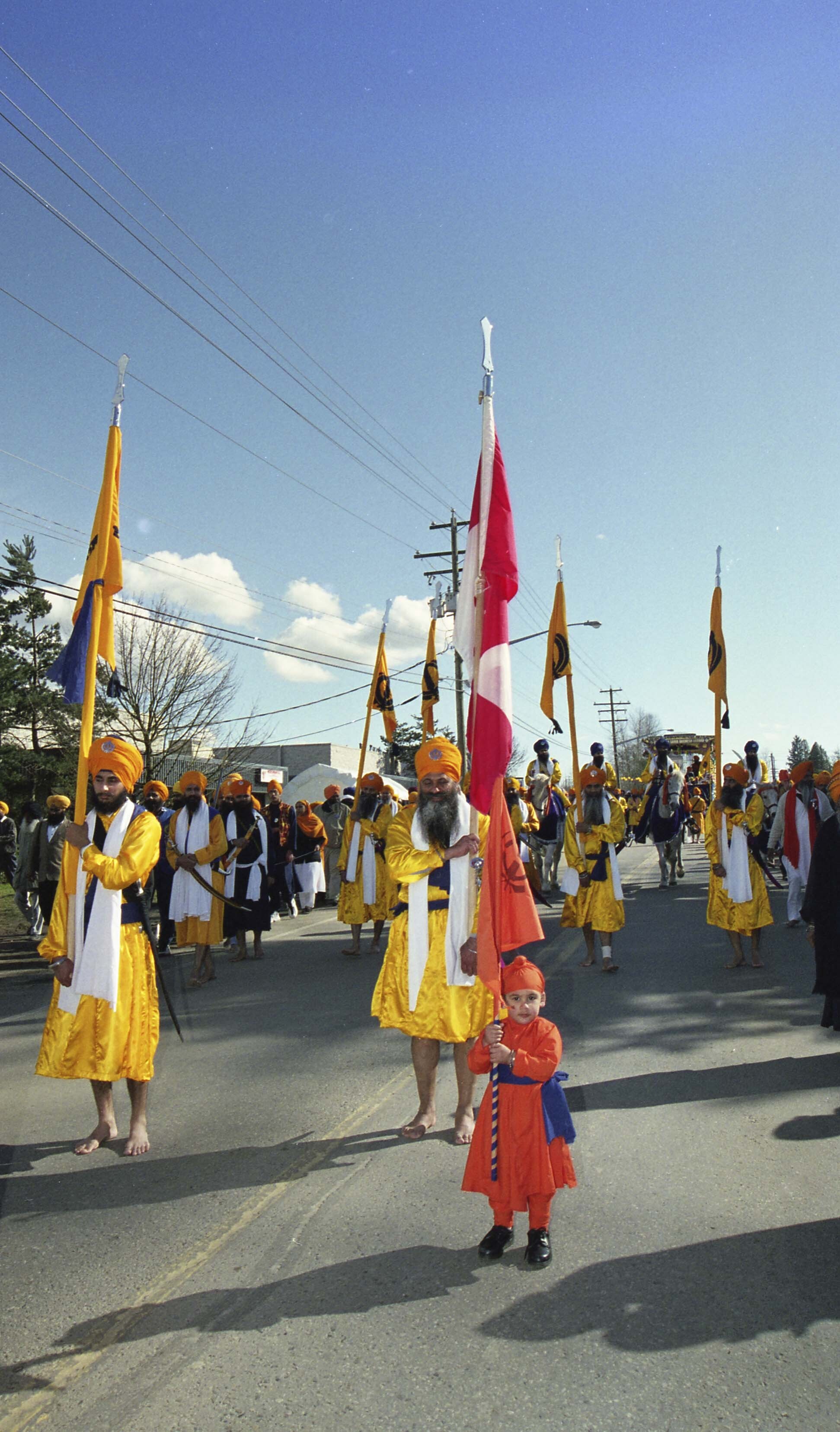
Photograph of a group of unidentified individuals, known as gursikhs, holding flags at the Vaisakhi Nagar Kirtan held in Surrey, British Columbia (B.C.).
Gursikhs, holding the Canadian and nishan sahib flag, are Sikhs devoted to the Guru and the teachings of Sikhi. The Nishan Sahib is a Sikh holy triangular flag made of cotton or silk cloth, with a tassel at its end. The word, Nishan means symbol, and the flag is hoisted on a tall flagpole, outside most Gurdwaras (temples). The flagpole itself is covered with fabric, and ends with a two-edged dagger (khanda) on top. The emblem on the flag, which depicts a double-edged sword called a khanda (☬) in the centre, a chakkar which is circular, and flanked by two single-edged swords, or kirpans. A traditional symbol of the Khalsa Panth, the Nishan Sahib can be seen from far away, signifying the presence of Khalsa in the neighbourhood.
Vaisakhi is one of the most important festivals in Sikhi, marking the formation of the Khalsa in 1699 by the tenth guru, Guru Gobind Singh Ji. It is a time of renewal, gratitude, and unity, celebrated with processions, prayers, and acts of service. Beyond its significance in Sikh history, Vaisakhi is also a harvest festival in Punjab, observed with joy and thanksgiving. Additionally, Vaisakhi holds special significance for Hindus, as it marks the beginning of the solar new year and is celebrated in various regions of India under different names, such as Pohela Boishakh in Bengal and Puthandu in Tamil Nadu.
Gursikhs, holding the Canadian and nishan sahib flag, are Sikhs devoted to the Guru and the teachings of Sikhi. The Nishan Sahib is a Sikh holy triangular flag made of cotton or silk cloth, with a tassel at its end. The word, Nishan means symbol, and the flag is hoisted on a tall flagpole, outside most Gurdwaras (temples). The flagpole itself is covered with fabric, and ends with a two-edged dagger (khanda) on top. The emblem on the flag, which depicts a double-edged sword called a khanda (☬) in the centre, a chakkar which is circular, and flanked by two single-edged swords, or kirpans. A traditional symbol of the Khalsa Panth, the Nishan Sahib can be seen from far away, signifying the presence of Khalsa in the neighbourhood.
Vaisakhi is one of the most important festivals in Sikhi, marking the formation of the Khalsa in 1699 by the tenth guru, Guru Gobind Singh Ji. It is a time of renewal, gratitude, and unity, celebrated with processions, prayers, and acts of service. Beyond its significance in Sikh history, Vaisakhi is also a harvest festival in Punjab, observed with joy and thanksgiving. Additionally, Vaisakhi holds special significance for Hindus, as it marks the beginning of the solar new year and is celebrated in various regions of India under different names, such as Pohela Boishakh in Bengal and Puthandu in Tamil Nadu.
Member of
Creator: Bodalia, Chandra
Description
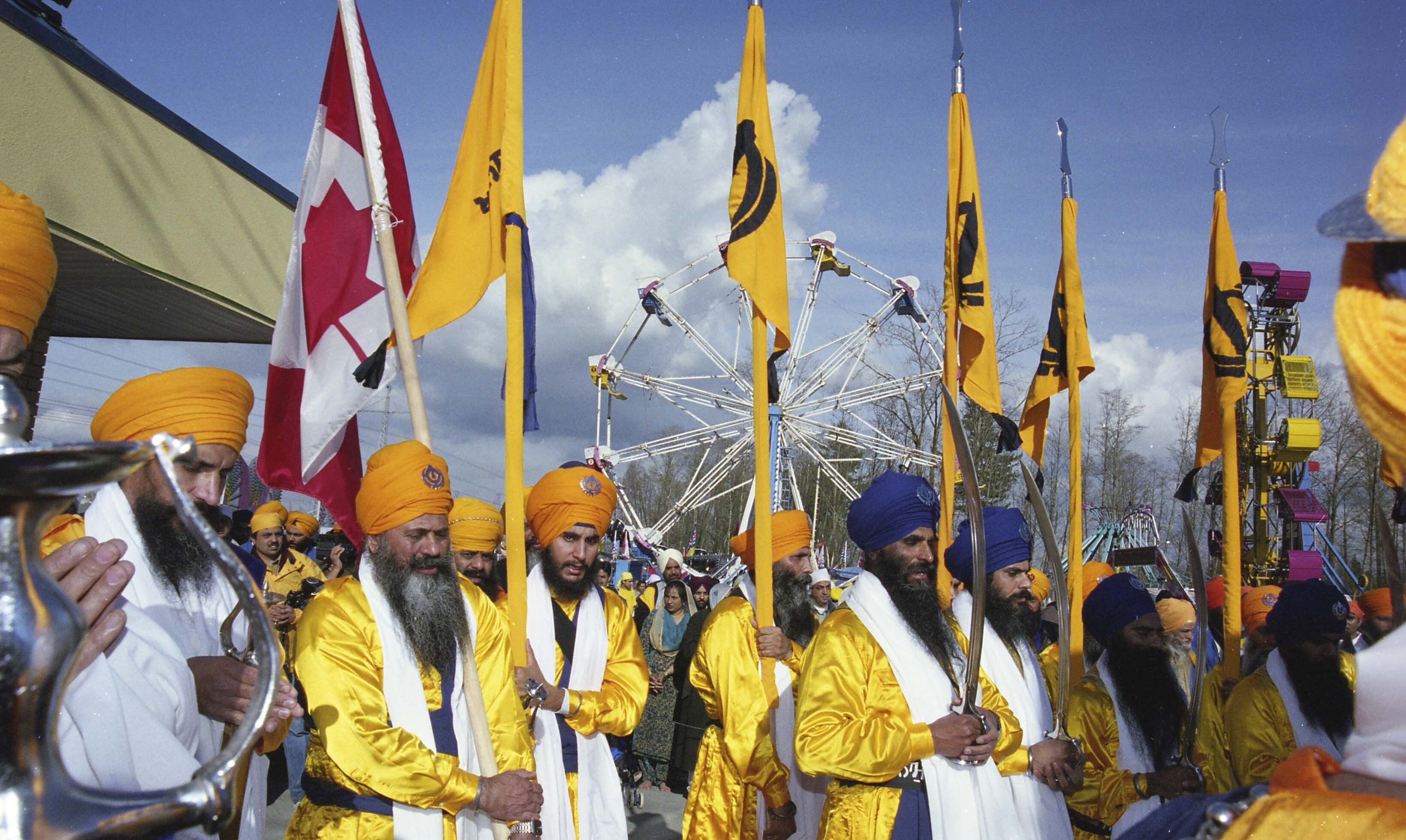
Photograph of a group of unidentified individuals, known as gursikhs, holding flags at Gurdwara Sahib Dasmesh Darbar in Surrey, British Columbia (B.C.). Individuals had gathered at the gurdwara (sikh temple) for the Vaisakhi Nagar Kirtan.
Gursikhs, holding the nishan sahib flag, are Sikhs devoted to the Guru and the teachings of Sikhi. The Nishan Sahib is a Sikh holy triangular flag made of cotton or silk cloth, with a tassel at its end. The word, Nishan means symbol, and the flag is hoisted on a tall flagpole, outside most Gurdwaras (temples). The flagpole itself is covered with fabric, and ends with a two-edged dagger (khanda) on top. The emblem on the flag, which depicts a double-edged sword called a khanda (☬) in the centre, a chakkar which is circular, and flanked by two single-edged swords, or kirpans. A traditional symbol of the Khalsa Panth, the Nishan Sahib can be seen from far away, signifying the presence of Khalsa in the neighbourhood.
Gurdwara Sahib Dasmesh Darbar, located in Surrey, B.C., was formed in 1998 to help combat the growing issues affecting the Sikh community both locally and globally. Since its formation, the Gurdwara Sahib has continuously held programs to benefit and promote the Sikh way of life.
Vaisakhi is one of the most important festivals in Sikhi, marking the formation of the Khalsa in 1699 by the tenth guru, Guru Gobind Singh Ji. It is a time of renewal, gratitude, and unity, celebrated with processions, prayers, and acts of service. Beyond its significance in Sikh history, Vaisakhi is also a harvest festival in Punjab, observed with joy and thanksgiving. Additionally, Vaisakhi holds special significance for Hindus, as it marks the beginning of the solar new year and is celebrated in various regions of India under different names, such as Pohela Boishakh in Bengal and Puthandu in Tamil Nadu.
Gursikhs, holding the nishan sahib flag, are Sikhs devoted to the Guru and the teachings of Sikhi. The Nishan Sahib is a Sikh holy triangular flag made of cotton or silk cloth, with a tassel at its end. The word, Nishan means symbol, and the flag is hoisted on a tall flagpole, outside most Gurdwaras (temples). The flagpole itself is covered with fabric, and ends with a two-edged dagger (khanda) on top. The emblem on the flag, which depicts a double-edged sword called a khanda (☬) in the centre, a chakkar which is circular, and flanked by two single-edged swords, or kirpans. A traditional symbol of the Khalsa Panth, the Nishan Sahib can be seen from far away, signifying the presence of Khalsa in the neighbourhood.
Gurdwara Sahib Dasmesh Darbar, located in Surrey, B.C., was formed in 1998 to help combat the growing issues affecting the Sikh community both locally and globally. Since its formation, the Gurdwara Sahib has continuously held programs to benefit and promote the Sikh way of life.
Vaisakhi is one of the most important festivals in Sikhi, marking the formation of the Khalsa in 1699 by the tenth guru, Guru Gobind Singh Ji. It is a time of renewal, gratitude, and unity, celebrated with processions, prayers, and acts of service. Beyond its significance in Sikh history, Vaisakhi is also a harvest festival in Punjab, observed with joy and thanksgiving. Additionally, Vaisakhi holds special significance for Hindus, as it marks the beginning of the solar new year and is celebrated in various regions of India under different names, such as Pohela Boishakh in Bengal and Puthandu in Tamil Nadu.
Member of
Creator: Bodalia, Chandra
Description
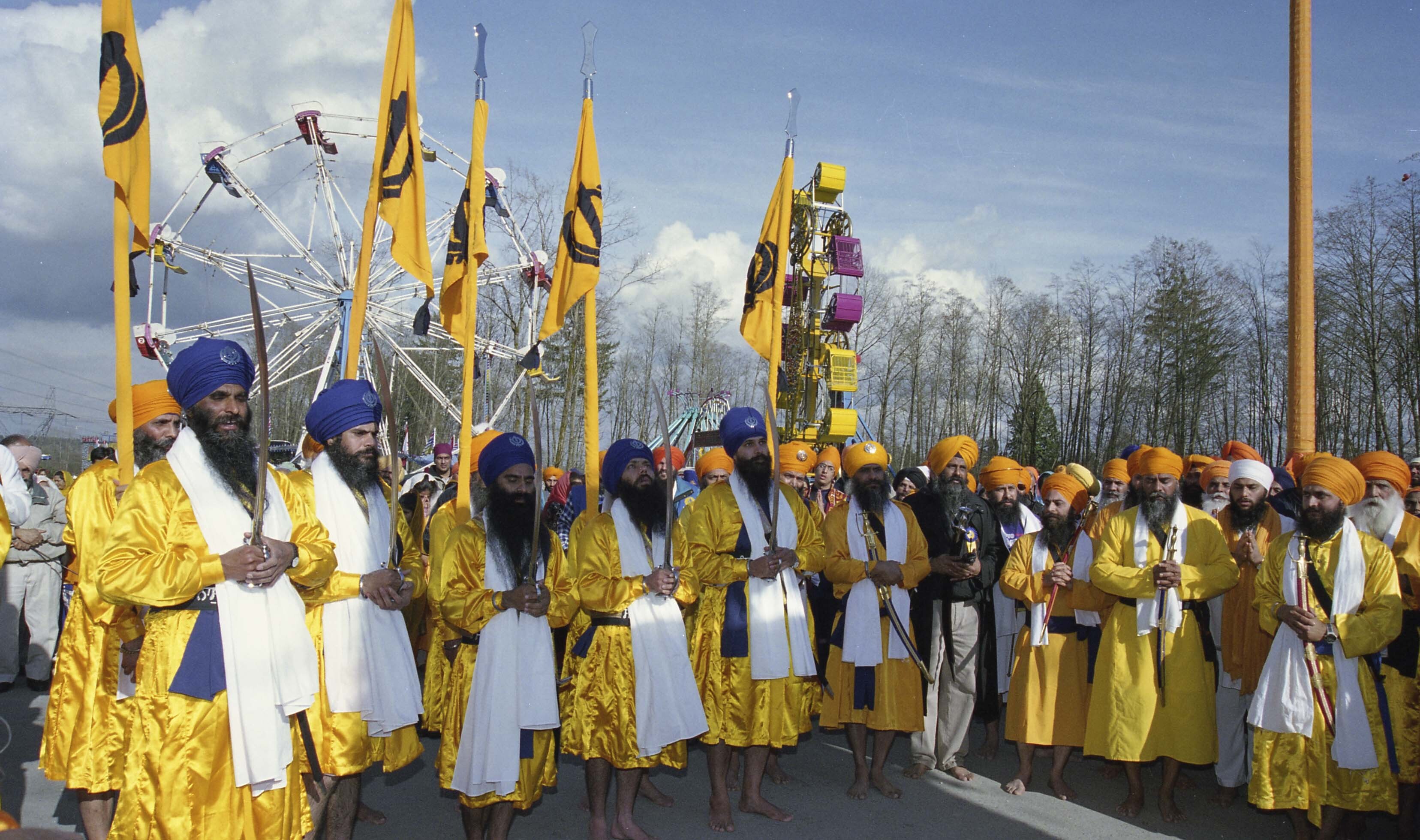
Photograph of a group of unidentified individuals, known as gursikhs, holding flags at Gurdwara Sahib Dasmesh Darbar in Surrey, British Columbia (B.C.). Individuals had gathered at the gurdwara (sikh temple) for the Vaisakhi Nagar Kirtan.
Gursikhs, holding the nishan sahib flag, are Sikhs devoted to the Guru and the teachings of Sikhi. The Nishan Sahib is a Sikh holy triangular flag made of cotton or silk cloth, with a tassel at its end. The word, Nishan means symbol, and the flag is hoisted on a tall flagpole, outside most Gurdwaras (temples). The flagpole itself is covered with fabric, and ends with a two-edged dagger (khanda) on top. The emblem on the flag, which depicts a double-edged sword called a khanda (☬) in the centre, a chakkar which is circular, and flanked by two single-edged swords, or kirpans. A traditional symbol of the Khalsa Panth, the Nishan Sahib can be seen from far away, signifying the presence of Khalsa in the neighbourhood.
Gurdwara Sahib Dasmesh Darbar, located in Surrey, B.C., was formed in 1998 to help combat the growing issues affecting the Sikh community both locally and globally. Since its formation, the Gurdwara Sahib has continuously held programs to benefit and promote the Sikh way of life.
Vaisakhi is one of the most important festivals in Sikhi, marking the formation of the Khalsa in 1699 by the tenth guru, Guru Gobind Singh Ji. It is a time of renewal, gratitude, and unity, celebrated with processions, prayers, and acts of service. Beyond its significance in Sikh history, Vaisakhi is also a harvest festival in Punjab, observed with joy and thanksgiving. Additionally, Vaisakhi holds special significance for Hindus, as it marks the beginning of the solar new year and is celebrated in various regions of India under different names, such as Pohela Boishakh in Bengal and Puthandu in Tamil Nadu.
Gursikhs, holding the nishan sahib flag, are Sikhs devoted to the Guru and the teachings of Sikhi. The Nishan Sahib is a Sikh holy triangular flag made of cotton or silk cloth, with a tassel at its end. The word, Nishan means symbol, and the flag is hoisted on a tall flagpole, outside most Gurdwaras (temples). The flagpole itself is covered with fabric, and ends with a two-edged dagger (khanda) on top. The emblem on the flag, which depicts a double-edged sword called a khanda (☬) in the centre, a chakkar which is circular, and flanked by two single-edged swords, or kirpans. A traditional symbol of the Khalsa Panth, the Nishan Sahib can be seen from far away, signifying the presence of Khalsa in the neighbourhood.
Gurdwara Sahib Dasmesh Darbar, located in Surrey, B.C., was formed in 1998 to help combat the growing issues affecting the Sikh community both locally and globally. Since its formation, the Gurdwara Sahib has continuously held programs to benefit and promote the Sikh way of life.
Vaisakhi is one of the most important festivals in Sikhi, marking the formation of the Khalsa in 1699 by the tenth guru, Guru Gobind Singh Ji. It is a time of renewal, gratitude, and unity, celebrated with processions, prayers, and acts of service. Beyond its significance in Sikh history, Vaisakhi is also a harvest festival in Punjab, observed with joy and thanksgiving. Additionally, Vaisakhi holds special significance for Hindus, as it marks the beginning of the solar new year and is celebrated in various regions of India under different names, such as Pohela Boishakh in Bengal and Puthandu in Tamil Nadu.
Member of
Creator: Bodalia, Chandra
Description
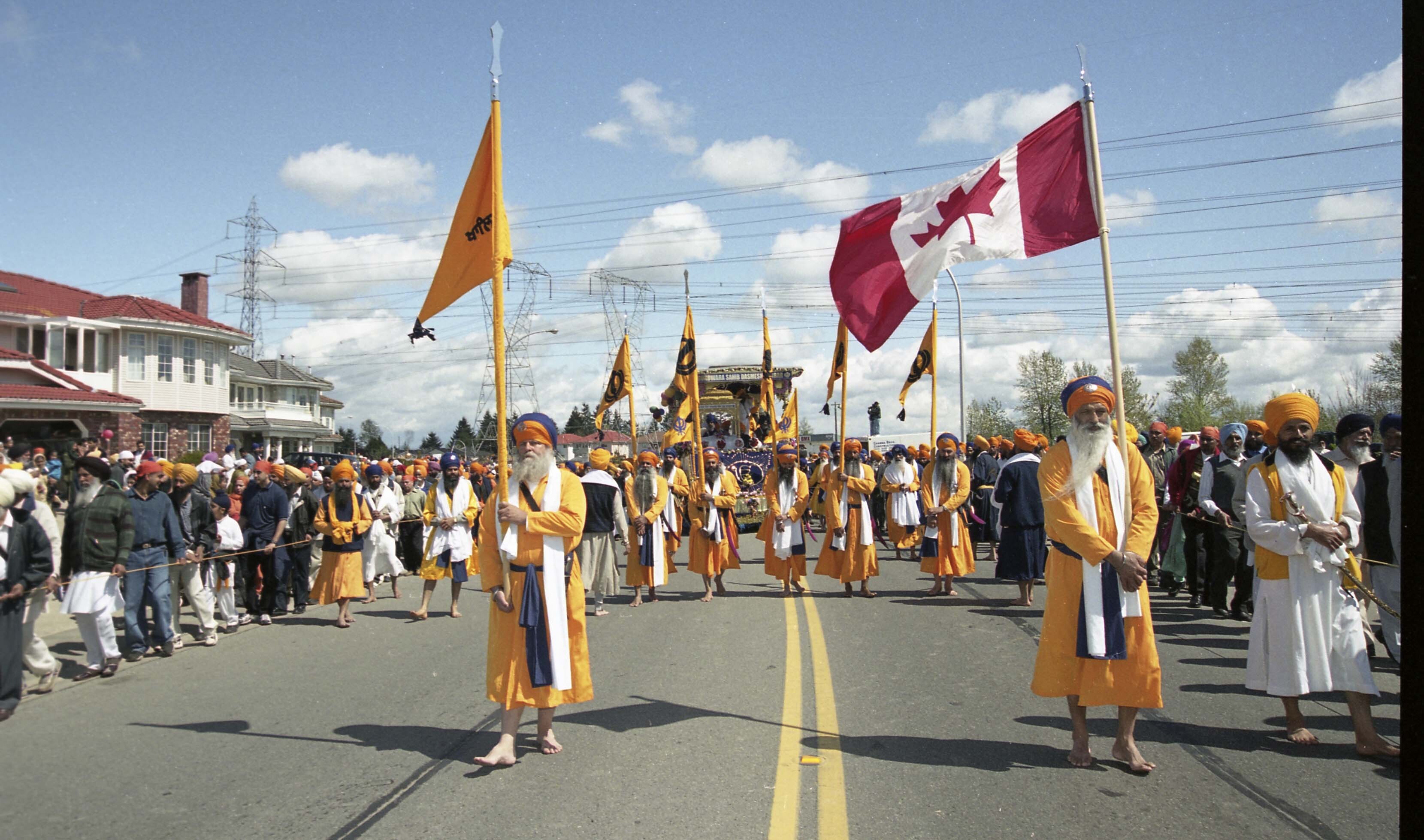
Photograph of a group of unidentified individuals, known as gursikhs, holding flags at the Vaisakhi Nagar Kirtan held in Surrey, British Columbia (B.C.).
Gursikhs, holding the Canadian and nishan sahib flag, are Sikhs devoted to the Guru and the teachings of Sikhi. The Nishan Sahib is a Sikh holy triangular flag made of cotton or silk cloth, with a tassel at its end. The word, Nishan means symbol, and the flag is hoisted on a tall flagpole, outside most Gurdwaras (temples). The flagpole itself is covered with fabric, and ends with a two-edged dagger (khanda) on top. The emblem on the flag, which depicts a double-edged sword called a khanda (☬) in the centre, a chakkar which is circular, and flanked by two single-edged swords, or kirpans. A traditional symbol of the Khalsa Panth, the Nishan Sahib can be seen from far away, signifying the presence of Khalsa in the neighbourhood.
Vaisakhi is one of the most important festivals in Sikhi, marking the formation of the Khalsa in 1699 by the tenth guru, Guru Gobind Singh Ji. It is a time of renewal, gratitude, and unity, celebrated with processions, prayers, and acts of service. Beyond its significance in Sikh history, Vaisakhi is also a harvest festival in Punjab, observed with joy and thanksgiving. Additionally, Vaisakhi holds special significance for Hindus, as it marks the beginning of the solar new year and is celebrated in various regions of India under different names, such as Pohela Boishakh in Bengal and Puthandu in Tamil Nadu.
Gursikhs, holding the Canadian and nishan sahib flag, are Sikhs devoted to the Guru and the teachings of Sikhi. The Nishan Sahib is a Sikh holy triangular flag made of cotton or silk cloth, with a tassel at its end. The word, Nishan means symbol, and the flag is hoisted on a tall flagpole, outside most Gurdwaras (temples). The flagpole itself is covered with fabric, and ends with a two-edged dagger (khanda) on top. The emblem on the flag, which depicts a double-edged sword called a khanda (☬) in the centre, a chakkar which is circular, and flanked by two single-edged swords, or kirpans. A traditional symbol of the Khalsa Panth, the Nishan Sahib can be seen from far away, signifying the presence of Khalsa in the neighbourhood.
Vaisakhi is one of the most important festivals in Sikhi, marking the formation of the Khalsa in 1699 by the tenth guru, Guru Gobind Singh Ji. It is a time of renewal, gratitude, and unity, celebrated with processions, prayers, and acts of service. Beyond its significance in Sikh history, Vaisakhi is also a harvest festival in Punjab, observed with joy and thanksgiving. Additionally, Vaisakhi holds special significance for Hindus, as it marks the beginning of the solar new year and is celebrated in various regions of India under different names, such as Pohela Boishakh in Bengal and Puthandu in Tamil Nadu.
Member of
Creator: Bodalia, Chandra
Description
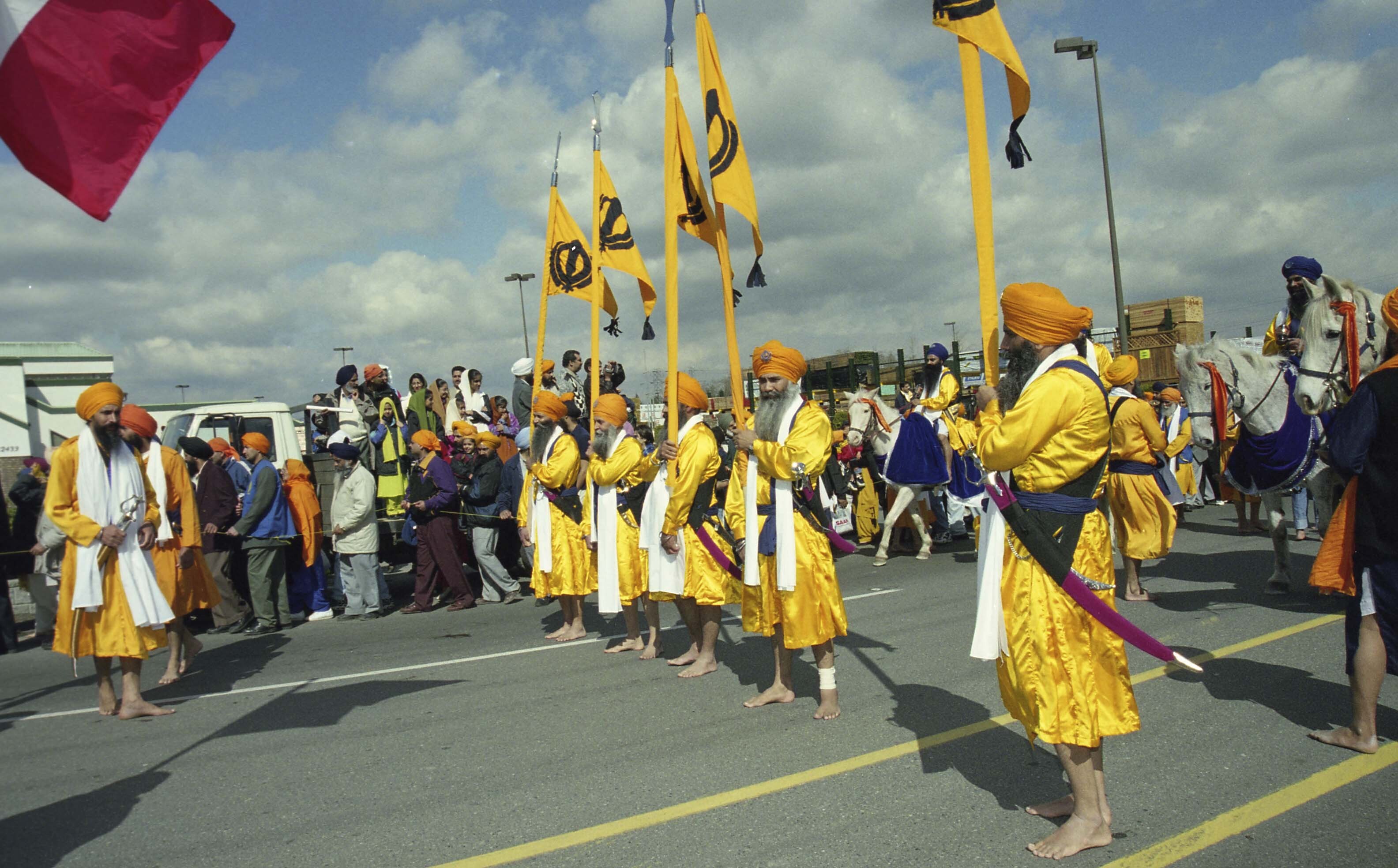
Photograph of a group of unidentified individuals, known as gursikhs, holding flags at the Vaisakhi Nagar Kirtan held in Surrey, British Columbia (B.C.).
Gursikhs, holding the nishan sahib flag, are Sikhs devoted to the Guru and the teachings of Sikhi. The Nishan Sahib is a Sikh holy triangular flag made of cotton or silk cloth, with a tassel at its end. The word, Nishan means symbol, and the flag is hoisted on a tall flagpole, outside most Gurdwaras (temples). The flagpole itself is covered with fabric, and ends with a two-edged dagger (khanda) on top. The emblem on the flag, which depicts a double-edged sword called a khanda (☬) in the centre, a chakkar which is circular, and flanked by two single-edged swords, or kirpans. A traditional symbol of the Khalsa Panth, the Nishan Sahib can be seen from far away, signifying the presence of Khalsa in the neighbourhood.
Vaisakhi is one of the most important festivals in Sikhi, marking the formation of the Khalsa in 1699 by the tenth guru, Guru Gobind Singh Ji. It is a time of renewal, gratitude, and unity, celebrated with processions, prayers, and acts of service. Beyond its significance in Sikh history, Vaisakhi is also a harvest festival in Punjab, observed with joy and thanksgiving. Additionally, Vaisakhi holds special significance for Hindus, as it marks the beginning of the solar new year and is celebrated in various regions of India under different names, such as Pohela Boishakh in Bengal and Puthandu in Tamil Nadu.
Gursikhs, holding the nishan sahib flag, are Sikhs devoted to the Guru and the teachings of Sikhi. The Nishan Sahib is a Sikh holy triangular flag made of cotton or silk cloth, with a tassel at its end. The word, Nishan means symbol, and the flag is hoisted on a tall flagpole, outside most Gurdwaras (temples). The flagpole itself is covered with fabric, and ends with a two-edged dagger (khanda) on top. The emblem on the flag, which depicts a double-edged sword called a khanda (☬) in the centre, a chakkar which is circular, and flanked by two single-edged swords, or kirpans. A traditional symbol of the Khalsa Panth, the Nishan Sahib can be seen from far away, signifying the presence of Khalsa in the neighbourhood.
Vaisakhi is one of the most important festivals in Sikhi, marking the formation of the Khalsa in 1699 by the tenth guru, Guru Gobind Singh Ji. It is a time of renewal, gratitude, and unity, celebrated with processions, prayers, and acts of service. Beyond its significance in Sikh history, Vaisakhi is also a harvest festival in Punjab, observed with joy and thanksgiving. Additionally, Vaisakhi holds special significance for Hindus, as it marks the beginning of the solar new year and is celebrated in various regions of India under different names, such as Pohela Boishakh in Bengal and Puthandu in Tamil Nadu.
Member of
Creator: Bodalia, Chandra
Description
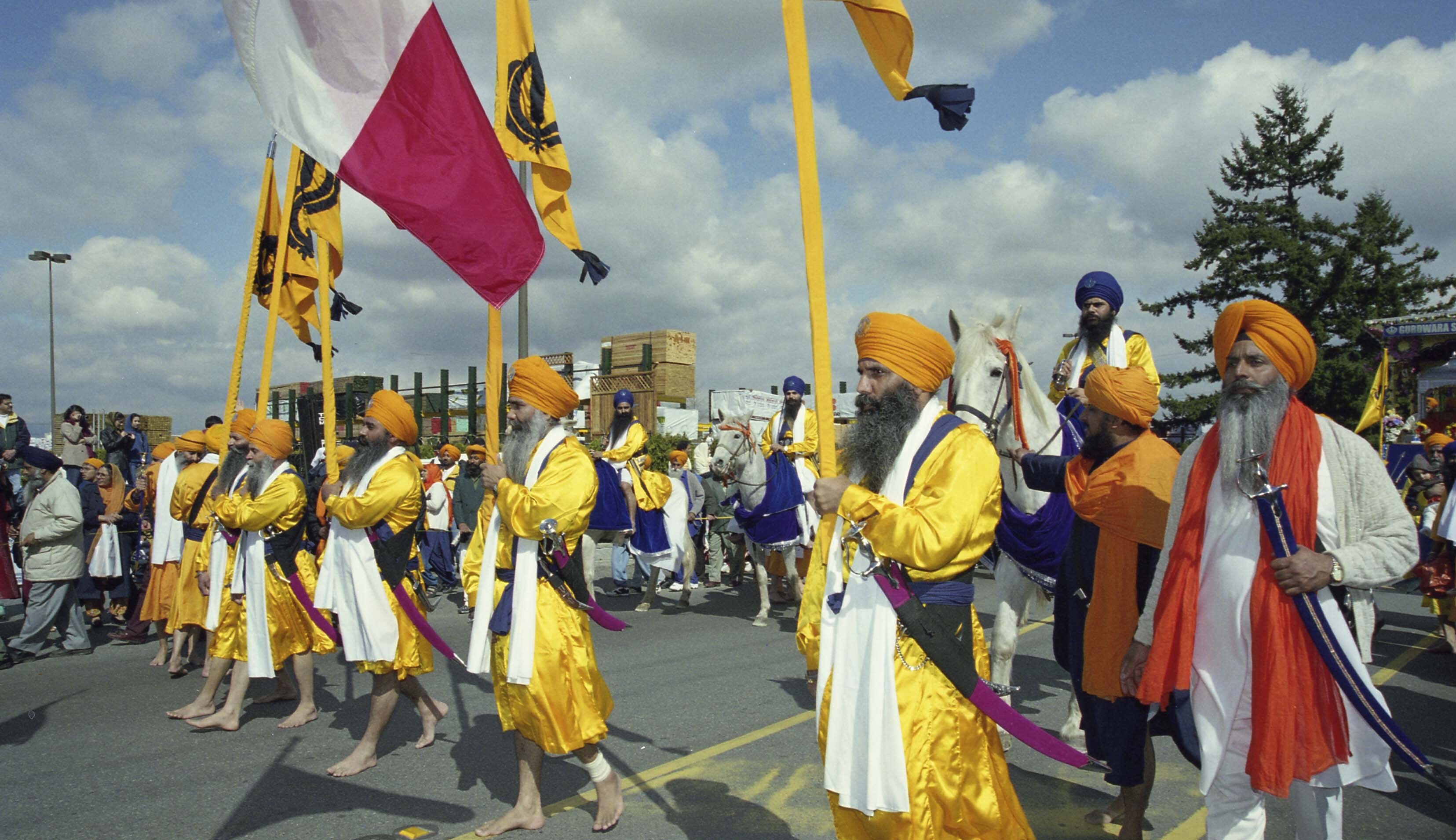
Photograph of a group of unidentified individuals, known as gursikhs, holding flags at the Vaisakhi Nagar Kirtan held in Surrey, British Columbia (B.C.).
Gursikhs, holding the nishan sahib flag, are Sikhs devoted to the Guru and the teachings of Sikhi. The Nishan Sahib is a Sikh holy triangular flag made of cotton or silk cloth, with a tassel at its end. The word, Nishan means symbol, and the flag is hoisted on a tall flagpole, outside most Gurdwaras (temples). The flagpole itself is covered with fabric, and ends with a two-edged dagger (khanda) on top. The emblem on the flag, which depicts a double-edged sword called a khanda (☬) in the centre, a chakkar which is circular, and flanked by two single-edged swords, or kirpans. A traditional symbol of the Khalsa Panth, the Nishan Sahib can be seen from far away, signifying the presence of Khalsa in the neighbourhood.
Vaisakhi is one of the most important festivals in Sikhi, marking the formation of the Khalsa in 1699 by the tenth guru, Guru Gobind Singh Ji. It is a time of renewal, gratitude, and unity, celebrated with processions, prayers, and acts of service. Beyond its significance in Sikh history, Vaisakhi is also a harvest festival in Punjab, observed with joy and thanksgiving. Additionally, Vaisakhi holds special significance for Hindus, as it marks the beginning of the solar new year and is celebrated in various regions of India under different names, such as Pohela Boishakh in Bengal and Puthandu in Tamil Nadu.
Gursikhs, holding the nishan sahib flag, are Sikhs devoted to the Guru and the teachings of Sikhi. The Nishan Sahib is a Sikh holy triangular flag made of cotton or silk cloth, with a tassel at its end. The word, Nishan means symbol, and the flag is hoisted on a tall flagpole, outside most Gurdwaras (temples). The flagpole itself is covered with fabric, and ends with a two-edged dagger (khanda) on top. The emblem on the flag, which depicts a double-edged sword called a khanda (☬) in the centre, a chakkar which is circular, and flanked by two single-edged swords, or kirpans. A traditional symbol of the Khalsa Panth, the Nishan Sahib can be seen from far away, signifying the presence of Khalsa in the neighbourhood.
Vaisakhi is one of the most important festivals in Sikhi, marking the formation of the Khalsa in 1699 by the tenth guru, Guru Gobind Singh Ji. It is a time of renewal, gratitude, and unity, celebrated with processions, prayers, and acts of service. Beyond its significance in Sikh history, Vaisakhi is also a harvest festival in Punjab, observed with joy and thanksgiving. Additionally, Vaisakhi holds special significance for Hindus, as it marks the beginning of the solar new year and is celebrated in various regions of India under different names, such as Pohela Boishakh in Bengal and Puthandu in Tamil Nadu.
Member of
Creator: Bodalia, Chandra
Description
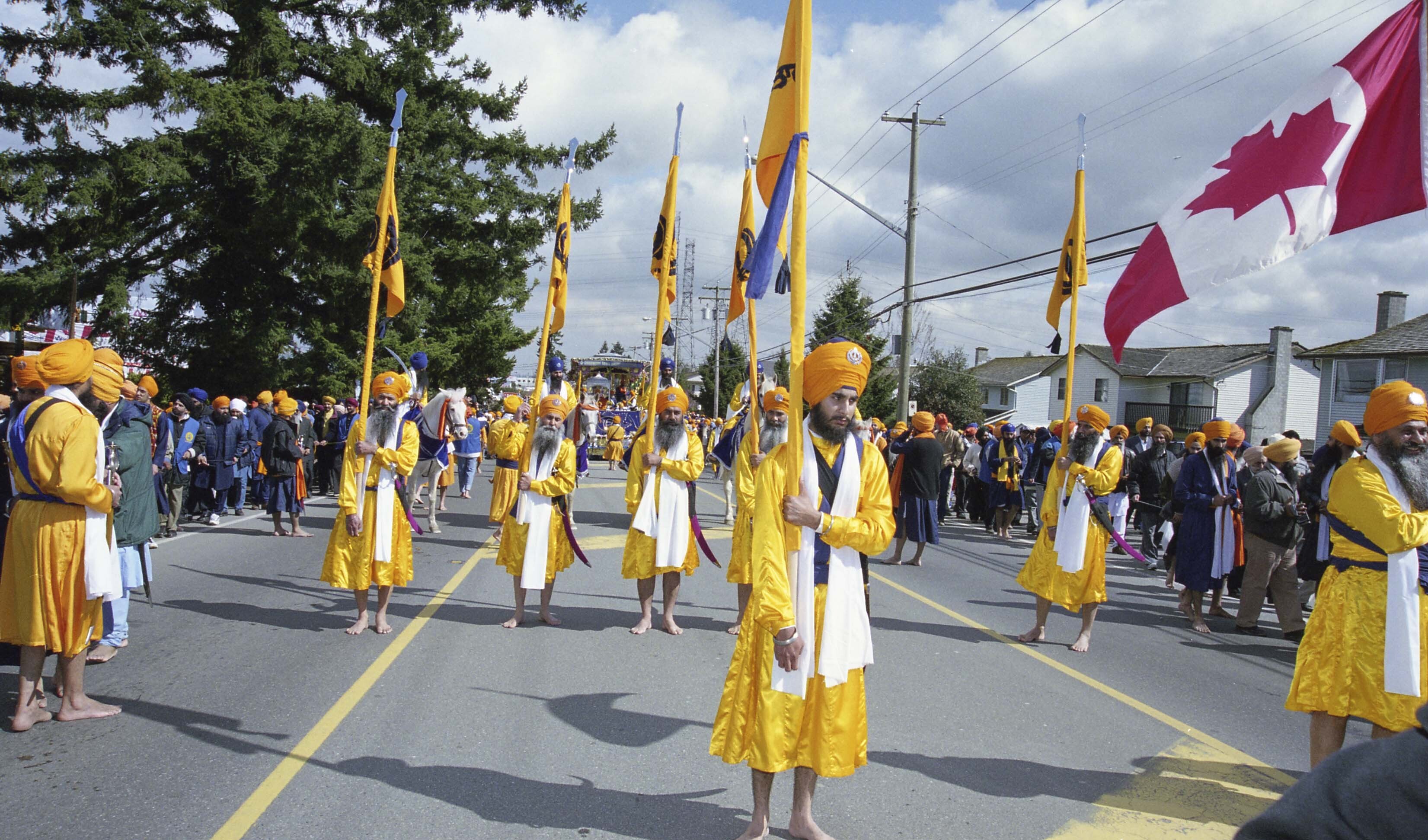
Photograph of a group of unidentified individuals, known as gursikhs, holding flags at the Vaisakhi Nagar Kirtan held in Surrey, British Columbia (B.C.).
Gursikhs, holding the Canadian and nishan sahib flag, are Sikhs devoted to the Guru and the teachings of Sikhi. The Nishan Sahib is a Sikh holy triangular flag made of cotton or silk cloth, with a tassel at its end. The word, Nishan means symbol, and the flag is hoisted on a tall flagpole, outside most Gurdwaras (temples). The flagpole itself is covered with fabric, and ends with a two-edged dagger (khanda) on top. The emblem on the flag, which depicts a double-edged sword called a khanda (☬) in the centre, a chakkar which is circular, and flanked by two single-edged swords, or kirpans. A traditional symbol of the Khalsa Panth, the Nishan Sahib can be seen from far away, signifying the presence of Khalsa in the neighbourhood.
Vaisakhi is one of the most important festivals in Sikhi, marking the formation of the Khalsa in 1699 by the tenth guru, Guru Gobind Singh Ji. It is a time of renewal, gratitude, and unity, celebrated with processions, prayers, and acts of service. Beyond its significance in Sikh history, Vaisakhi is also a harvest festival in Punjab, observed with joy and thanksgiving. Additionally, Vaisakhi holds special significance for Hindus, as it marks the beginning of the solar new year and is celebrated in various regions of India under different names, such as Pohela Boishakh in Bengal and Puthandu in Tamil Nadu.
Gursikhs, holding the Canadian and nishan sahib flag, are Sikhs devoted to the Guru and the teachings of Sikhi. The Nishan Sahib is a Sikh holy triangular flag made of cotton or silk cloth, with a tassel at its end. The word, Nishan means symbol, and the flag is hoisted on a tall flagpole, outside most Gurdwaras (temples). The flagpole itself is covered with fabric, and ends with a two-edged dagger (khanda) on top. The emblem on the flag, which depicts a double-edged sword called a khanda (☬) in the centre, a chakkar which is circular, and flanked by two single-edged swords, or kirpans. A traditional symbol of the Khalsa Panth, the Nishan Sahib can be seen from far away, signifying the presence of Khalsa in the neighbourhood.
Vaisakhi is one of the most important festivals in Sikhi, marking the formation of the Khalsa in 1699 by the tenth guru, Guru Gobind Singh Ji. It is a time of renewal, gratitude, and unity, celebrated with processions, prayers, and acts of service. Beyond its significance in Sikh history, Vaisakhi is also a harvest festival in Punjab, observed with joy and thanksgiving. Additionally, Vaisakhi holds special significance for Hindus, as it marks the beginning of the solar new year and is celebrated in various regions of India under different names, such as Pohela Boishakh in Bengal and Puthandu in Tamil Nadu.
Member of
Creator: Bodalia, Chandra
Description
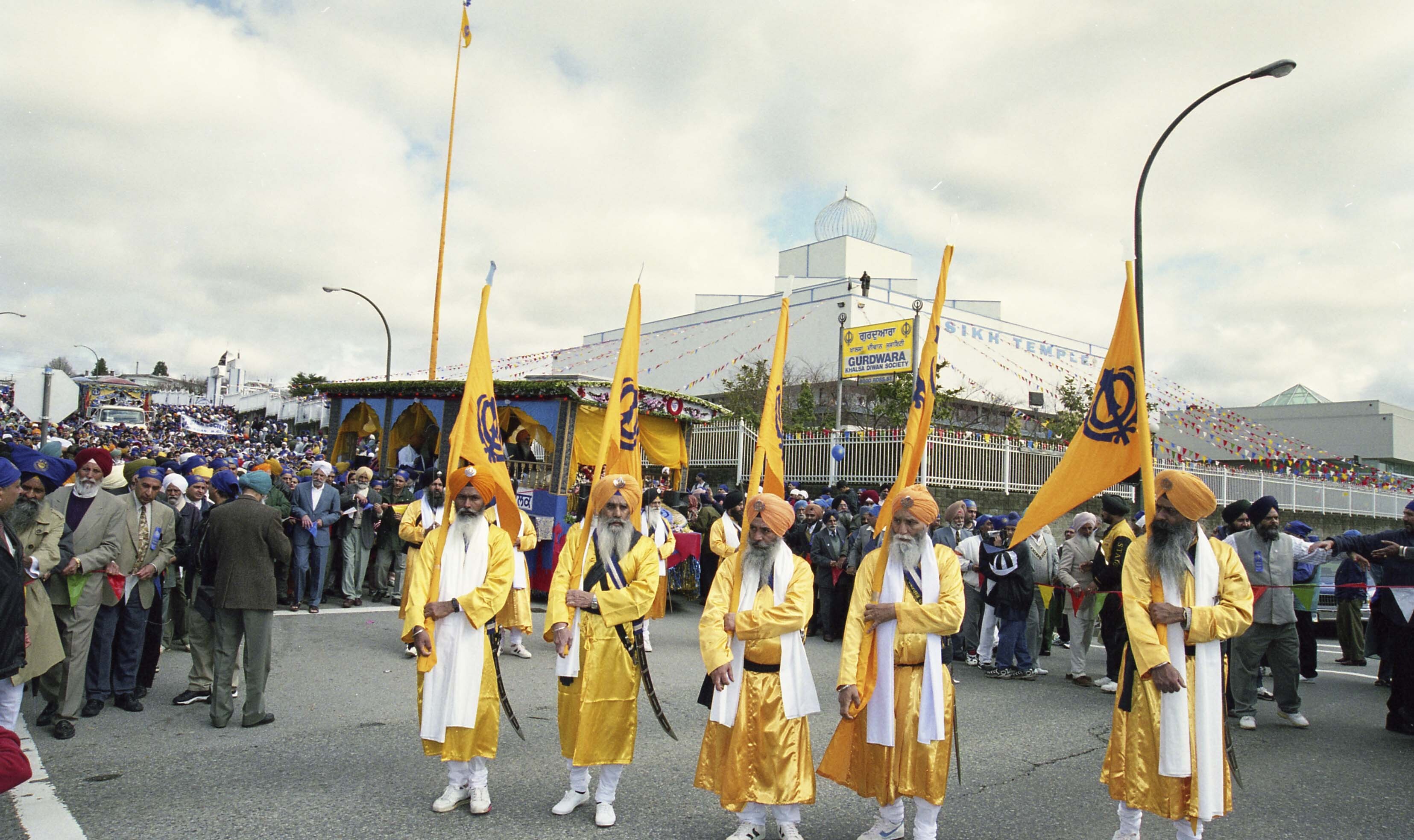
Photograph of a group of unidentified individuals, known as gursikhs, holding the nishan sahib flag outside the Sikh Temple (gurdwara) located in Vancouver, British Columbia (B.C.). Individuals had gathered at the Sikh Temple for the Vaisakhi Nagar Kirtan, an annual event hosted and organized by the Khalsa Diwan Society in Vancouver.
Gursikhs are Sikhs devoted to the Guru and the teachings of Sikhi. The Nishan Sahib is a Sikh holy triangular flag made of cotton or silk cloth, with a tassel at its end. The word, Nishan means symbol, and the flag is hoisted on a tall flagpole, outside most Gurdwaras (temples). The flagpole itself is covered with fabric, and ends with a two-edged dagger (khanda) on top. The emblem on the flag, which depicts a double-edged sword called a khanda (☬) in the centre, a chakkar which is circular, and flanked by two single-edged swords, or kirpans. A traditional symbol of the Khalsa Panth, the Nishan Sahib can be seen from far away, signifying the presence of Khalsa in the neighbourhood.
Vaisakhi is one of the most important festivals in Sikhi, marking the formation of the Khalsa in 1699 by the tenth guru, Guru Gobind Singh Ji. It is a time of renewal, gratitude, and unity, celebrated with processions, prayers, and acts of service. Beyond its significance in Sikh history, Vaisakhi is also a harvest festival in Punjab, observed with joy and thanksgiving. Additionally, Vaisakhi holds special significance for Hindus, as it marks the beginning of the solar new year and is celebrated in various regions of India under different names, such as Pohela Boishakh in Bengal and Puthandu in Tamil Nadu.
The Khalsa Diwan Society of Vancouver oversees the Vaisakhi celebrations in Vancouver. The Khalsa Diwan Society is a pioneer Sikh society, one of the oldest in Vancouver, formed on July 22, 1902 in British Columbia, Canada, formally established in 1906. In 1908, the Society purchased and built the first Sikh temple in Vancouver, which was located on West 2nd Avenue. This is believed to be the first Sikh temple in the whole of the American continent. This temple served the Sikh community until a new temple was occupied on April 25, 1970. The original temple was sold to build a bigger (present) temple located on Ross Street. The Khalsa Diwan Society has been a pioneer in raising Sikhi related issues and getting recognition for Sikhs in Canada. It continues to build a strong community based on Sikh values and principles. Every year the society organizes sports activities, including soccer and wrestling tournaments.
Gursikhs are Sikhs devoted to the Guru and the teachings of Sikhi. The Nishan Sahib is a Sikh holy triangular flag made of cotton or silk cloth, with a tassel at its end. The word, Nishan means symbol, and the flag is hoisted on a tall flagpole, outside most Gurdwaras (temples). The flagpole itself is covered with fabric, and ends with a two-edged dagger (khanda) on top. The emblem on the flag, which depicts a double-edged sword called a khanda (☬) in the centre, a chakkar which is circular, and flanked by two single-edged swords, or kirpans. A traditional symbol of the Khalsa Panth, the Nishan Sahib can be seen from far away, signifying the presence of Khalsa in the neighbourhood.
Vaisakhi is one of the most important festivals in Sikhi, marking the formation of the Khalsa in 1699 by the tenth guru, Guru Gobind Singh Ji. It is a time of renewal, gratitude, and unity, celebrated with processions, prayers, and acts of service. Beyond its significance in Sikh history, Vaisakhi is also a harvest festival in Punjab, observed with joy and thanksgiving. Additionally, Vaisakhi holds special significance for Hindus, as it marks the beginning of the solar new year and is celebrated in various regions of India under different names, such as Pohela Boishakh in Bengal and Puthandu in Tamil Nadu.
The Khalsa Diwan Society of Vancouver oversees the Vaisakhi celebrations in Vancouver. The Khalsa Diwan Society is a pioneer Sikh society, one of the oldest in Vancouver, formed on July 22, 1902 in British Columbia, Canada, formally established in 1906. In 1908, the Society purchased and built the first Sikh temple in Vancouver, which was located on West 2nd Avenue. This is believed to be the first Sikh temple in the whole of the American continent. This temple served the Sikh community until a new temple was occupied on April 25, 1970. The original temple was sold to build a bigger (present) temple located on Ross Street. The Khalsa Diwan Society has been a pioneer in raising Sikhi related issues and getting recognition for Sikhs in Canada. It continues to build a strong community based on Sikh values and principles. Every year the society organizes sports activities, including soccer and wrestling tournaments.
Member of
Creator: Bodalia, Chandra
Description
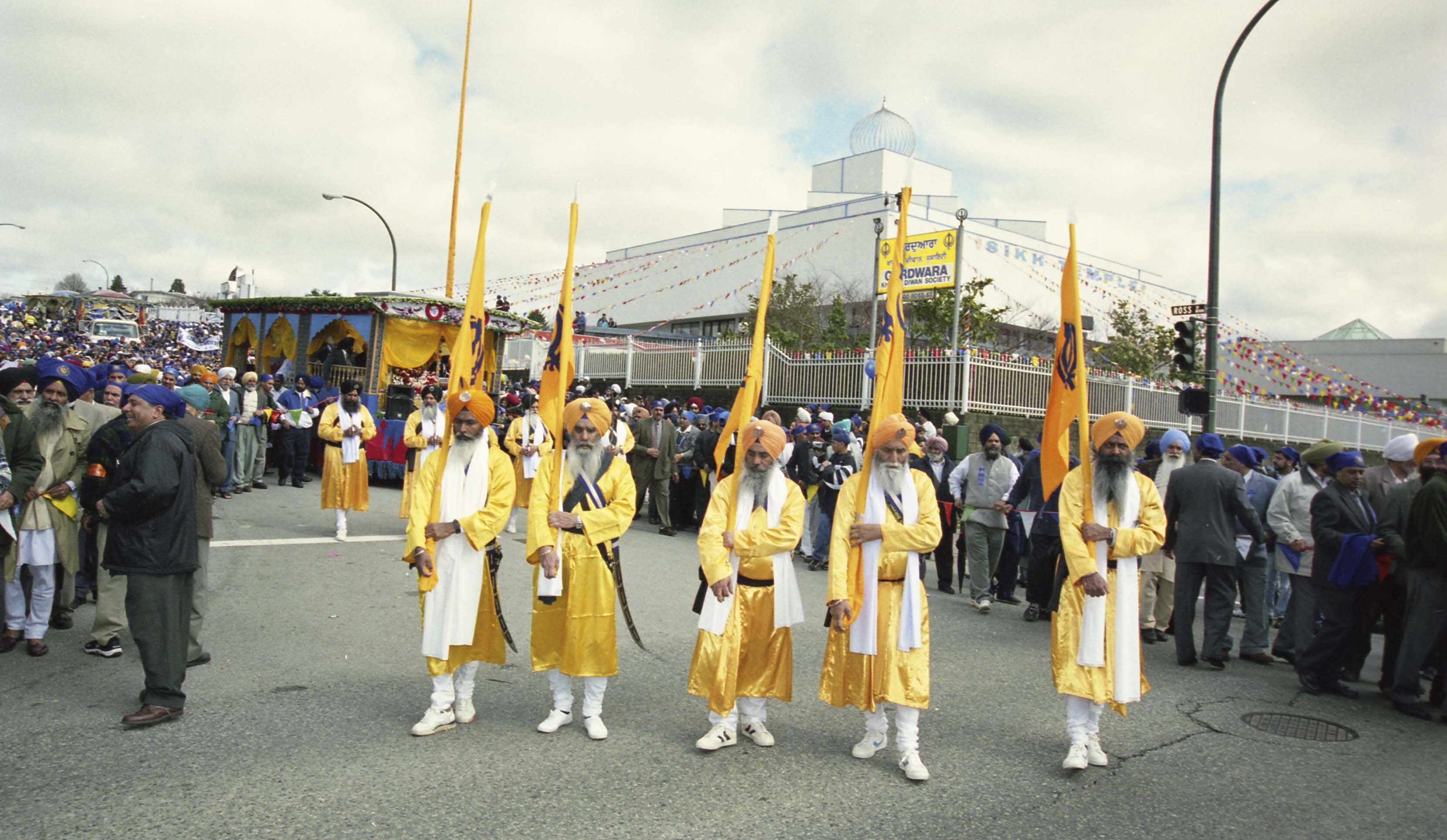
Photograph of a group of unidentified individuals, known as gursikhs, holding the nishan sahib flag outside the Sikh Temple (gurdwara) located in Vancouver, British Columbia (B.C.). Individuals had gathered at the Sikh Temple for the Vaisakhi Nagar Kirtan, an annual event hosted and organized by the Khalsa Diwan Society in Vancouver.
Gursikhs are Sikhs devoted to the Guru and the teachings of Sikhi. The Nishan Sahib is a Sikh holy triangular flag made of cotton or silk cloth, with a tassel at its end. The word, Nishan means symbol, and the flag is hoisted on a tall flagpole, outside most Gurdwaras (temples). The flagpole itself is covered with fabric, and ends with a two-edged dagger (khanda) on top. The emblem on the flag, which depicts a double-edged sword called a khanda (☬) in the centre, a chakkar which is circular, and flanked by two single-edged swords, or kirpans. A traditional symbol of the Khalsa Panth, the Nishan Sahib can be seen from far away, signifying the presence of Khalsa in the neighbourhood.
Vaisakhi is one of the most important festivals in Sikhi, marking the formation of the Khalsa in 1699 by the tenth guru, Guru Gobind Singh Ji. It is a time of renewal, gratitude, and unity, celebrated with processions, prayers, and acts of service. Beyond its significance in Sikh history, Vaisakhi is also a harvest festival in Punjab, observed with joy and thanksgiving. Additionally, Vaisakhi holds special significance for Hindus, as it marks the beginning of the solar new year and is celebrated in various regions of India under different names, such as Pohela Boishakh in Bengal and Puthandu in Tamil Nadu.
The Khalsa Diwan Society of Vancouver oversees the Vaisakhi celebrations in Vancouver. The Khalsa Diwan Society is a pioneer Sikh society, one of the oldest in Vancouver, formed on July 22, 1902 in British Columbia, Canada, formally established in 1906. In 1908, the Society purchased and built the first Sikh temple in Vancouver, which was located on West 2nd Avenue. This is believed to be the first Sikh temple in the whole of the American continent. This temple served the Sikh community until a new temple was occupied on April 25, 1970. The original temple was sold to build a bigger (present) temple located on Ross Street. The Khalsa Diwan Society has been a pioneer in raising Sikhi related issues and getting recognition for Sikhs in Canada. It continues to build a strong community based on Sikh values and principles. Every year the society organizes sports activities, including soccer and wrestling tournaments.
Gursikhs are Sikhs devoted to the Guru and the teachings of Sikhi. The Nishan Sahib is a Sikh holy triangular flag made of cotton or silk cloth, with a tassel at its end. The word, Nishan means symbol, and the flag is hoisted on a tall flagpole, outside most Gurdwaras (temples). The flagpole itself is covered with fabric, and ends with a two-edged dagger (khanda) on top. The emblem on the flag, which depicts a double-edged sword called a khanda (☬) in the centre, a chakkar which is circular, and flanked by two single-edged swords, or kirpans. A traditional symbol of the Khalsa Panth, the Nishan Sahib can be seen from far away, signifying the presence of Khalsa in the neighbourhood.
Vaisakhi is one of the most important festivals in Sikhi, marking the formation of the Khalsa in 1699 by the tenth guru, Guru Gobind Singh Ji. It is a time of renewal, gratitude, and unity, celebrated with processions, prayers, and acts of service. Beyond its significance in Sikh history, Vaisakhi is also a harvest festival in Punjab, observed with joy and thanksgiving. Additionally, Vaisakhi holds special significance for Hindus, as it marks the beginning of the solar new year and is celebrated in various regions of India under different names, such as Pohela Boishakh in Bengal and Puthandu in Tamil Nadu.
The Khalsa Diwan Society of Vancouver oversees the Vaisakhi celebrations in Vancouver. The Khalsa Diwan Society is a pioneer Sikh society, one of the oldest in Vancouver, formed on July 22, 1902 in British Columbia, Canada, formally established in 1906. In 1908, the Society purchased and built the first Sikh temple in Vancouver, which was located on West 2nd Avenue. This is believed to be the first Sikh temple in the whole of the American continent. This temple served the Sikh community until a new temple was occupied on April 25, 1970. The original temple was sold to build a bigger (present) temple located on Ross Street. The Khalsa Diwan Society has been a pioneer in raising Sikhi related issues and getting recognition for Sikhs in Canada. It continues to build a strong community based on Sikh values and principles. Every year the society organizes sports activities, including soccer and wrestling tournaments.