
India Mahila Association
Member of
Creator: Bodalia, Chandra
Description
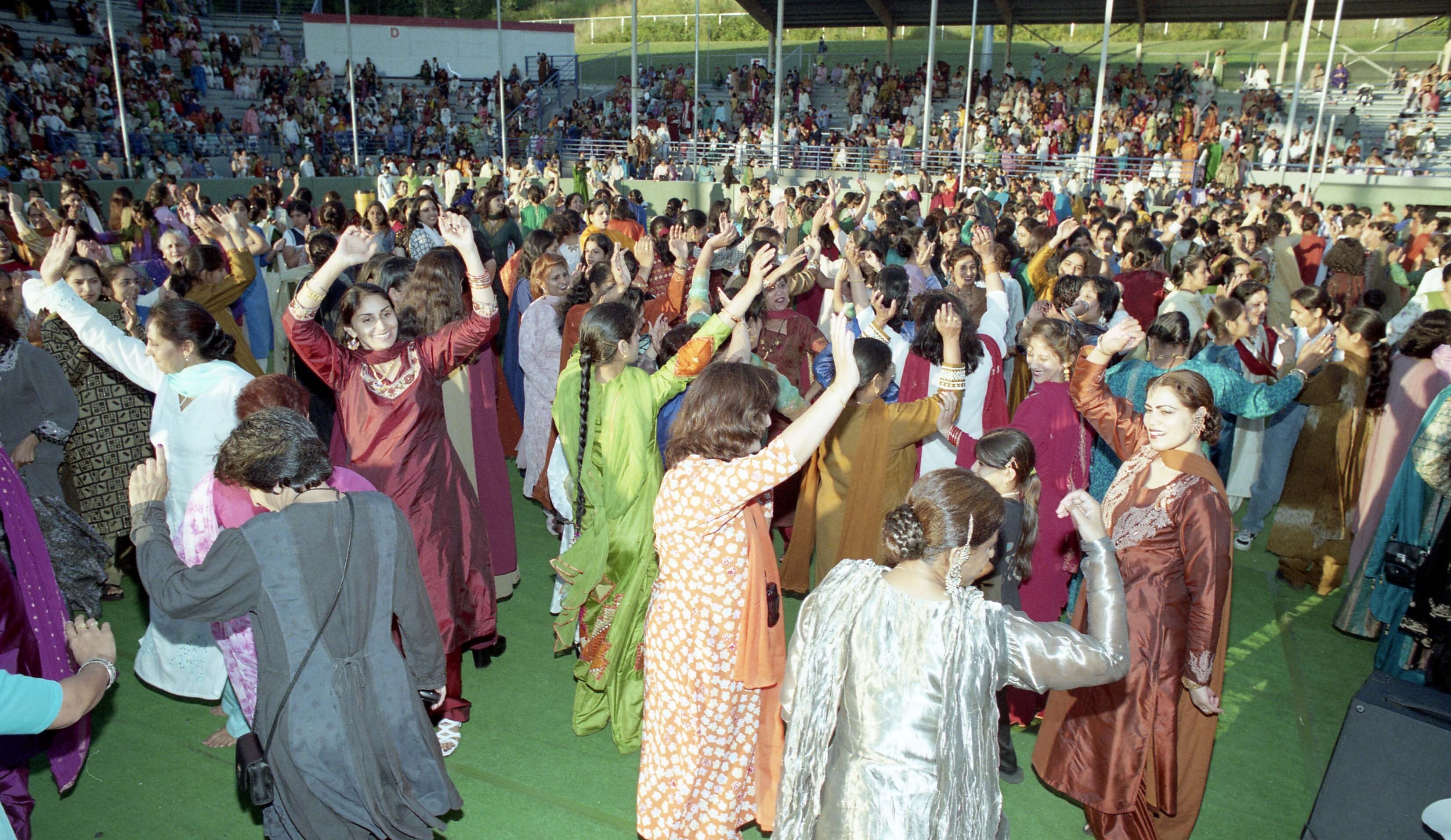
Photograph of a crowd of unidentified individuals dancing at a Teeyan (Teej) festival celebration hosted by the India Mahila Association[?] on August 2, 1998[?]. The event was held in Cloverdale, in Surrey, British Columbia (B.C.).
Teeyan, also known as Teej, is a festival observed primarily by women in the northern regions of India, including Punjab, Rajasthan, Uttar Pradesh, Bihar, Odisha, and Madhya Pradesh. It takes place annually during the months of July or August, marking the beginning of the monsoon season. The festival is associated with religious observance and social gathering, particularly among newly married and unmarried women. Participants celebrate by adorning themselves in traditional attire and taking part in rituals dedicated to Goddess Parvati. The festival involves prayers for the well-being and longevity of husbands or future spouses and includes regional customs that vary by state.
The India Mahila Association (IMA) is a non-profit, volunteer-driven organization established in 1973 to support and empower women of South Asian descent in Canada. Open to women of all backgrounds, IMA focuses on advocacy, education, and community engagement while addressing issues such as gender equality, violence, and discrimination. The organization operates without external funding and has created an endowment fund with the Vancouver Foundation to sustain its mission. For over 50 years, IMA has provided support, resources, and a platform for women to connect and uplift one another.
Teeyan, also known as Teej, is a festival observed primarily by women in the northern regions of India, including Punjab, Rajasthan, Uttar Pradesh, Bihar, Odisha, and Madhya Pradesh. It takes place annually during the months of July or August, marking the beginning of the monsoon season. The festival is associated with religious observance and social gathering, particularly among newly married and unmarried women. Participants celebrate by adorning themselves in traditional attire and taking part in rituals dedicated to Goddess Parvati. The festival involves prayers for the well-being and longevity of husbands or future spouses and includes regional customs that vary by state.
The India Mahila Association (IMA) is a non-profit, volunteer-driven organization established in 1973 to support and empower women of South Asian descent in Canada. Open to women of all backgrounds, IMA focuses on advocacy, education, and community engagement while addressing issues such as gender equality, violence, and discrimination. The organization operates without external funding and has created an endowment fund with the Vancouver Foundation to sustain its mission. For over 50 years, IMA has provided support, resources, and a platform for women to connect and uplift one another.
Member of
Creator: Bodalia, Chandra
Description
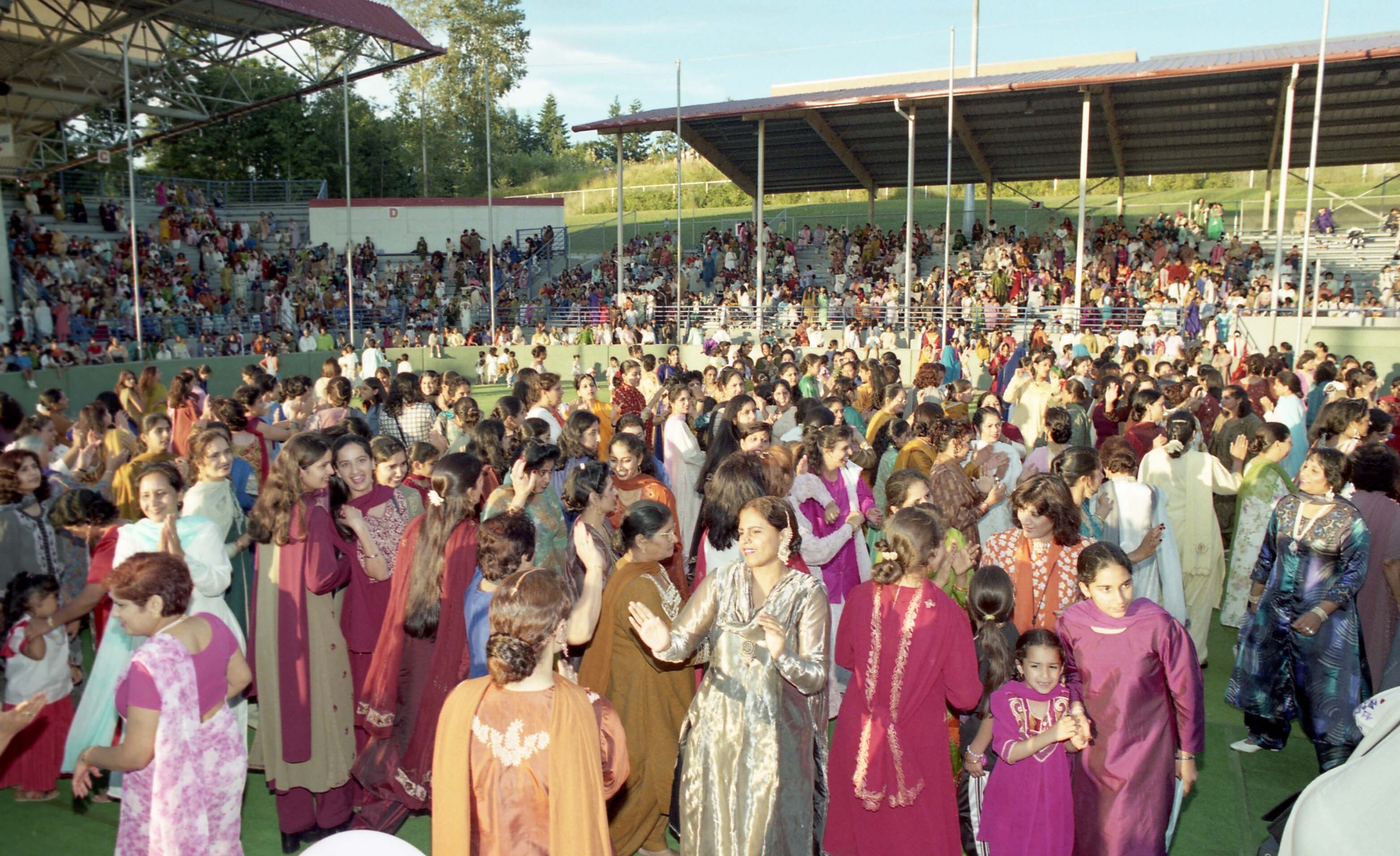
Photograph of a crowd of unidentified individuals dancing at a Teeyan (Teej) festival celebration hosted by the India Mahila Association[?] on August 2, 1998[?]. The event was held in Cloverdale, in Surrey, British Columbia (B.C.).
Teeyan, also known as Teej, is a festival observed primarily by women in the northern regions of India, including Punjab, Rajasthan, Uttar Pradesh, Bihar, Odisha, and Madhya Pradesh. It takes place annually during the months of July or August, marking the beginning of the monsoon season. The festival is associated with religious observance and social gathering, particularly among newly married and unmarried women. Participants celebrate by adorning themselves in traditional attire and taking part in rituals dedicated to Goddess Parvati. The festival involves prayers for the well-being and longevity of husbands or future spouses and includes regional customs that vary by state.
The India Mahila Association (IMA) is a non-profit, volunteer-driven organization established in 1973 to support and empower women of South Asian descent in Canada. Open to women of all backgrounds, IMA focuses on advocacy, education, and community engagement while addressing issues such as gender equality, violence, and discrimination. The organization operates without external funding and has created an endowment fund with the Vancouver Foundation to sustain its mission. For over 50 years, IMA has provided support, resources, and a platform for women to connect and uplift one another.
Teeyan, also known as Teej, is a festival observed primarily by women in the northern regions of India, including Punjab, Rajasthan, Uttar Pradesh, Bihar, Odisha, and Madhya Pradesh. It takes place annually during the months of July or August, marking the beginning of the monsoon season. The festival is associated with religious observance and social gathering, particularly among newly married and unmarried women. Participants celebrate by adorning themselves in traditional attire and taking part in rituals dedicated to Goddess Parvati. The festival involves prayers for the well-being and longevity of husbands or future spouses and includes regional customs that vary by state.
The India Mahila Association (IMA) is a non-profit, volunteer-driven organization established in 1973 to support and empower women of South Asian descent in Canada. Open to women of all backgrounds, IMA focuses on advocacy, education, and community engagement while addressing issues such as gender equality, violence, and discrimination. The organization operates without external funding and has created an endowment fund with the Vancouver Foundation to sustain its mission. For over 50 years, IMA has provided support, resources, and a platform for women to connect and uplift one another.
Member of
Creator: Bodalia, Chandra
Description
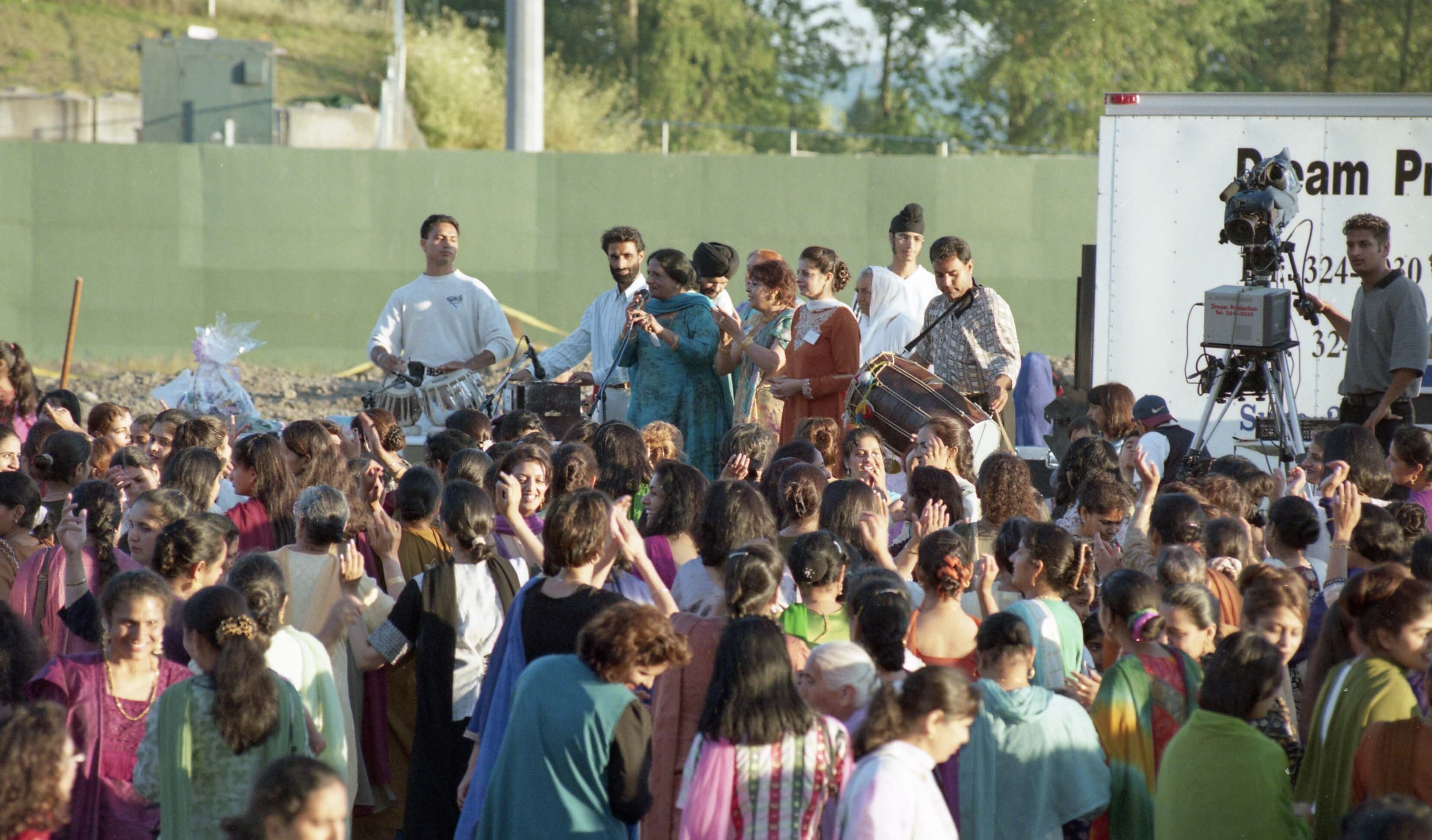
Photograph of Surinder Kaur and a group of unidentified individuals performing folk songs onstage at a Teeyan (Teej) festival celebration hosted by the India Mahila Association[?] on August 2, 1998[?]. The event was held in Cloverdale, in Surrey, British Columbia (B.C.).
Surinder Kaur (November 25, 1929 - June 14, 2006) was a Panjabi folk singer, one of the most popular folk singers of the gramophone age. She was born in Lahore, the capital of what was then the undivided state of Panjab, although after the partition in 1947, Kaur moved to Delhi with her parents. Kaur had a rigorous classical musical training under Inayat Husain, a Muslim, and Pandit Mani Parshad, a Hindu. No other popular contemporary Panjabi singer, except Nusrat Fateh Ali, mastered the nuances of the Indian musical scale to the same extent. Kaur gave her first live performance at the age of 13 in August 1943 and the following year made her first record, along with her sister Parkash Kaur. Apart from folk songs, Kaur sang Muslim Sufi Panjabi kafis and lyrics.
Teeyan, also known as Teej, is a festival observed primarily by women in the northern regions of India, including Punjab, Rajasthan, Uttar Pradesh, Bihar, Odisha, and Madhya Pradesh. It takes place annually during the months of July or August, marking the beginning of the monsoon season. The festival is associated with religious observance and social gathering, particularly among newly married and unmarried women. Participants celebrate by adorning themselves in traditional attire and taking part in rituals dedicated to Goddess Parvati. The festival involves prayers for the well-being and longevity of husbands or future spouses and includes regional customs that vary by state.
The India Mahila Association (IMA) is a non-profit, volunteer-driven organization established in 1973 to support and empower women of South Asian descent in Canada. Open to women of all backgrounds, IMA focuses on advocacy, education, and community engagement while addressing issues such as gender equality, violence, and discrimination. The organization operates without external funding and has created an endowment fund with the Vancouver Foundation to sustain its mission. For over 50 years, IMA has provided support, resources, and a platform for women to connect and uplift one another.
Surinder Kaur (November 25, 1929 - June 14, 2006) was a Panjabi folk singer, one of the most popular folk singers of the gramophone age. She was born in Lahore, the capital of what was then the undivided state of Panjab, although after the partition in 1947, Kaur moved to Delhi with her parents. Kaur had a rigorous classical musical training under Inayat Husain, a Muslim, and Pandit Mani Parshad, a Hindu. No other popular contemporary Panjabi singer, except Nusrat Fateh Ali, mastered the nuances of the Indian musical scale to the same extent. Kaur gave her first live performance at the age of 13 in August 1943 and the following year made her first record, along with her sister Parkash Kaur. Apart from folk songs, Kaur sang Muslim Sufi Panjabi kafis and lyrics.
Teeyan, also known as Teej, is a festival observed primarily by women in the northern regions of India, including Punjab, Rajasthan, Uttar Pradesh, Bihar, Odisha, and Madhya Pradesh. It takes place annually during the months of July or August, marking the beginning of the monsoon season. The festival is associated with religious observance and social gathering, particularly among newly married and unmarried women. Participants celebrate by adorning themselves in traditional attire and taking part in rituals dedicated to Goddess Parvati. The festival involves prayers for the well-being and longevity of husbands or future spouses and includes regional customs that vary by state.
The India Mahila Association (IMA) is a non-profit, volunteer-driven organization established in 1973 to support and empower women of South Asian descent in Canada. Open to women of all backgrounds, IMA focuses on advocacy, education, and community engagement while addressing issues such as gender equality, violence, and discrimination. The organization operates without external funding and has created an endowment fund with the Vancouver Foundation to sustain its mission. For over 50 years, IMA has provided support, resources, and a platform for women to connect and uplift one another.
Member of
Creator: Bodalia, Chandra
Description
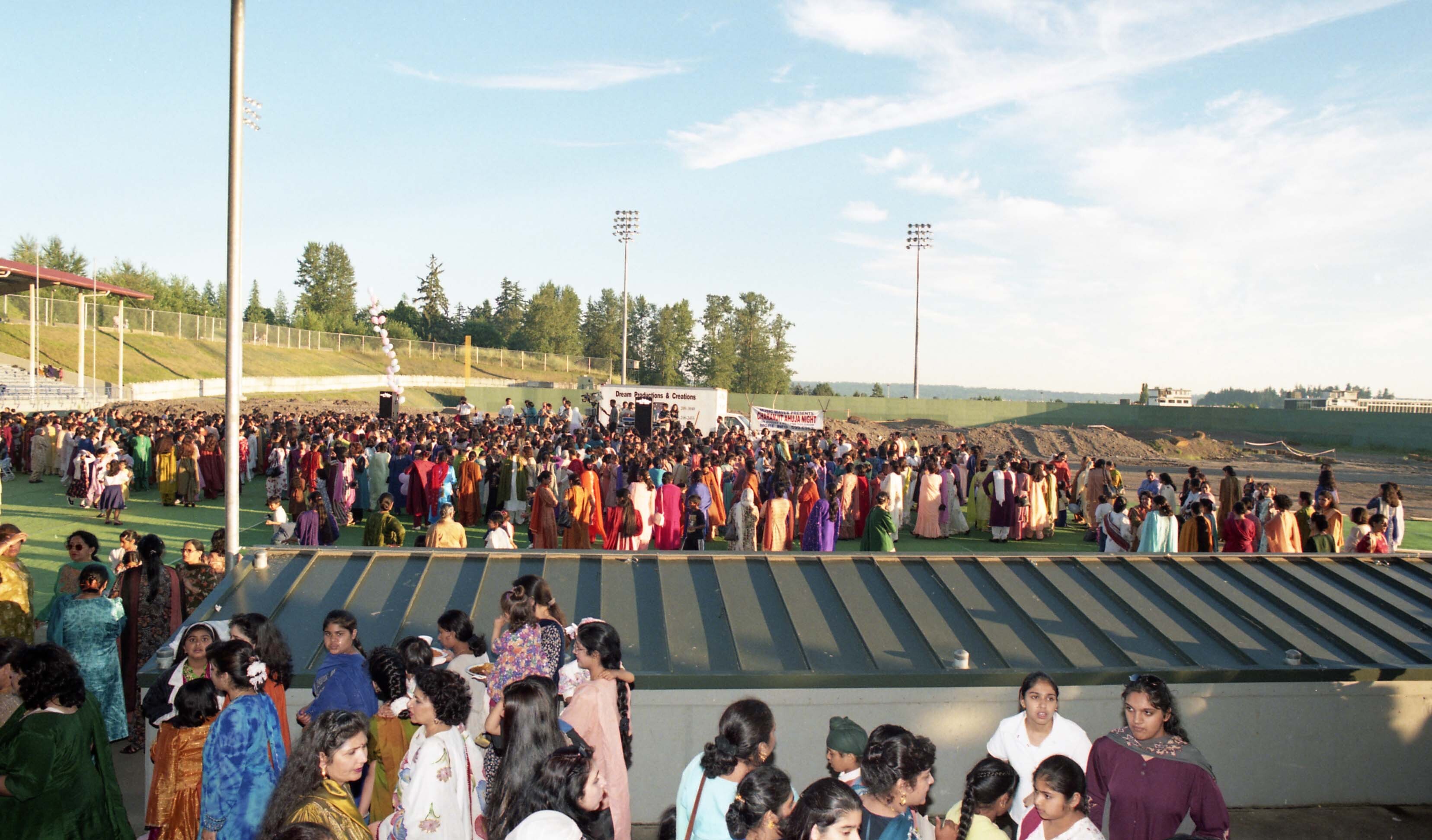
Photograph of the crowd at a Teeyan (Teej) festival celebration hosted by the India Mahila Association[?] on August 2, 1998[?]. The event was held in Cloverdale, in Surrey, British Columbia (B.C.). A banner advertising another event called "Charanjit Ahuja Night" organized by Music Waves Productions Ltd., is displayed alongside a production truck of Dream Productions and Creations.
Teeyan, also known as Teej, is a festival observed primarily by women in the northern regions of India, including Punjab, Rajasthan, Uttar Pradesh, Bihar, Odisha, and Madhya Pradesh. It takes place annually during the months of July or August, marking the beginning of the monsoon season. The festival is associated with religious observance and social gathering, particularly among newly married and unmarried women. Participants celebrate by adorning themselves in traditional attire and taking part in rituals dedicated to Goddess Parvati. The festival involves prayers for the well-being and longevity of husbands or future spouses and includes regional customs that vary by state.
The India Mahila Association (IMA) is a non-profit, volunteer-driven organization established in 1973 to support and empower women of South Asian descent in Canada. Open to women of all backgrounds, IMA focuses on advocacy, education, and community engagement while addressing issues such as gender equality, violence, and discrimination. The organization operates without external funding and has created an endowment fund with the Vancouver Foundation to sustain its mission. For over 50 years, IMA has provided support, resources, and a platform for women to connect and uplift one another.
Music Waves, founded in 1991, is a Punjabi music company established to provide a platform for emerging Punjabi singers. The company has been involved in the promotion and distribution of albums by various artists who later achieved recognition in the industry.
Teeyan, also known as Teej, is a festival observed primarily by women in the northern regions of India, including Punjab, Rajasthan, Uttar Pradesh, Bihar, Odisha, and Madhya Pradesh. It takes place annually during the months of July or August, marking the beginning of the monsoon season. The festival is associated with religious observance and social gathering, particularly among newly married and unmarried women. Participants celebrate by adorning themselves in traditional attire and taking part in rituals dedicated to Goddess Parvati. The festival involves prayers for the well-being and longevity of husbands or future spouses and includes regional customs that vary by state.
The India Mahila Association (IMA) is a non-profit, volunteer-driven organization established in 1973 to support and empower women of South Asian descent in Canada. Open to women of all backgrounds, IMA focuses on advocacy, education, and community engagement while addressing issues such as gender equality, violence, and discrimination. The organization operates without external funding and has created an endowment fund with the Vancouver Foundation to sustain its mission. For over 50 years, IMA has provided support, resources, and a platform for women to connect and uplift one another.
Music Waves, founded in 1991, is a Punjabi music company established to provide a platform for emerging Punjabi singers. The company has been involved in the promotion and distribution of albums by various artists who later achieved recognition in the industry.
Member of
Creator: Bodalia, Chandra
Description
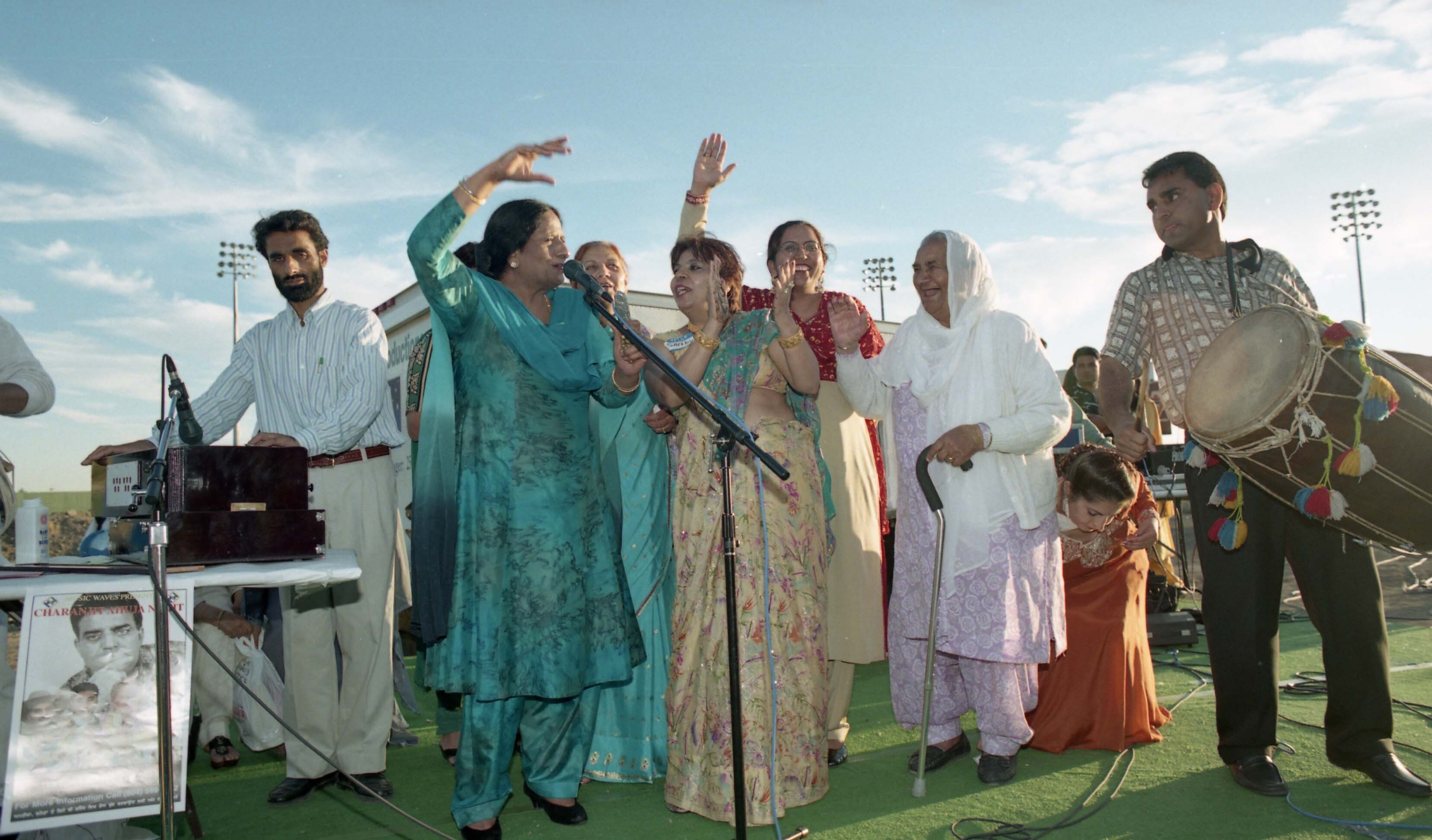
Photograph of Surinder Kaur and a group of unidentified individuals performing folk songs onstage at a Teeyan (Teej) festival celebration hosted by the India Mahila Association[?] on August 2, 1998[?]. The event was held in Cloverdale, in Surrey, British Columbia (B.C.).
Surinder Kaur (November 25, 1929 - June 14, 2006) was a Panjabi folk singer, one of the most popular folk singers of the gramophone age. She was born in Lahore, the capital of what was then the undivided state of Panjab, although after the partition in 1947, Kaur moved to Delhi with her parents. Kaur had a rigorous classical musical training under Inayat Husain, a Muslim, and Pandit Mani Parshad, a Hindu. No other popular contemporary Panjabi singer, except Nusrat Fateh Ali, mastered the nuances of the Indian musical scale to the same extent. Kaur gave her first live performance at the age of 13 in August 1943 and the following year made her first record, along with her sister Parkash Kaur. Apart from folk songs, Kaur sang Muslim Sufi Panjabi kafis and lyrics.
Teeyan, also known as Teej, is a festival observed primarily by women in the northern regions of India, including Punjab, Rajasthan, Uttar Pradesh, Bihar, Odisha, and Madhya Pradesh. It takes place annually during the months of July or August, marking the beginning of the monsoon season. The festival is associated with religious observance and social gathering, particularly among newly married and unmarried women. Participants celebrate by adorning themselves in traditional attire and taking part in rituals dedicated to Goddess Parvati. The festival involves prayers for the well-being and longevity of husbands or future spouses and includes regional customs that vary by state.
The India Mahila Association (IMA) is a non-profit, volunteer-driven organization established in 1973 to support and empower women of South Asian descent in Canada. Open to women of all backgrounds, IMA focuses on advocacy, education, and community engagement while addressing issues such as gender equality, violence, and discrimination. The organization operates without external funding and has created an endowment fund with the Vancouver Foundation to sustain its mission. For over 50 years, IMA has provided support, resources, and a platform for women to connect and uplift one another.
Surinder Kaur (November 25, 1929 - June 14, 2006) was a Panjabi folk singer, one of the most popular folk singers of the gramophone age. She was born in Lahore, the capital of what was then the undivided state of Panjab, although after the partition in 1947, Kaur moved to Delhi with her parents. Kaur had a rigorous classical musical training under Inayat Husain, a Muslim, and Pandit Mani Parshad, a Hindu. No other popular contemporary Panjabi singer, except Nusrat Fateh Ali, mastered the nuances of the Indian musical scale to the same extent. Kaur gave her first live performance at the age of 13 in August 1943 and the following year made her first record, along with her sister Parkash Kaur. Apart from folk songs, Kaur sang Muslim Sufi Panjabi kafis and lyrics.
Teeyan, also known as Teej, is a festival observed primarily by women in the northern regions of India, including Punjab, Rajasthan, Uttar Pradesh, Bihar, Odisha, and Madhya Pradesh. It takes place annually during the months of July or August, marking the beginning of the monsoon season. The festival is associated with religious observance and social gathering, particularly among newly married and unmarried women. Participants celebrate by adorning themselves in traditional attire and taking part in rituals dedicated to Goddess Parvati. The festival involves prayers for the well-being and longevity of husbands or future spouses and includes regional customs that vary by state.
The India Mahila Association (IMA) is a non-profit, volunteer-driven organization established in 1973 to support and empower women of South Asian descent in Canada. Open to women of all backgrounds, IMA focuses on advocacy, education, and community engagement while addressing issues such as gender equality, violence, and discrimination. The organization operates without external funding and has created an endowment fund with the Vancouver Foundation to sustain its mission. For over 50 years, IMA has provided support, resources, and a platform for women to connect and uplift one another.
Member of
Creator: Bodalia, Chandra
Description
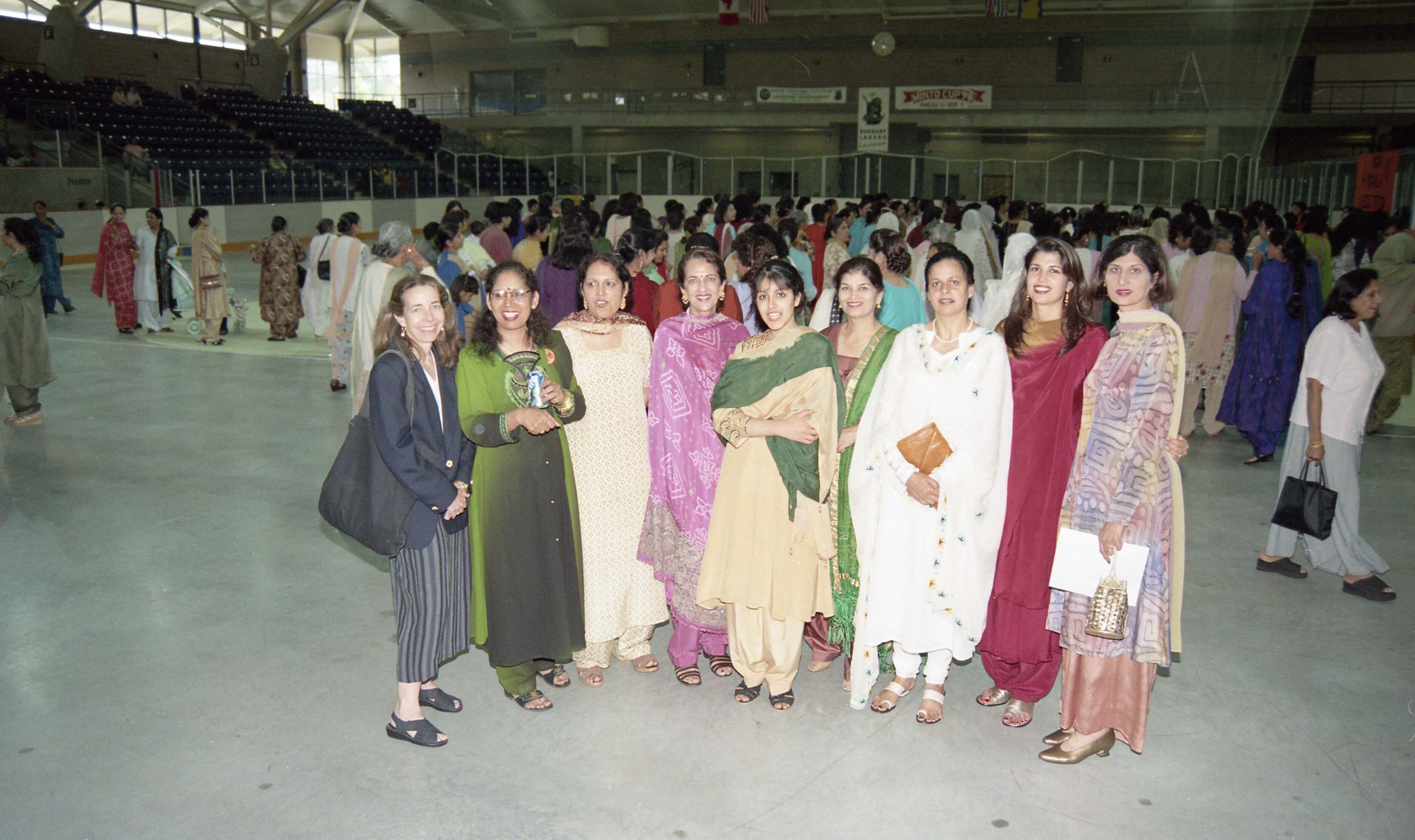
Photograph of a group of unidentified individuals at a Teeyan (Teej) festival celebration hosted by the India Mahila Association[?] on August 2, 1998[?]. The event was held in Cloverdale, in Surrey, British Columbia (B.C.).
Teeyan, also known as Teej, is a festival observed primarily by women in the northern regions of India, including Punjab, Rajasthan, Uttar Pradesh, Bihar, Odisha, and Madhya Pradesh. It takes place annually during the months of July or August, marking the beginning of the monsoon season. The festival is associated with religious observance and social gathering, particularly among newly married and unmarried women. Participants celebrate by adorning themselves in traditional attire and taking part in rituals dedicated to Goddess Parvati. The festival involves prayers for the well-being and longevity of husbands or future spouses and includes regional customs that vary by state.
The India Mahila Association (IMA) is a non-profit, volunteer-driven organization established in 1973 to support and empower women of South Asian descent in Canada. Open to women of all backgrounds, IMA focuses on advocacy, education, and community engagement while addressing issues such as gender equality, violence, and discrimination. The organization operates without external funding and has created an endowment fund with the Vancouver Foundation to sustain its mission. For over 50 years, IMA has provided support, resources, and a platform for women to connect and uplift one another.
Teeyan, also known as Teej, is a festival observed primarily by women in the northern regions of India, including Punjab, Rajasthan, Uttar Pradesh, Bihar, Odisha, and Madhya Pradesh. It takes place annually during the months of July or August, marking the beginning of the monsoon season. The festival is associated with religious observance and social gathering, particularly among newly married and unmarried women. Participants celebrate by adorning themselves in traditional attire and taking part in rituals dedicated to Goddess Parvati. The festival involves prayers for the well-being and longevity of husbands or future spouses and includes regional customs that vary by state.
The India Mahila Association (IMA) is a non-profit, volunteer-driven organization established in 1973 to support and empower women of South Asian descent in Canada. Open to women of all backgrounds, IMA focuses on advocacy, education, and community engagement while addressing issues such as gender equality, violence, and discrimination. The organization operates without external funding and has created an endowment fund with the Vancouver Foundation to sustain its mission. For over 50 years, IMA has provided support, resources, and a platform for women to connect and uplift one another.