
Campbell, Gordon
Creator: Chandra Bodalia
Description
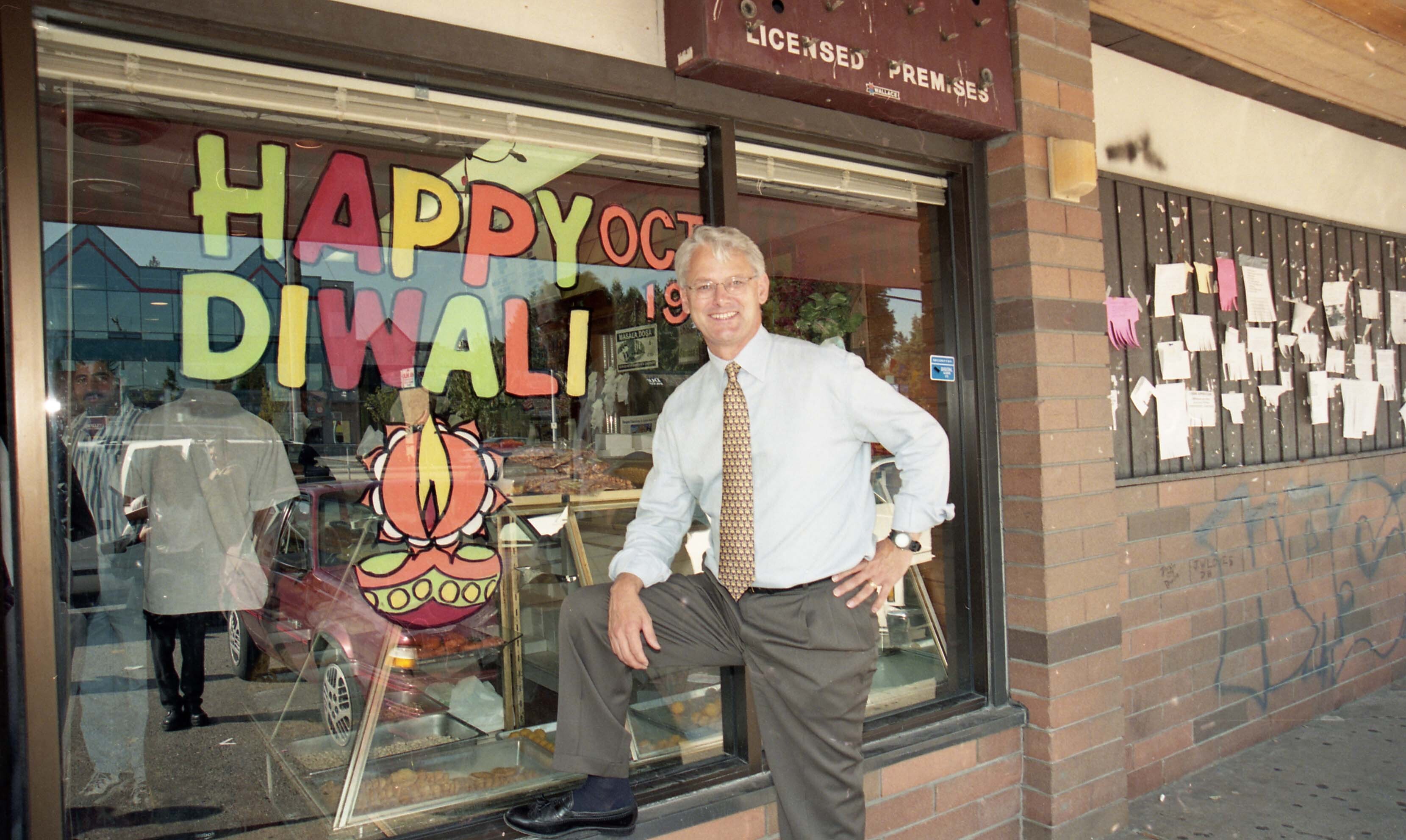
Photograph of Gordon Campbell at a storefront in Surrey, British Columbia (B.C.). Campbell was in Surrey for a community meet-and-greet pertaining to the B.C. Liberal Party.
Gordon Campbell was sworn in as British Columbia's 34th Premier on June 5, 2001. Campbell was elected leader of the B.C. Liberal Party in September 1993. He was elected to the B.C. Legislature in 1994 in a by-election to represent the riding of Vancouver-Quilchena and was re-elected in 1996 and 2001 for Vancouver-Point Grey. Campbell attended public school in Vancouver. After graduating he received a scholarship to Dartmouth College in New Hampshire. He worked his way through university in the dining hall and as the associate to the secretary of the college, and received his bachelor of arts degree. He later received a master's of business administration from Simon Fraser University. He was a secondary school teacher, basketball and track coach in Yola, Nigeria, working under the auspices of CUSO. He then became an assistant to former Vancouver mayor Art Phillips. From 1976 to 1981, he worked with Marathon Realty, where he became general manager of development. In 1981, he founded Citycore Development Corporation. In 1984, Campbell was elected to Vancouver City Council. From 1986 to 1993, he served as Mayor of Vancouver for three successive terms. From 2001 to 2011, Campbell served as Premier of British Columbia, and High Commissioner to the United Kingdom from 2011 to 2016. During his tenure as Premier, Campbell reduced taxes, restrained spending, revolutionized the measurement and management of regulations, and markedly improved the economy of the province. Among his recognitions and awards, Campbell received the Order of British Columbia as well as the Order of Canada. In 2014, he was presented an Honorary Doctorate of Laws from Thompson Rivers University. He was awarded both the Queen Elizabeth II Golden Jubilee Medal (2002) and the Diamond Jubilee Medal (2012) for his contributions to the province and country.
Gordon Campbell was sworn in as British Columbia's 34th Premier on June 5, 2001. Campbell was elected leader of the B.C. Liberal Party in September 1993. He was elected to the B.C. Legislature in 1994 in a by-election to represent the riding of Vancouver-Quilchena and was re-elected in 1996 and 2001 for Vancouver-Point Grey. Campbell attended public school in Vancouver. After graduating he received a scholarship to Dartmouth College in New Hampshire. He worked his way through university in the dining hall and as the associate to the secretary of the college, and received his bachelor of arts degree. He later received a master's of business administration from Simon Fraser University. He was a secondary school teacher, basketball and track coach in Yola, Nigeria, working under the auspices of CUSO. He then became an assistant to former Vancouver mayor Art Phillips. From 1976 to 1981, he worked with Marathon Realty, where he became general manager of development. In 1981, he founded Citycore Development Corporation. In 1984, Campbell was elected to Vancouver City Council. From 1986 to 1993, he served as Mayor of Vancouver for three successive terms. From 2001 to 2011, Campbell served as Premier of British Columbia, and High Commissioner to the United Kingdom from 2011 to 2016. During his tenure as Premier, Campbell reduced taxes, restrained spending, revolutionized the measurement and management of regulations, and markedly improved the economy of the province. Among his recognitions and awards, Campbell received the Order of British Columbia as well as the Order of Canada. In 2014, he was presented an Honorary Doctorate of Laws from Thompson Rivers University. He was awarded both the Queen Elizabeth II Golden Jubilee Medal (2002) and the Diamond Jubilee Medal (2012) for his contributions to the province and country.
Creator: Chandra Bodalia
Description
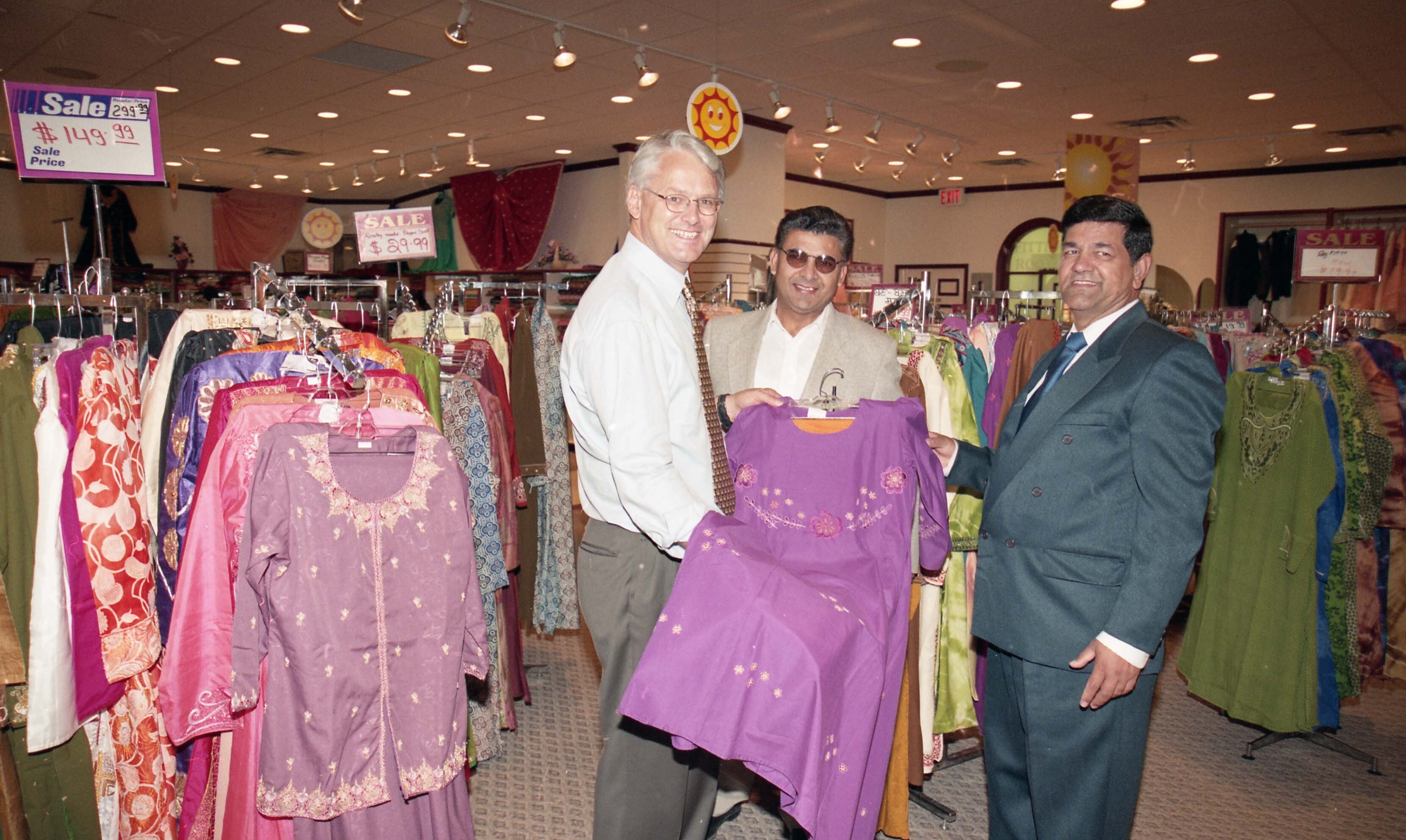
Photograph of Gordon Campbell, holding a South Asian garment, with unidentified individuals in a clothing store in Surrey, British Columbia (B.C.). Campbell was in Surrey for a community meet-and-greet pertaining to the B.C. Liberal Party.
Gordon Campbell was sworn in as British Columbia's 34th Premier on June 5, 2001. Campbell was elected leader of the B.C. Liberal Party in September 1993. He was elected to the B.C. Legislature in 1994 in a by-election to represent the riding of Vancouver-Quilchena and was re-elected in 1996 and 2001 for Vancouver-Point Grey. Campbell attended public school in Vancouver. After graduating he received a scholarship to Dartmouth College in New Hampshire. He worked his way through university in the dining hall and as the associate to the secretary of the college, and received his bachelor of arts degree. He later received a master's of business administration from Simon Fraser University. He was a secondary school teacher, basketball and track coach in Yola, Nigeria, working under the auspices of CUSO. He then became an assistant to former Vancouver mayor Art Phillips. From 1976 to 1981, he worked with Marathon Realty, where he became general manager of development. In 1981, he founded Citycore Development Corporation. In 1984, Campbell was elected to Vancouver City Council. From 1986 to 1993, he served as Mayor of Vancouver for three successive terms. From 2001 to 2011, Campbell served as Premier of British Columbia, and High Commissioner to the United Kingdom from 2011 to 2016. During his tenure as Premier, Campbell reduced taxes, restrained spending, revolutionized the measurement and management of regulations, and markedly improved the economy of the province. Among his recognitions and awards, Campbell received the Order of British Columbia as well as the Order of Canada. In 2014, he was presented an Honorary Doctorate of Laws from Thompson Rivers University. He was awarded both the Queen Elizabeth II Golden Jubilee Medal (2002) and the Diamond Jubilee Medal (2012) for his contributions to the province and country.
Gordon Campbell was sworn in as British Columbia's 34th Premier on June 5, 2001. Campbell was elected leader of the B.C. Liberal Party in September 1993. He was elected to the B.C. Legislature in 1994 in a by-election to represent the riding of Vancouver-Quilchena and was re-elected in 1996 and 2001 for Vancouver-Point Grey. Campbell attended public school in Vancouver. After graduating he received a scholarship to Dartmouth College in New Hampshire. He worked his way through university in the dining hall and as the associate to the secretary of the college, and received his bachelor of arts degree. He later received a master's of business administration from Simon Fraser University. He was a secondary school teacher, basketball and track coach in Yola, Nigeria, working under the auspices of CUSO. He then became an assistant to former Vancouver mayor Art Phillips. From 1976 to 1981, he worked with Marathon Realty, where he became general manager of development. In 1981, he founded Citycore Development Corporation. In 1984, Campbell was elected to Vancouver City Council. From 1986 to 1993, he served as Mayor of Vancouver for three successive terms. From 2001 to 2011, Campbell served as Premier of British Columbia, and High Commissioner to the United Kingdom from 2011 to 2016. During his tenure as Premier, Campbell reduced taxes, restrained spending, revolutionized the measurement and management of regulations, and markedly improved the economy of the province. Among his recognitions and awards, Campbell received the Order of British Columbia as well as the Order of Canada. In 2014, he was presented an Honorary Doctorate of Laws from Thompson Rivers University. He was awarded both the Queen Elizabeth II Golden Jubilee Medal (2002) and the Diamond Jubilee Medal (2012) for his contributions to the province and country.
Member of
Creator: Bodalia, Chandra
Description
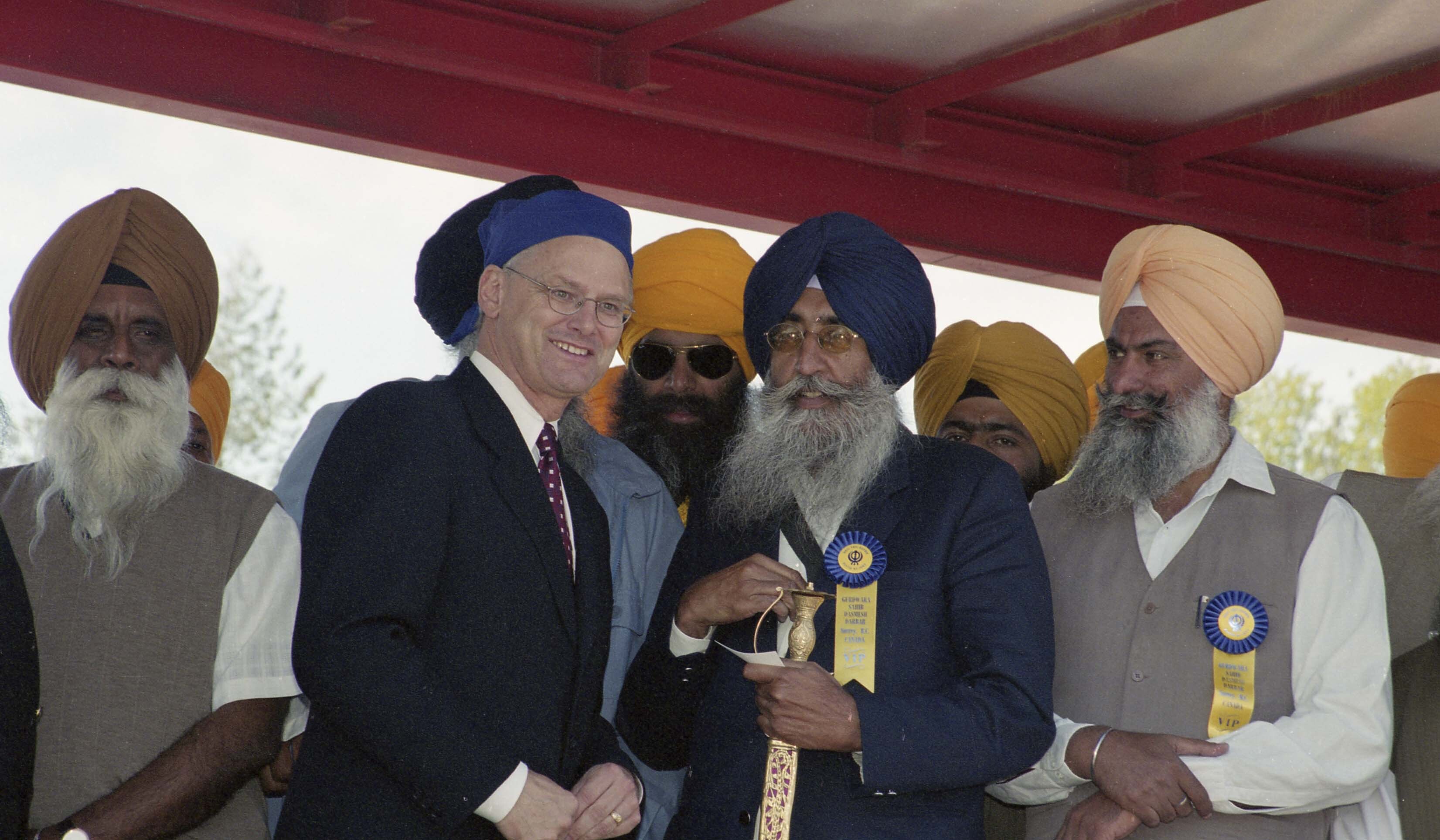
Photograph of Gordon Campbell with a group of unidentified individuals onstage at the Vaisakhi Nagar Kirtan held in Surrey, British Columbia (B.C.).
Gordon Campbell was sworn in as British Columbia's 34th Premier on June 5, 2001. Campbell was elected leader of the B.C. Liberal Party in September 1993. He was elected to the B.C. Legislature in 1994 in a by-election to represent the riding of Vancouver-Quilchena and was re-elected in 1996 and 2001 for Vancouver-Point Grey. Campbell attended public school in Vancouver. After graduating he received a scholarship to Dartmouth College in New Hampshire. He worked his way through university in the dining hall and as the associate to the secretary of the college, and received his bachelor of arts degree. He later received a master's of business administration from Simon Fraser University. He was a secondary school teacher, basketball and track coach in Yola, Nigeria, working under the auspices of CUSO. He then became an assistant to former Vancouver mayor Art Phillips. From 1976 to 1981, he worked with Marathon Realty, where he became general manager of development. In 1981, he founded Citycore Development Corporation. In 1984, Campbell was elected to Vancouver City Council. From 1986 to 1993, he served as Mayor of Vancouver for three successive terms. From 2001 to 2011, Campbell served as Premier of British Columbia, and High Commissioner to the United Kingdom from 2011 to 2016. During his tenure as Premier, Campbell reduced taxes, restrained spending, revolutionized the measurement and management of regulations, and markedly improved the economy of the province. Among his recognitions and awards, Campbell received the Order of British Columbia as well as the Order of Canada. In 2014, he was presented an Honorary Doctorate of Laws from Thompson Rivers University. He was awarded both the Queen Elizabeth II Golden Jubilee Medal (2002) and the Diamond Jubilee Medal (2012) for his contributions to the province and country.
Vaisakhi is one of the most important festivals in Sikhi, marking the formation of the Khalsa in 1699 by the tenth guru, Guru Gobind Singh Ji. It is a time of renewal, gratitude, and unity, celebrated with processions, prayers, and acts of service. Beyond its significance in Sikh history, Vaisakhi is also a harvest festival in Punjab, observed with joy and thanksgiving. Additionally, Vaisakhi holds special significance for Hindus, as it marks the beginning of the solar new year and is celebrated in various regions of India under different names, such as Pohela Boishakh in Bengal and Puthandu in Tamil Nadu.
Gordon Campbell was sworn in as British Columbia's 34th Premier on June 5, 2001. Campbell was elected leader of the B.C. Liberal Party in September 1993. He was elected to the B.C. Legislature in 1994 in a by-election to represent the riding of Vancouver-Quilchena and was re-elected in 1996 and 2001 for Vancouver-Point Grey. Campbell attended public school in Vancouver. After graduating he received a scholarship to Dartmouth College in New Hampshire. He worked his way through university in the dining hall and as the associate to the secretary of the college, and received his bachelor of arts degree. He later received a master's of business administration from Simon Fraser University. He was a secondary school teacher, basketball and track coach in Yola, Nigeria, working under the auspices of CUSO. He then became an assistant to former Vancouver mayor Art Phillips. From 1976 to 1981, he worked with Marathon Realty, where he became general manager of development. In 1981, he founded Citycore Development Corporation. In 1984, Campbell was elected to Vancouver City Council. From 1986 to 1993, he served as Mayor of Vancouver for three successive terms. From 2001 to 2011, Campbell served as Premier of British Columbia, and High Commissioner to the United Kingdom from 2011 to 2016. During his tenure as Premier, Campbell reduced taxes, restrained spending, revolutionized the measurement and management of regulations, and markedly improved the economy of the province. Among his recognitions and awards, Campbell received the Order of British Columbia as well as the Order of Canada. In 2014, he was presented an Honorary Doctorate of Laws from Thompson Rivers University. He was awarded both the Queen Elizabeth II Golden Jubilee Medal (2002) and the Diamond Jubilee Medal (2012) for his contributions to the province and country.
Vaisakhi is one of the most important festivals in Sikhi, marking the formation of the Khalsa in 1699 by the tenth guru, Guru Gobind Singh Ji. It is a time of renewal, gratitude, and unity, celebrated with processions, prayers, and acts of service. Beyond its significance in Sikh history, Vaisakhi is also a harvest festival in Punjab, observed with joy and thanksgiving. Additionally, Vaisakhi holds special significance for Hindus, as it marks the beginning of the solar new year and is celebrated in various regions of India under different names, such as Pohela Boishakh in Bengal and Puthandu in Tamil Nadu.
Member of
Creator: Bodalia, Chandra
Description
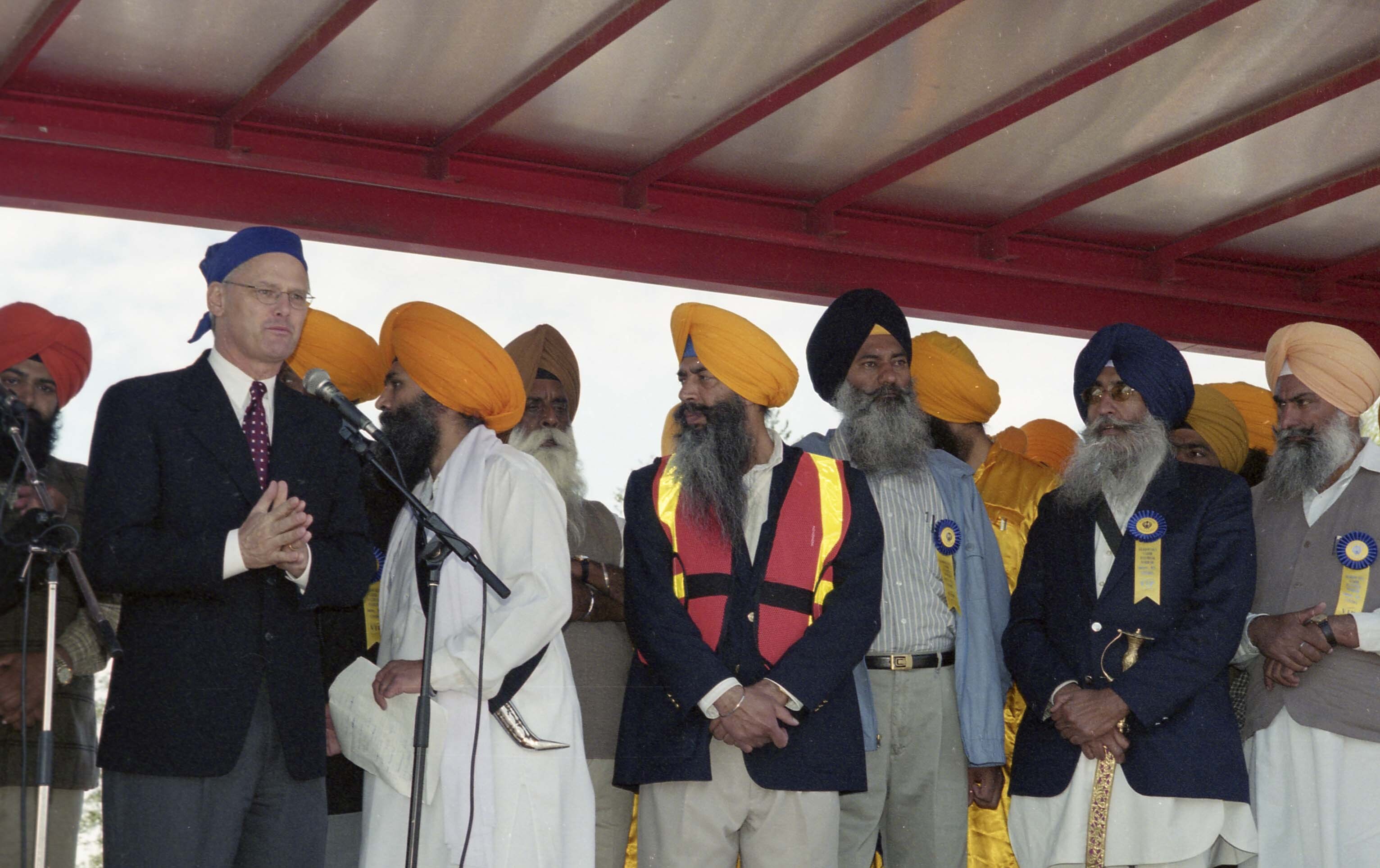
Photograph of a group of unidentified individuals onstage as Gordon Campbell addresses the audience at the Vaisakhi Nagar Kirtan held in Surrey, British Columbia (B.C.).
Gordon Campbell was sworn in as British Columbia's 34th Premier on June 5, 2001. Campbell was elected leader of the B.C. Liberal Party in September 1993. He was elected to the B.C. Legislature in 1994 in a by-election to represent the riding of Vancouver-Quilchena and was re-elected in 1996 and 2001 for Vancouver-Point Grey. Campbell attended public school in Vancouver. After graduating he received a scholarship to Dartmouth College in New Hampshire. He worked his way through university in the dining hall and as the associate to the secretary of the college, and received his bachelor of arts degree. He later received a master's of business administration from Simon Fraser University. He was a secondary school teacher, basketball and track coach in Yola, Nigeria, working under the auspices of CUSO. He then became an assistant to former Vancouver mayor Art Phillips. From 1976 to 1981, he worked with Marathon Realty, where he became general manager of development. In 1981, he founded Citycore Development Corporation. In 1984, Campbell was elected to Vancouver City Council. From 1986 to 1993, he served as Mayor of Vancouver for three successive terms. From 2001 to 2011, Campbell served as Premier of British Columbia, and High Commissioner to the United Kingdom from 2011 to 2016. During his tenure as Premier, Campbell reduced taxes, restrained spending, revolutionized the measurement and management of regulations, and markedly improved the economy of the province. Among his recognitions and awards, Campbell received the Order of British Columbia as well as the Order of Canada. In 2014, he was presented an Honorary Doctorate of Laws from Thompson Rivers University. He was awarded both the Queen Elizabeth II Golden Jubilee Medal (2002) and the Diamond Jubilee Medal (2012) for his contributions to the province and country.
Vaisakhi is one of the most important festivals in Sikhi, marking the formation of the Khalsa in 1699 by the tenth guru, Guru Gobind Singh Ji. It is a time of renewal, gratitude, and unity, celebrated with processions, prayers, and acts of service. Beyond its significance in Sikh history, Vaisakhi is also a harvest festival in Punjab, observed with joy and thanksgiving. Additionally, Vaisakhi holds special significance for Hindus, as it marks the beginning of the solar new year and is celebrated in various regions of India under different names, such as Pohela Boishakh in Bengal and Puthandu in Tamil Nadu.
Gordon Campbell was sworn in as British Columbia's 34th Premier on June 5, 2001. Campbell was elected leader of the B.C. Liberal Party in September 1993. He was elected to the B.C. Legislature in 1994 in a by-election to represent the riding of Vancouver-Quilchena and was re-elected in 1996 and 2001 for Vancouver-Point Grey. Campbell attended public school in Vancouver. After graduating he received a scholarship to Dartmouth College in New Hampshire. He worked his way through university in the dining hall and as the associate to the secretary of the college, and received his bachelor of arts degree. He later received a master's of business administration from Simon Fraser University. He was a secondary school teacher, basketball and track coach in Yola, Nigeria, working under the auspices of CUSO. He then became an assistant to former Vancouver mayor Art Phillips. From 1976 to 1981, he worked with Marathon Realty, where he became general manager of development. In 1981, he founded Citycore Development Corporation. In 1984, Campbell was elected to Vancouver City Council. From 1986 to 1993, he served as Mayor of Vancouver for three successive terms. From 2001 to 2011, Campbell served as Premier of British Columbia, and High Commissioner to the United Kingdom from 2011 to 2016. During his tenure as Premier, Campbell reduced taxes, restrained spending, revolutionized the measurement and management of regulations, and markedly improved the economy of the province. Among his recognitions and awards, Campbell received the Order of British Columbia as well as the Order of Canada. In 2014, he was presented an Honorary Doctorate of Laws from Thompson Rivers University. He was awarded both the Queen Elizabeth II Golden Jubilee Medal (2002) and the Diamond Jubilee Medal (2012) for his contributions to the province and country.
Vaisakhi is one of the most important festivals in Sikhi, marking the formation of the Khalsa in 1699 by the tenth guru, Guru Gobind Singh Ji. It is a time of renewal, gratitude, and unity, celebrated with processions, prayers, and acts of service. Beyond its significance in Sikh history, Vaisakhi is also a harvest festival in Punjab, observed with joy and thanksgiving. Additionally, Vaisakhi holds special significance for Hindus, as it marks the beginning of the solar new year and is celebrated in various regions of India under different names, such as Pohela Boishakh in Bengal and Puthandu in Tamil Nadu.
Member of
Creator: Bodalia, Chandra
Description
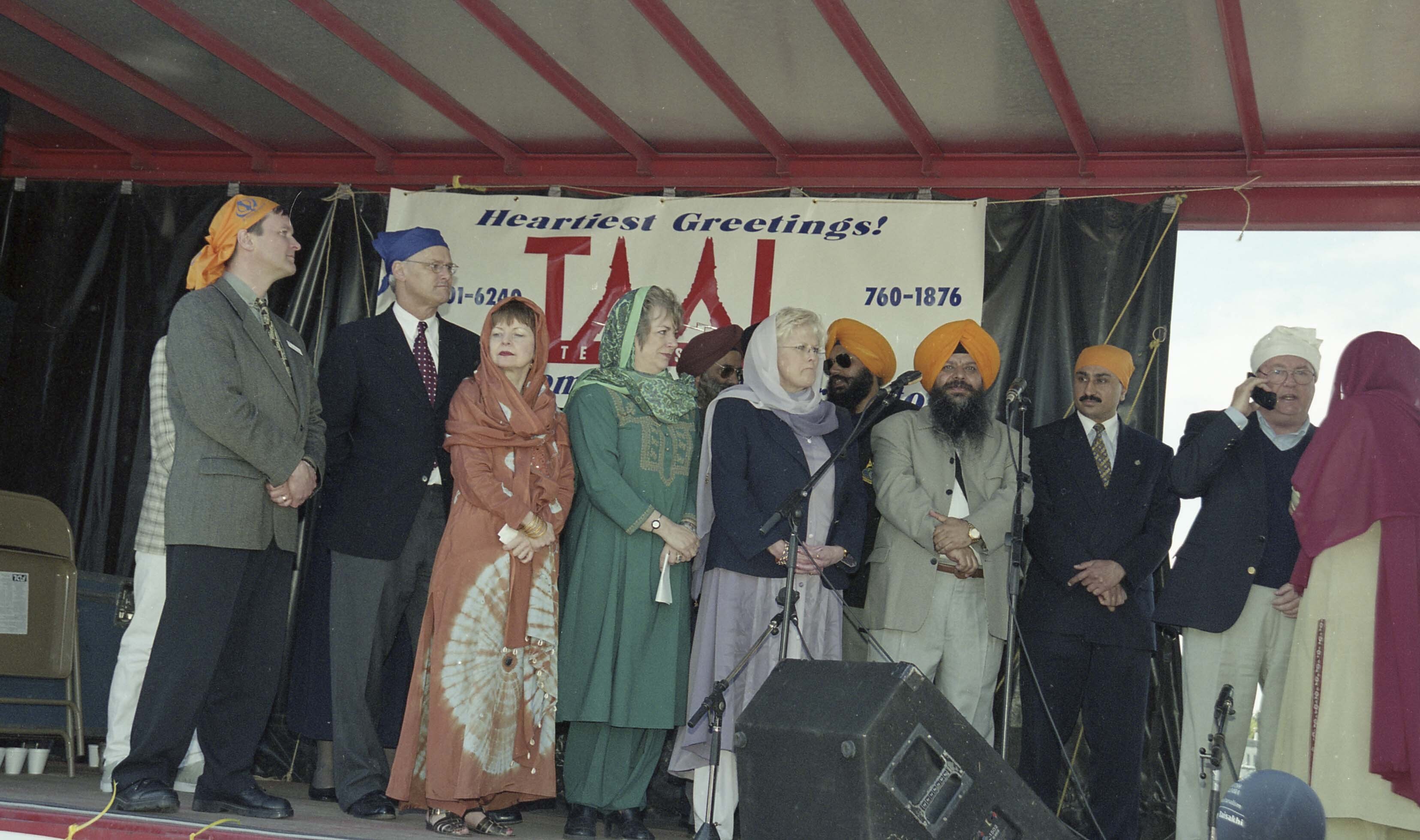
Photograph of a group of unidentified individuals onstage at the Vaisakhi Nagar Kirtan held in Surrey, British Columbia (B.C.). Among the group are Gordon Campbell, Penny Priddy and Sue Hammell.
Gordon Campbell was sworn in as British Columbia's 34th Premier on June 5, 2001. Campbell was elected leader of the B.C. Liberal Party in September 1993. He was elected to the B.C. Legislature in 1994 in a by-election to represent the riding of Vancouver-Quilchena and was re-elected in 1996 and 2001 for Vancouver-Point Grey. Campbell attended public school in Vancouver. After graduating he received a scholarship to Dartmouth College in New Hampshire. He worked his way through university in the dining hall and as the associate to the secretary of the college, and received his bachelor of arts degree. He later received a master's of business administration from Simon Fraser University. He was a secondary school teacher, basketball and track coach in Yola, Nigeria, working under the auspices of CUSO. He then became an assistant to former Vancouver mayor Art Phillips. From 1976 to 1981, he worked with Marathon Realty, where he became general manager of development. In 1981, he founded Citycore Development Corporation. In 1984, Campbell was elected to Vancouver City Council. From 1986 to 1993, he served as Mayor of Vancouver for three successive terms. From 2001 to 2011, Campbell served as Premier of British Columbia, and High Commissioner to the United Kingdom from 2011 to 2016. During his tenure as Premier, Campbell reduced taxes, restrained spending, revolutionized the measurement and management of regulations, and markedly improved the economy of the province. Among his recognitions and awards, Campbell received the Order of British Columbia as well as the Order of Canada. In 2014, he was presented an Honorary Doctorate of Laws from Thompson Rivers University. He was awarded both the Queen Elizabeth II Golden Jubilee Medal (2002) and the Diamond Jubilee Medal (2012) for his contributions to the province and country.
Penny Priddy is a Canadian politician who served as a Member of the Legislative Assembly for Surrey-Newton from 1991 to 2001. She held several ministerial roles, including Minister of Women's Equality, Minister of Health, and Minister of Education. A trained nurse, she worked extensively in community services, supporting children, families, and people with disabilities. Priddy was also active in the Surrey School Board and various community organizations.
Sue Hammell is a former Member of the Legislative Assembly for Surrey-Green Timbers, serving multiple terms since 1991. She held key roles, including Minister for Women's Equality, and co-founded the Minerva Foundation for BC Women. Hammell also worked internationally to support female leaders and served as Executive Director of the Surrey Aboriginal Society.
Vaisakhi is one of the most important festivals in Sikhi, marking the formation of the Khalsa in 1699 by the tenth guru, Guru Gobind Singh Ji. It is a time of renewal, gratitude, and unity, celebrated with processions, prayers, and acts of service. Beyond its significance in Sikh history, Vaisakhi is also a harvest festival in Punjab, observed with joy and thanksgiving. Additionally, Vaisakhi holds special significance for Hindus, as it marks the beginning of the solar new year and is celebrated in various regions of India under different names, such as Pohela Boishakh in Bengal and Puthandu in Tamil Nadu.
Gordon Campbell was sworn in as British Columbia's 34th Premier on June 5, 2001. Campbell was elected leader of the B.C. Liberal Party in September 1993. He was elected to the B.C. Legislature in 1994 in a by-election to represent the riding of Vancouver-Quilchena and was re-elected in 1996 and 2001 for Vancouver-Point Grey. Campbell attended public school in Vancouver. After graduating he received a scholarship to Dartmouth College in New Hampshire. He worked his way through university in the dining hall and as the associate to the secretary of the college, and received his bachelor of arts degree. He later received a master's of business administration from Simon Fraser University. He was a secondary school teacher, basketball and track coach in Yola, Nigeria, working under the auspices of CUSO. He then became an assistant to former Vancouver mayor Art Phillips. From 1976 to 1981, he worked with Marathon Realty, where he became general manager of development. In 1981, he founded Citycore Development Corporation. In 1984, Campbell was elected to Vancouver City Council. From 1986 to 1993, he served as Mayor of Vancouver for three successive terms. From 2001 to 2011, Campbell served as Premier of British Columbia, and High Commissioner to the United Kingdom from 2011 to 2016. During his tenure as Premier, Campbell reduced taxes, restrained spending, revolutionized the measurement and management of regulations, and markedly improved the economy of the province. Among his recognitions and awards, Campbell received the Order of British Columbia as well as the Order of Canada. In 2014, he was presented an Honorary Doctorate of Laws from Thompson Rivers University. He was awarded both the Queen Elizabeth II Golden Jubilee Medal (2002) and the Diamond Jubilee Medal (2012) for his contributions to the province and country.
Penny Priddy is a Canadian politician who served as a Member of the Legislative Assembly for Surrey-Newton from 1991 to 2001. She held several ministerial roles, including Minister of Women's Equality, Minister of Health, and Minister of Education. A trained nurse, she worked extensively in community services, supporting children, families, and people with disabilities. Priddy was also active in the Surrey School Board and various community organizations.
Sue Hammell is a former Member of the Legislative Assembly for Surrey-Green Timbers, serving multiple terms since 1991. She held key roles, including Minister for Women's Equality, and co-founded the Minerva Foundation for BC Women. Hammell also worked internationally to support female leaders and served as Executive Director of the Surrey Aboriginal Society.
Vaisakhi is one of the most important festivals in Sikhi, marking the formation of the Khalsa in 1699 by the tenth guru, Guru Gobind Singh Ji. It is a time of renewal, gratitude, and unity, celebrated with processions, prayers, and acts of service. Beyond its significance in Sikh history, Vaisakhi is also a harvest festival in Punjab, observed with joy and thanksgiving. Additionally, Vaisakhi holds special significance for Hindus, as it marks the beginning of the solar new year and is celebrated in various regions of India under different names, such as Pohela Boishakh in Bengal and Puthandu in Tamil Nadu.
Member of
Creator: Bodalia, Chandra
Description
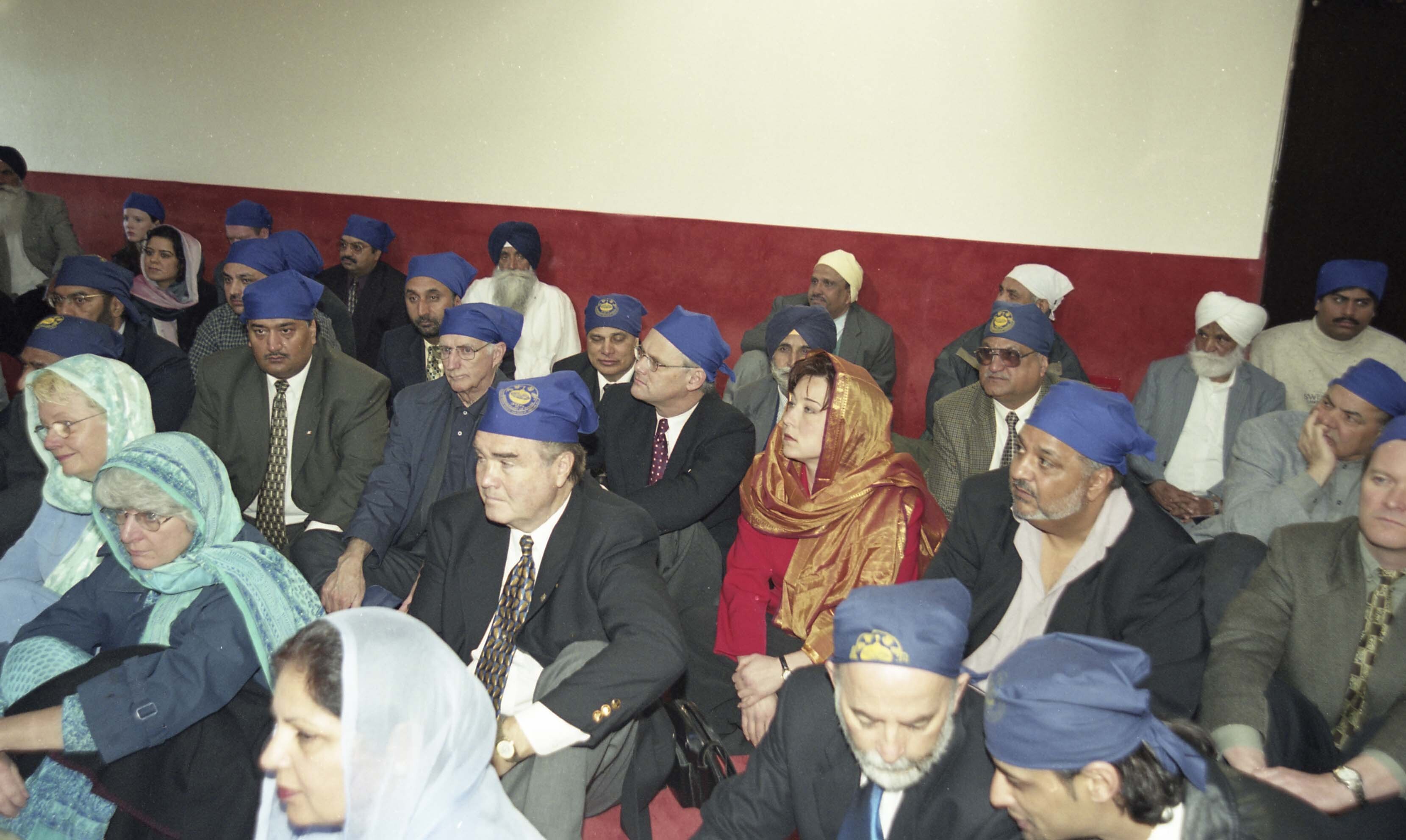
Photograph of a group of unidentified individuals at the Sikh Temple (gurdwara) located in Vancouver, British Columbia (B.C.). Individuals had gathered at the Sikh Temple for the Vaisakhi Nagar Kirtan, an annual event hosted and organized by the Khalsa Diwan Society in Vancouver. Among the group of individuals are Gordon Campbell and Christy Clark.
Gordon Campbell was sworn in as British Columbia's 34th Premier on June 5, 2001. Campbell was elected leader of the B.C. Liberal Party in September 1993. He was elected to the B.C. Legislature in 1994 in a by-election to represent the riding of Vancouver-Quilchena and was re-elected in 1996 and 2001 for Vancouver-Point Grey. Campbell attended public school in Vancouver. After graduating he received a scholarship to Dartmouth College in New Hampshire. He worked his way through university in the dining hall and as the associate to the secretary of the college, and received his bachelor of arts degree. He later received a master's of business administration from Simon Fraser University. He was a secondary school teacher, basketball and track coach in Yola, Nigeria, working under the auspices of CUSO. He then became an assistant to former Vancouver mayor Art Phillips. From 1976 to 1981, he worked with Marathon Realty, where he became general manager of development. In 1981, he founded Citycore Development Corporation. In 1984, Campbell was elected to Vancouver City Council. From 1986 to 1993, he served as Mayor of Vancouver for three successive terms. From 2001 to 2011, Campbell served as Premier of British Columbia, and High Commissioner to the United Kingdom from 2011 to 2016. During his tenure as Premier, Campbell reduced taxes, restrained spending, revolutionized the measurement and management of regulations, and markedly improved the economy of the province. Among his recognitions and awards, Campbell received the Order of British Columbia as well as the Order of Canada. In 2014, he was presented an Honorary Doctorate of Laws from Thompson Rivers University. He was awarded both the Queen Elizabeth II Golden Jubilee Medal (2002) and the Diamond Jubilee Medal (2012) for his contributions to the province and country.
Christy Clark was born and raised in Burnaby, B.C., where she later attended Simon Fraser University. Clark's educational pursuits also took her to the University of Edinburgh and the Sorbonne. She ran successfully as the B.C. Liberal Party candidate in the riding of Port Moody-Burnaby Mountain in the 1996 provincial general election and was re-elected to the Legislative Assembly to represent Port Moody-Westwood in 2001. Clark served as Deputy Premier, Minister of Education, Minister of Children and Family Development and Vice-Chair of Treasury Board. In 2005, she stepped back from public life to spend more time with family. In the ensuing years, Clark worked in media as a columnist, commentator and as host of the "Christy Clark Show" on Vancouver radio station CKNW. In 2011, she returned to provincial politics, winning the leadership of the governing B.C. Liberal Party and thereby becoming Premier of British Columbia. In a subsequent by-election, Clark was elected to represent the riding of Vancouver-Point Grey in the Legislative Assembly. Through her re-election in 2013, this time in the riding of Westside-Kelowna, Clark became the first woman elected as Premier in British Columbia. Among her initiatives as Premier, Clark brought the anti-bullying "Pink Shirt Campaign" to British Columbia to raise awareness of issues related to bullying in schools, workplaces and communities. She was re-elected in the 2017 provincial general election, becoming the first woman to be re-elected as Premier in British Columbia. Following the change of government in British Columbia in July 2017, Clark became the Leader of the Official Opposition. She resigned as leader of the BC Liberal Party and the member for Kelowna West in August 2017. Clark is a recipient of many awards, including the YWCA Woman of Distinction Award in 2009.
Vaisakhi is one of the most important festivals in Sikhi, marking the formation of the Khalsa in 1699 by the tenth guru, Guru Gobind Singh Ji. It is a time of renewal, gratitude, and unity, celebrated with processions, prayers, and acts of service. Beyond its significance in Sikh history, Vaisakhi is also a harvest festival in Punjab, observed with joy and thanksgiving. Additionally, Vaisakhi holds special significance for Hindus, as it marks the beginning of the solar new year and is celebrated in various regions of India under different names, such as Pohela Boishakh in Bengal and Puthandu in Tamil Nadu.
The Khalsa Diwan Society of Vancouver oversees the Vaisakhi celebrations in Vancouver. The Khalsa Diwan Society is a pioneer Sikh society, one of the oldest in Vancouver, formed on July 22, 1902 in British Columbia, Canada, formally established in 1906. In 1908, the Society purchased and built the first Sikh temple in Vancouver, which was located on West 2nd Avenue. This is believed to be the first Sikh temple in the whole of the American continent. This temple served the Sikh community until a new temple was occupied on April 25, 1970. The original temple was sold to build a bigger (present) temple located on Ross Street. The Khalsa Diwan Society has been a pioneer in raising Sikhi related issues and getting recognition for Sikhs in Canada. It continues to build a strong community based on Sikh values and principles. Every year the society organizes sports activities, including soccer and wrestling tournaments.
Gordon Campbell was sworn in as British Columbia's 34th Premier on June 5, 2001. Campbell was elected leader of the B.C. Liberal Party in September 1993. He was elected to the B.C. Legislature in 1994 in a by-election to represent the riding of Vancouver-Quilchena and was re-elected in 1996 and 2001 for Vancouver-Point Grey. Campbell attended public school in Vancouver. After graduating he received a scholarship to Dartmouth College in New Hampshire. He worked his way through university in the dining hall and as the associate to the secretary of the college, and received his bachelor of arts degree. He later received a master's of business administration from Simon Fraser University. He was a secondary school teacher, basketball and track coach in Yola, Nigeria, working under the auspices of CUSO. He then became an assistant to former Vancouver mayor Art Phillips. From 1976 to 1981, he worked with Marathon Realty, where he became general manager of development. In 1981, he founded Citycore Development Corporation. In 1984, Campbell was elected to Vancouver City Council. From 1986 to 1993, he served as Mayor of Vancouver for three successive terms. From 2001 to 2011, Campbell served as Premier of British Columbia, and High Commissioner to the United Kingdom from 2011 to 2016. During his tenure as Premier, Campbell reduced taxes, restrained spending, revolutionized the measurement and management of regulations, and markedly improved the economy of the province. Among his recognitions and awards, Campbell received the Order of British Columbia as well as the Order of Canada. In 2014, he was presented an Honorary Doctorate of Laws from Thompson Rivers University. He was awarded both the Queen Elizabeth II Golden Jubilee Medal (2002) and the Diamond Jubilee Medal (2012) for his contributions to the province and country.
Christy Clark was born and raised in Burnaby, B.C., where she later attended Simon Fraser University. Clark's educational pursuits also took her to the University of Edinburgh and the Sorbonne. She ran successfully as the B.C. Liberal Party candidate in the riding of Port Moody-Burnaby Mountain in the 1996 provincial general election and was re-elected to the Legislative Assembly to represent Port Moody-Westwood in 2001. Clark served as Deputy Premier, Minister of Education, Minister of Children and Family Development and Vice-Chair of Treasury Board. In 2005, she stepped back from public life to spend more time with family. In the ensuing years, Clark worked in media as a columnist, commentator and as host of the "Christy Clark Show" on Vancouver radio station CKNW. In 2011, she returned to provincial politics, winning the leadership of the governing B.C. Liberal Party and thereby becoming Premier of British Columbia. In a subsequent by-election, Clark was elected to represent the riding of Vancouver-Point Grey in the Legislative Assembly. Through her re-election in 2013, this time in the riding of Westside-Kelowna, Clark became the first woman elected as Premier in British Columbia. Among her initiatives as Premier, Clark brought the anti-bullying "Pink Shirt Campaign" to British Columbia to raise awareness of issues related to bullying in schools, workplaces and communities. She was re-elected in the 2017 provincial general election, becoming the first woman to be re-elected as Premier in British Columbia. Following the change of government in British Columbia in July 2017, Clark became the Leader of the Official Opposition. She resigned as leader of the BC Liberal Party and the member for Kelowna West in August 2017. Clark is a recipient of many awards, including the YWCA Woman of Distinction Award in 2009.
Vaisakhi is one of the most important festivals in Sikhi, marking the formation of the Khalsa in 1699 by the tenth guru, Guru Gobind Singh Ji. It is a time of renewal, gratitude, and unity, celebrated with processions, prayers, and acts of service. Beyond its significance in Sikh history, Vaisakhi is also a harvest festival in Punjab, observed with joy and thanksgiving. Additionally, Vaisakhi holds special significance for Hindus, as it marks the beginning of the solar new year and is celebrated in various regions of India under different names, such as Pohela Boishakh in Bengal and Puthandu in Tamil Nadu.
The Khalsa Diwan Society of Vancouver oversees the Vaisakhi celebrations in Vancouver. The Khalsa Diwan Society is a pioneer Sikh society, one of the oldest in Vancouver, formed on July 22, 1902 in British Columbia, Canada, formally established in 1906. In 1908, the Society purchased and built the first Sikh temple in Vancouver, which was located on West 2nd Avenue. This is believed to be the first Sikh temple in the whole of the American continent. This temple served the Sikh community until a new temple was occupied on April 25, 1970. The original temple was sold to build a bigger (present) temple located on Ross Street. The Khalsa Diwan Society has been a pioneer in raising Sikhi related issues and getting recognition for Sikhs in Canada. It continues to build a strong community based on Sikh values and principles. Every year the society organizes sports activities, including soccer and wrestling tournaments.
Member of
Creator: Bodalia, Chandra
Description
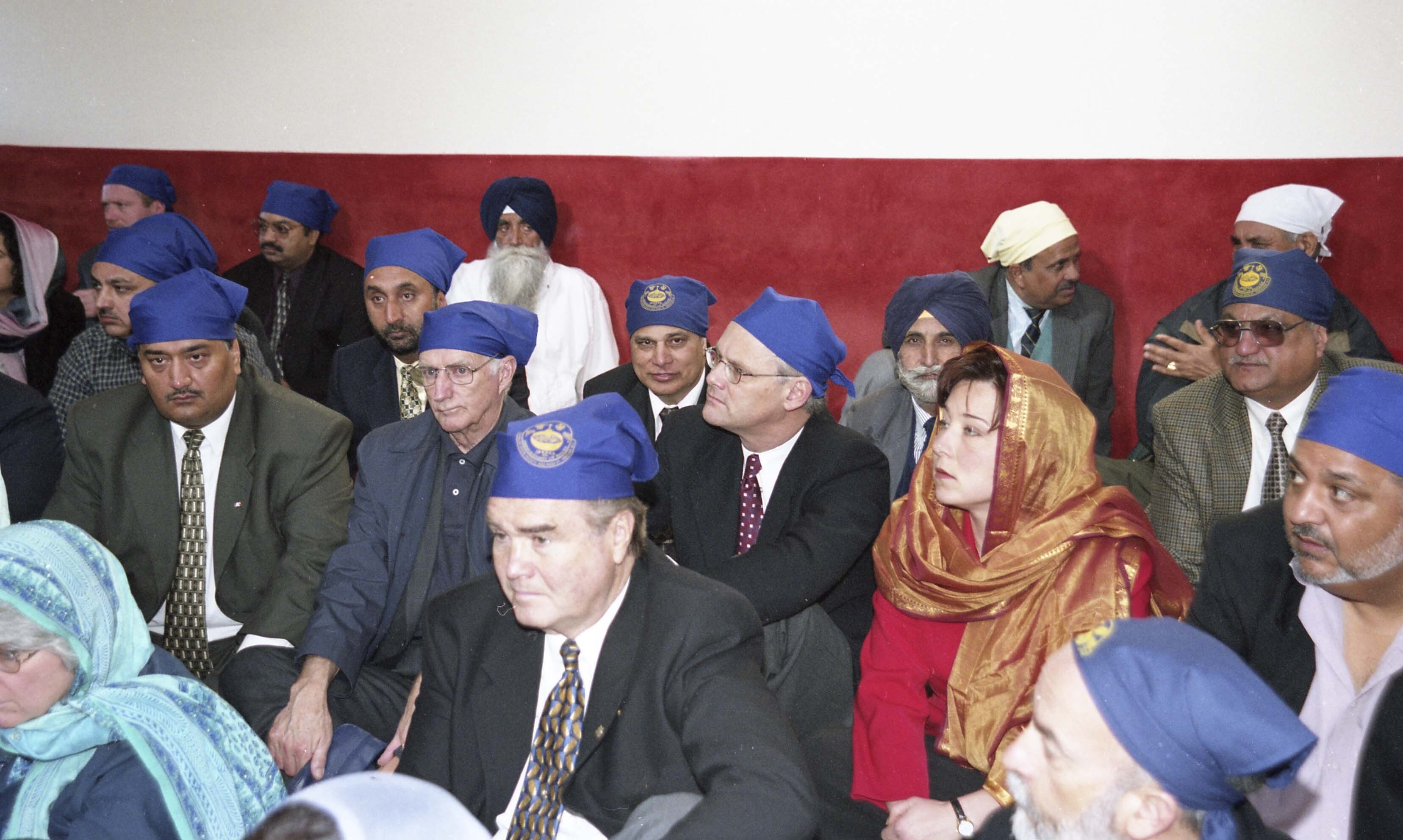
Photograph of a group of unidentified individuals at the Sikh Temple (gurdwara) located in Vancouver, British Columbia (B.C.). Individuals had gathered at the Sikh Temple for the Vaisakhi Nagar Kirtan, an annual event hosted and organized by the Khalsa Diwan Society in Vancouver. Among the group of individuals are Gordon Campbell and Christy Clark.
Gordon Campbell was sworn in as British Columbia's 34th Premier on June 5, 2001. Campbell was elected leader of the B.C. Liberal Party in September 1993. He was elected to the B.C. Legislature in 1994 in a by-election to represent the riding of Vancouver-Quilchena and was re-elected in 1996 and 2001 for Vancouver-Point Grey. Campbell attended public school in Vancouver. After graduating he received a scholarship to Dartmouth College in New Hampshire. He worked his way through university in the dining hall and as the associate to the secretary of the college, and received his bachelor of arts degree. He later received a master's of business administration from Simon Fraser University. He was a secondary school teacher, basketball and track coach in Yola, Nigeria, working under the auspices of CUSO. He then became an assistant to former Vancouver mayor Art Phillips. From 1976 to 1981, he worked with Marathon Realty, where he became general manager of development. In 1981, he founded Citycore Development Corporation. In 1984, Campbell was elected to Vancouver City Council. From 1986 to 1993, he served as Mayor of Vancouver for three successive terms. From 2001 to 2011, Campbell served as Premier of British Columbia, and High Commissioner to the United Kingdom from 2011 to 2016. During his tenure as Premier, Campbell reduced taxes, restrained spending, revolutionized the measurement and management of regulations, and markedly improved the economy of the province. Among his recognitions and awards, Campbell received the Order of British Columbia as well as the Order of Canada. In 2014, he was presented an Honorary Doctorate of Laws from Thompson Rivers University. He was awarded both the Queen Elizabeth II Golden Jubilee Medal (2002) and the Diamond Jubilee Medal (2012) for his contributions to the province and country.
Christy Clark was born and raised in Burnaby, B.C., where she later attended Simon Fraser University. Clark's educational pursuits also took her to the University of Edinburgh and the Sorbonne. She ran successfully as the B.C. Liberal Party candidate in the riding of Port Moody-Burnaby Mountain in the 1996 provincial general election and was re-elected to the Legislative Assembly to represent Port Moody-Westwood in 2001. Clark served as Deputy Premier, Minister of Education, Minister of Children and Family Development and Vice-Chair of Treasury Board. In 2005, she stepped back from public life to spend more time with family. In the ensuing years, Clark worked in media as a columnist, commentator and as host of the "Christy Clark Show" on Vancouver radio station CKNW. In 2011, she returned to provincial politics, winning the leadership of the governing B.C. Liberal Party and thereby becoming Premier of British Columbia. In a subsequent by-election, Clark was elected to represent the riding of Vancouver-Point Grey in the Legislative Assembly. Through her re-election in 2013, this time in the riding of Westside-Kelowna, Clark became the first woman elected as Premier in British Columbia. Among her initiatives as Premier, Clark brought the anti-bullying "Pink Shirt Campaign" to British Columbia to raise awareness of issues related to bullying in schools, workplaces and communities. She was re-elected in the 2017 provincial general election, becoming the first woman to be re-elected as Premier in British Columbia. Following the change of government in British Columbia in July 2017, Clark became the Leader of the Official Opposition. She resigned as leader of the BC Liberal Party and the member for Kelowna West in August 2017. Clark is a recipient of many awards, including the YWCA Woman of Distinction Award in 2009.
Vaisakhi is one of the most important festivals in Sikhi, marking the formation of the Khalsa in 1699 by the tenth guru, Guru Gobind Singh Ji. It is a time of renewal, gratitude, and unity, celebrated with processions, prayers, and acts of service. Beyond its significance in Sikh history, Vaisakhi is also a harvest festival in Punjab, observed with joy and thanksgiving. Additionally, Vaisakhi holds special significance for Hindus, as it marks the beginning of the solar new year and is celebrated in various regions of India under different names, such as Pohela Boishakh in Bengal and Puthandu in Tamil Nadu.
The Khalsa Diwan Society of Vancouver oversees the Vaisakhi celebrations in Vancouver. The Khalsa Diwan Society is a pioneer Sikh society, one of the oldest in Vancouver, formed on July 22, 1902 in British Columbia, Canada, formally established in 1906. In 1908, the Society purchased and built the first Sikh temple in Vancouver, which was located on West 2nd Avenue. This is believed to be the first Sikh temple in the whole of the American continent. This temple served the Sikh community until a new temple was occupied on April 25, 1970. The original temple was sold to build a bigger (present) temple located on Ross Street. The Khalsa Diwan Society has been a pioneer in raising Sikhi related issues and getting recognition for Sikhs in Canada. It continues to build a strong community based on Sikh values and principles. Every year the society organizes sports activities, including soccer and wrestling tournaments.
Gordon Campbell was sworn in as British Columbia's 34th Premier on June 5, 2001. Campbell was elected leader of the B.C. Liberal Party in September 1993. He was elected to the B.C. Legislature in 1994 in a by-election to represent the riding of Vancouver-Quilchena and was re-elected in 1996 and 2001 for Vancouver-Point Grey. Campbell attended public school in Vancouver. After graduating he received a scholarship to Dartmouth College in New Hampshire. He worked his way through university in the dining hall and as the associate to the secretary of the college, and received his bachelor of arts degree. He later received a master's of business administration from Simon Fraser University. He was a secondary school teacher, basketball and track coach in Yola, Nigeria, working under the auspices of CUSO. He then became an assistant to former Vancouver mayor Art Phillips. From 1976 to 1981, he worked with Marathon Realty, where he became general manager of development. In 1981, he founded Citycore Development Corporation. In 1984, Campbell was elected to Vancouver City Council. From 1986 to 1993, he served as Mayor of Vancouver for three successive terms. From 2001 to 2011, Campbell served as Premier of British Columbia, and High Commissioner to the United Kingdom from 2011 to 2016. During his tenure as Premier, Campbell reduced taxes, restrained spending, revolutionized the measurement and management of regulations, and markedly improved the economy of the province. Among his recognitions and awards, Campbell received the Order of British Columbia as well as the Order of Canada. In 2014, he was presented an Honorary Doctorate of Laws from Thompson Rivers University. He was awarded both the Queen Elizabeth II Golden Jubilee Medal (2002) and the Diamond Jubilee Medal (2012) for his contributions to the province and country.
Christy Clark was born and raised in Burnaby, B.C., where she later attended Simon Fraser University. Clark's educational pursuits also took her to the University of Edinburgh and the Sorbonne. She ran successfully as the B.C. Liberal Party candidate in the riding of Port Moody-Burnaby Mountain in the 1996 provincial general election and was re-elected to the Legislative Assembly to represent Port Moody-Westwood in 2001. Clark served as Deputy Premier, Minister of Education, Minister of Children and Family Development and Vice-Chair of Treasury Board. In 2005, she stepped back from public life to spend more time with family. In the ensuing years, Clark worked in media as a columnist, commentator and as host of the "Christy Clark Show" on Vancouver radio station CKNW. In 2011, she returned to provincial politics, winning the leadership of the governing B.C. Liberal Party and thereby becoming Premier of British Columbia. In a subsequent by-election, Clark was elected to represent the riding of Vancouver-Point Grey in the Legislative Assembly. Through her re-election in 2013, this time in the riding of Westside-Kelowna, Clark became the first woman elected as Premier in British Columbia. Among her initiatives as Premier, Clark brought the anti-bullying "Pink Shirt Campaign" to British Columbia to raise awareness of issues related to bullying in schools, workplaces and communities. She was re-elected in the 2017 provincial general election, becoming the first woman to be re-elected as Premier in British Columbia. Following the change of government in British Columbia in July 2017, Clark became the Leader of the Official Opposition. She resigned as leader of the BC Liberal Party and the member for Kelowna West in August 2017. Clark is a recipient of many awards, including the YWCA Woman of Distinction Award in 2009.
Vaisakhi is one of the most important festivals in Sikhi, marking the formation of the Khalsa in 1699 by the tenth guru, Guru Gobind Singh Ji. It is a time of renewal, gratitude, and unity, celebrated with processions, prayers, and acts of service. Beyond its significance in Sikh history, Vaisakhi is also a harvest festival in Punjab, observed with joy and thanksgiving. Additionally, Vaisakhi holds special significance for Hindus, as it marks the beginning of the solar new year and is celebrated in various regions of India under different names, such as Pohela Boishakh in Bengal and Puthandu in Tamil Nadu.
The Khalsa Diwan Society of Vancouver oversees the Vaisakhi celebrations in Vancouver. The Khalsa Diwan Society is a pioneer Sikh society, one of the oldest in Vancouver, formed on July 22, 1902 in British Columbia, Canada, formally established in 1906. In 1908, the Society purchased and built the first Sikh temple in Vancouver, which was located on West 2nd Avenue. This is believed to be the first Sikh temple in the whole of the American continent. This temple served the Sikh community until a new temple was occupied on April 25, 1970. The original temple was sold to build a bigger (present) temple located on Ross Street. The Khalsa Diwan Society has been a pioneer in raising Sikhi related issues and getting recognition for Sikhs in Canada. It continues to build a strong community based on Sikh values and principles. Every year the society organizes sports activities, including soccer and wrestling tournaments.
Member of
Creator: Bodalia, Chandra
Description
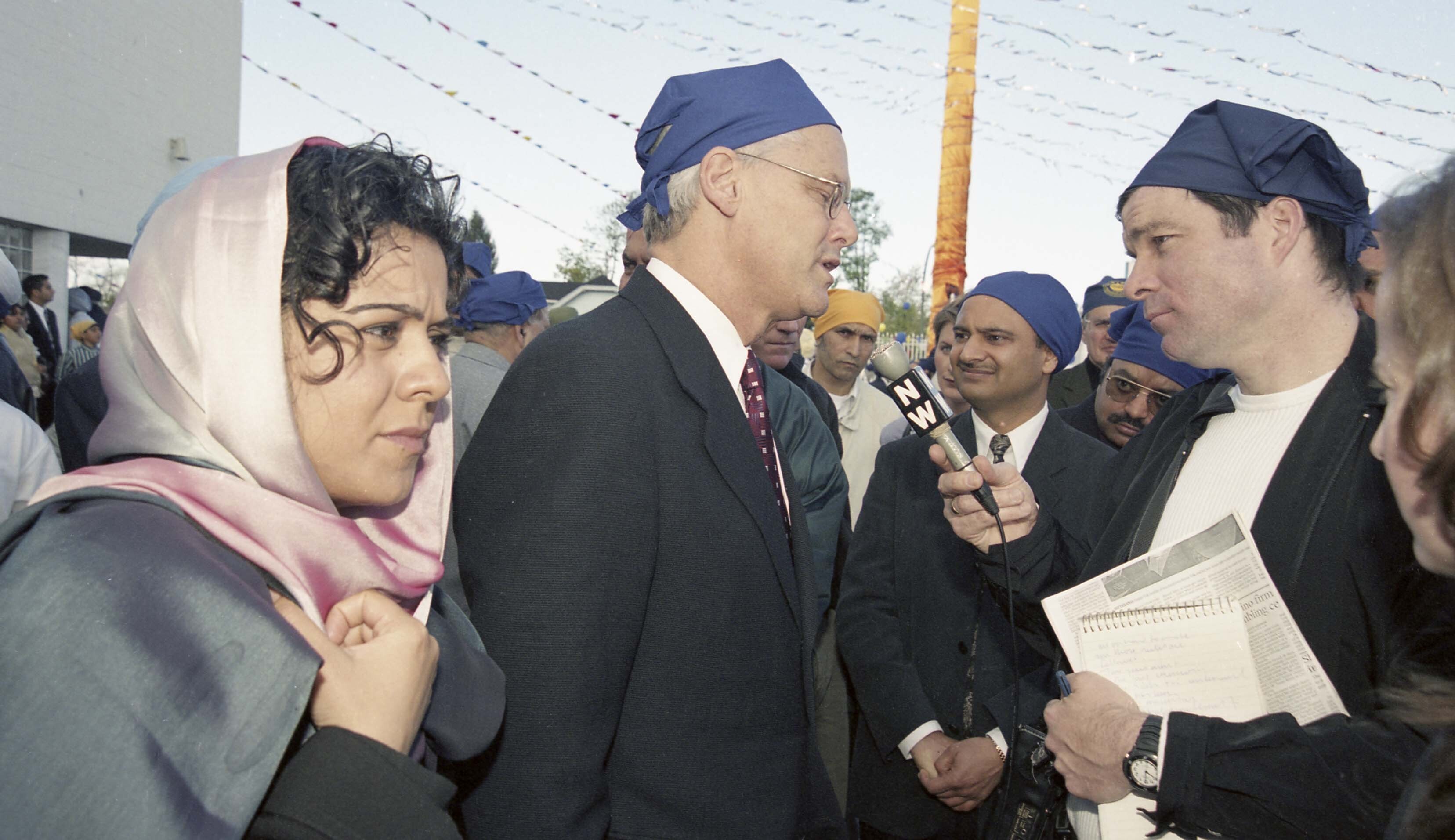
Photograph of Gordon Campbell being interviewed by press at the Sikh Temple (gurdwara) located in Vancouver, British Columbia (B.C.). Patty Sahota can be seen standing next to Campbell. Individuals had gathered at the Sikh Temple for the Vaisakhi Nagar Kirtan, an annual event hosted and organized by the Khalsa Diwan Society in Vancouver.
Gordon Campbell was sworn in as British Columbia's 34th Premier on June 5, 2001. Campbell was elected leader of the B.C. Liberal Party in September 1993. He was elected to the B.C. Legislature in 1994 in a by-election to represent the riding of Vancouver-Quilchena and was re-elected in 1996 and 2001 for Vancouver-Point Grey. Campbell attended public school in Vancouver. After graduating he received a scholarship to Dartmouth College in New Hampshire. He worked his way through university in the dining hall and as the associate to the secretary of the college, and received his bachelor of arts degree. He later received a master's of business administration from Simon Fraser University. He was a secondary school teacher, basketball and track coach in Yola, Nigeria, working under the auspices of CUSO. He then became an assistant to former Vancouver mayor Art Phillips. From 1976 to 1981, he worked with Marathon Realty, where he became general manager of development. In 1981, he founded Citycore Development Corporation. In 1984, Campbell was elected to Vancouver City Council. From 1986 to 1993, he served as Mayor of Vancouver for three successive terms. From 2001 to 2011, Campbell served as Premier of British Columbia, and High Commissioner to the United Kingdom from 2011 to 2016. During his tenure as Premier, Campbell reduced taxes, restrained spending, revolutionized the measurement and management of regulations, and markedly improved the economy of the province. Among his recognitions and awards, Campbell received the Order of British Columbia as well as the Order of Canada. In 2014, he was presented an Honorary Doctorate of Laws from Thompson Rivers University. He was awarded both the Queen Elizabeth II Golden Jubilee Medal (2002) and the Diamond Jubilee Medal (2012) for his contributions to the province and country.
Patty Sahota was a Canadian politician who served as the Minister of State for Resort Development in British Columbia from 2005. She was first elected to the Legislative Assembly in 2001, representing Burnaby-Edmonds. During her tenure, she played a key role in securing the 2009 World Police and Fire Games for Burnaby and contributed to various legislative committees on Aboriginal affairs, finance, health, and policing. Before politics, she worked in the forestry industry and commercial real estate. Sahota held a BA in political science from the University of Victoria and had been actively involved with the B.C. Liberal Party. Born in India, she grew up in Merritt, B.C. She passed away February 12, 2024, at the age of 54.
Vaisakhi is one of the most important festivals in Sikhi, marking the formation of the Khalsa in 1699 by the tenth guru, Guru Gobind Singh Ji. It is a time of renewal, gratitude, and unity, celebrated with processions, prayers, and acts of service. Beyond its significance in Sikh history, Vaisakhi is also a harvest festival in Punjab, observed with joy and thanksgiving. Additionally, Vaisakhi holds special significance for Hindus, as it marks the beginning of the solar new year and is celebrated in various regions of India under different names, such as Pohela Boishakh in Bengal and Puthandu in Tamil Nadu.
The Khalsa Diwan Society of Vancouver oversees the Vaisakhi celebrations in Vancouver. The Khalsa Diwan Society is a pioneer Sikh society, one of the oldest in Vancouver, formed on July 22, 1902 in British Columbia, Canada, formally established in 1906. In 1908, the Society purchased and built the first Sikh temple in Vancouver, which was located on West 2nd Avenue. This is believed to be the first Sikh temple in the whole of the American continent. This temple served the Sikh community until a new temple was occupied on April 25, 1970. The original temple was sold to build a bigger (present) temple located on Ross Street. The Khalsa Diwan Society has been a pioneer in raising Sikhi related issues and getting recognition for Sikhs in Canada. It continues to build a strong community based on Sikh values and principles. Every year the society organizes sports activities, including soccer and wrestling tournaments.
Gordon Campbell was sworn in as British Columbia's 34th Premier on June 5, 2001. Campbell was elected leader of the B.C. Liberal Party in September 1993. He was elected to the B.C. Legislature in 1994 in a by-election to represent the riding of Vancouver-Quilchena and was re-elected in 1996 and 2001 for Vancouver-Point Grey. Campbell attended public school in Vancouver. After graduating he received a scholarship to Dartmouth College in New Hampshire. He worked his way through university in the dining hall and as the associate to the secretary of the college, and received his bachelor of arts degree. He later received a master's of business administration from Simon Fraser University. He was a secondary school teacher, basketball and track coach in Yola, Nigeria, working under the auspices of CUSO. He then became an assistant to former Vancouver mayor Art Phillips. From 1976 to 1981, he worked with Marathon Realty, where he became general manager of development. In 1981, he founded Citycore Development Corporation. In 1984, Campbell was elected to Vancouver City Council. From 1986 to 1993, he served as Mayor of Vancouver for three successive terms. From 2001 to 2011, Campbell served as Premier of British Columbia, and High Commissioner to the United Kingdom from 2011 to 2016. During his tenure as Premier, Campbell reduced taxes, restrained spending, revolutionized the measurement and management of regulations, and markedly improved the economy of the province. Among his recognitions and awards, Campbell received the Order of British Columbia as well as the Order of Canada. In 2014, he was presented an Honorary Doctorate of Laws from Thompson Rivers University. He was awarded both the Queen Elizabeth II Golden Jubilee Medal (2002) and the Diamond Jubilee Medal (2012) for his contributions to the province and country.
Patty Sahota was a Canadian politician who served as the Minister of State for Resort Development in British Columbia from 2005. She was first elected to the Legislative Assembly in 2001, representing Burnaby-Edmonds. During her tenure, she played a key role in securing the 2009 World Police and Fire Games for Burnaby and contributed to various legislative committees on Aboriginal affairs, finance, health, and policing. Before politics, she worked in the forestry industry and commercial real estate. Sahota held a BA in political science from the University of Victoria and had been actively involved with the B.C. Liberal Party. Born in India, she grew up in Merritt, B.C. She passed away February 12, 2024, at the age of 54.
Vaisakhi is one of the most important festivals in Sikhi, marking the formation of the Khalsa in 1699 by the tenth guru, Guru Gobind Singh Ji. It is a time of renewal, gratitude, and unity, celebrated with processions, prayers, and acts of service. Beyond its significance in Sikh history, Vaisakhi is also a harvest festival in Punjab, observed with joy and thanksgiving. Additionally, Vaisakhi holds special significance for Hindus, as it marks the beginning of the solar new year and is celebrated in various regions of India under different names, such as Pohela Boishakh in Bengal and Puthandu in Tamil Nadu.
The Khalsa Diwan Society of Vancouver oversees the Vaisakhi celebrations in Vancouver. The Khalsa Diwan Society is a pioneer Sikh society, one of the oldest in Vancouver, formed on July 22, 1902 in British Columbia, Canada, formally established in 1906. In 1908, the Society purchased and built the first Sikh temple in Vancouver, which was located on West 2nd Avenue. This is believed to be the first Sikh temple in the whole of the American continent. This temple served the Sikh community until a new temple was occupied on April 25, 1970. The original temple was sold to build a bigger (present) temple located on Ross Street. The Khalsa Diwan Society has been a pioneer in raising Sikhi related issues and getting recognition for Sikhs in Canada. It continues to build a strong community based on Sikh values and principles. Every year the society organizes sports activities, including soccer and wrestling tournaments.
Member of
Creator: Bodalia, Chandra
Description
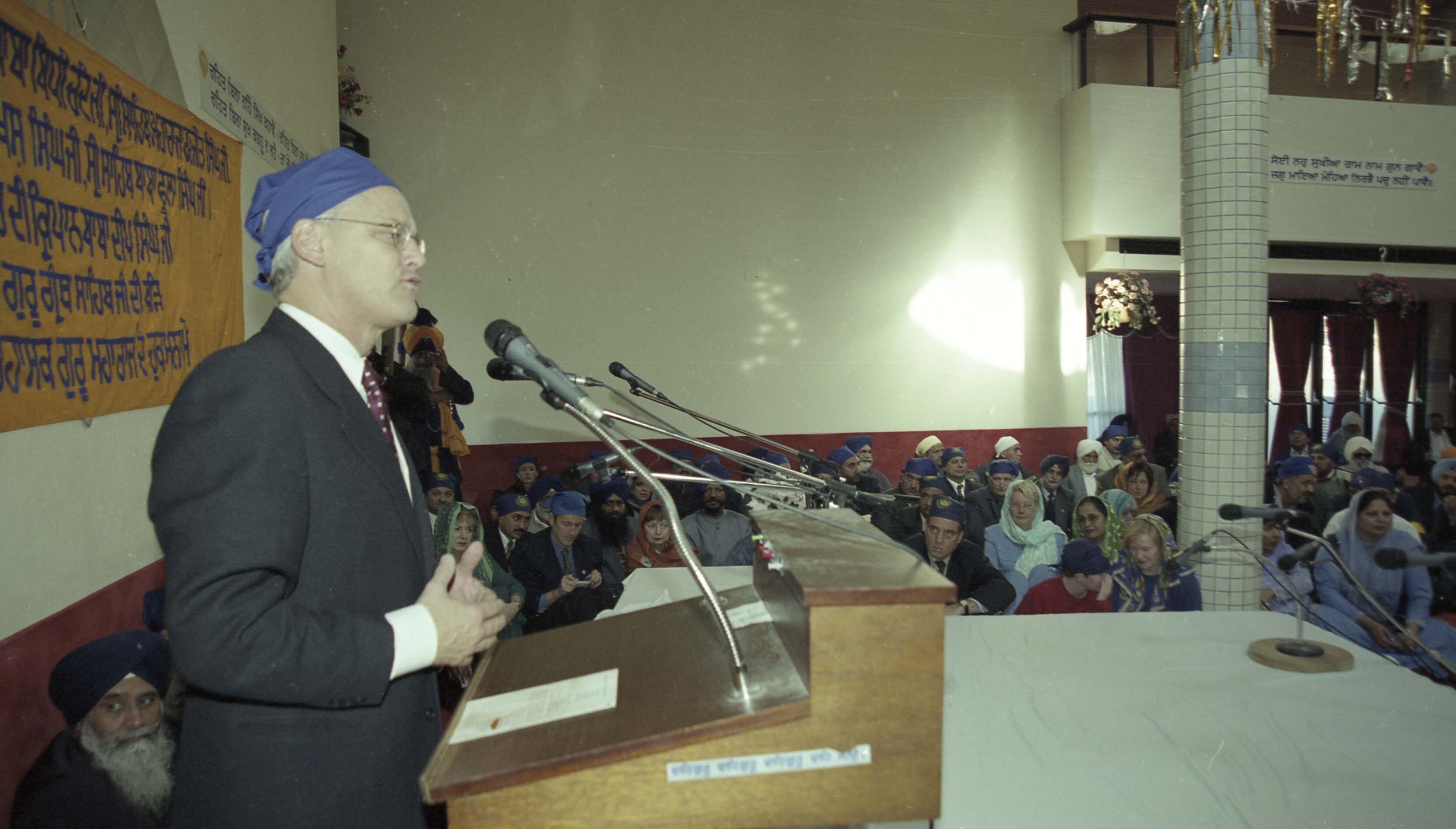
Photograph of Gordon Campbell addressing the audience at the Sikh Temple (gurdwara) located in Vancouver, British Columbia (B.C.). Individuals had gathered at the Sikh Temple for the Vaisakhi Nagar Kirtan, an annual event hosted and organized by the Khalsa Diwan Society in Vancouver.
Gordon Campbell was sworn in as British Columbia's 34th Premier on June 5, 2001. Campbell was elected leader of the B.C. Liberal Party in September 1993. He was elected to the B.C. Legislature in 1994 in a by-election to represent the riding of Vancouver-Quilchena and was re-elected in 1996 and 2001 for Vancouver-Point Grey. Campbell attended public school in Vancouver. After graduating he received a scholarship to Dartmouth College in New Hampshire. He worked his way through university in the dining hall and as the associate to the secretary of the college, and received his bachelor of arts degree. He later received a master's of business administration from Simon Fraser University. He was a secondary school teacher, basketball and track coach in Yola, Nigeria, working under the auspices of CUSO. He then became an assistant to former Vancouver mayor Art Phillips. From 1976 to 1981, he worked with Marathon Realty, where he became general manager of development. In 1981, he founded Citycore Development Corporation. In 1984, Campbell was elected to Vancouver City Council. From 1986 to 1993, he served as Mayor of Vancouver for three successive terms. From 2001 to 2011, Campbell served as Premier of British Columbia, and High Commissioner to the United Kingdom from 2011 to 2016. During his tenure as Premier, Campbell reduced taxes, restrained spending, revolutionized the measurement and management of regulations, and markedly improved the economy of the province. Among his recognitions and awards, Campbell received the Order of British Columbia as well as the Order of Canada. In 2014, he was presented an Honorary Doctorate of Laws from Thompson Rivers University. He was awarded both the Queen Elizabeth II Golden Jubilee Medal (2002) and the Diamond Jubilee Medal (2012) for his contributions to the province and country.
Vaisakhi is one of the most important festivals in Sikhi, marking the formation of the Khalsa in 1699 by the tenth guru, Guru Gobind Singh Ji. It is a time of renewal, gratitude, and unity, celebrated with processions, prayers, and acts of service. Beyond its significance in Sikh history, Vaisakhi is also a harvest festival in Punjab, observed with joy and thanksgiving. Additionally, Vaisakhi holds special significance for Hindus, as it marks the beginning of the solar new year and is celebrated in various regions of India under different names, such as Pohela Boishakh in Bengal and Puthandu in Tamil Nadu.
The Khalsa Diwan Society of Vancouver oversees the Vaisakhi celebrations in Vancouver. The Khalsa Diwan Society is a pioneer Sikh society, one of the oldest in Vancouver, formed on July 22, 1902 in British Columbia, Canada, formally established in 1906. In 1908, the Society purchased and built the first Sikh temple in Vancouver, which was located on West 2nd Avenue. This is believed to be the first Sikh temple in the whole of the American continent. This temple served the Sikh community until a new temple was occupied on April 25, 1970. The original temple was sold to build a bigger (present) temple located on Ross Street. The Khalsa Diwan Society has been a pioneer in raising Sikhi related issues and getting recognition for Sikhs in Canada. It continues to build a strong community based on Sikh values and principles. Every year the society organizes sports activities, including soccer and wrestling tournaments.
Gordon Campbell was sworn in as British Columbia's 34th Premier on June 5, 2001. Campbell was elected leader of the B.C. Liberal Party in September 1993. He was elected to the B.C. Legislature in 1994 in a by-election to represent the riding of Vancouver-Quilchena and was re-elected in 1996 and 2001 for Vancouver-Point Grey. Campbell attended public school in Vancouver. After graduating he received a scholarship to Dartmouth College in New Hampshire. He worked his way through university in the dining hall and as the associate to the secretary of the college, and received his bachelor of arts degree. He later received a master's of business administration from Simon Fraser University. He was a secondary school teacher, basketball and track coach in Yola, Nigeria, working under the auspices of CUSO. He then became an assistant to former Vancouver mayor Art Phillips. From 1976 to 1981, he worked with Marathon Realty, where he became general manager of development. In 1981, he founded Citycore Development Corporation. In 1984, Campbell was elected to Vancouver City Council. From 1986 to 1993, he served as Mayor of Vancouver for three successive terms. From 2001 to 2011, Campbell served as Premier of British Columbia, and High Commissioner to the United Kingdom from 2011 to 2016. During his tenure as Premier, Campbell reduced taxes, restrained spending, revolutionized the measurement and management of regulations, and markedly improved the economy of the province. Among his recognitions and awards, Campbell received the Order of British Columbia as well as the Order of Canada. In 2014, he was presented an Honorary Doctorate of Laws from Thompson Rivers University. He was awarded both the Queen Elizabeth II Golden Jubilee Medal (2002) and the Diamond Jubilee Medal (2012) for his contributions to the province and country.
Vaisakhi is one of the most important festivals in Sikhi, marking the formation of the Khalsa in 1699 by the tenth guru, Guru Gobind Singh Ji. It is a time of renewal, gratitude, and unity, celebrated with processions, prayers, and acts of service. Beyond its significance in Sikh history, Vaisakhi is also a harvest festival in Punjab, observed with joy and thanksgiving. Additionally, Vaisakhi holds special significance for Hindus, as it marks the beginning of the solar new year and is celebrated in various regions of India under different names, such as Pohela Boishakh in Bengal and Puthandu in Tamil Nadu.
The Khalsa Diwan Society of Vancouver oversees the Vaisakhi celebrations in Vancouver. The Khalsa Diwan Society is a pioneer Sikh society, one of the oldest in Vancouver, formed on July 22, 1902 in British Columbia, Canada, formally established in 1906. In 1908, the Society purchased and built the first Sikh temple in Vancouver, which was located on West 2nd Avenue. This is believed to be the first Sikh temple in the whole of the American continent. This temple served the Sikh community until a new temple was occupied on April 25, 1970. The original temple was sold to build a bigger (present) temple located on Ross Street. The Khalsa Diwan Society has been a pioneer in raising Sikhi related issues and getting recognition for Sikhs in Canada. It continues to build a strong community based on Sikh values and principles. Every year the society organizes sports activities, including soccer and wrestling tournaments.
Member of
Creator: Bodalia, Chandra
Description
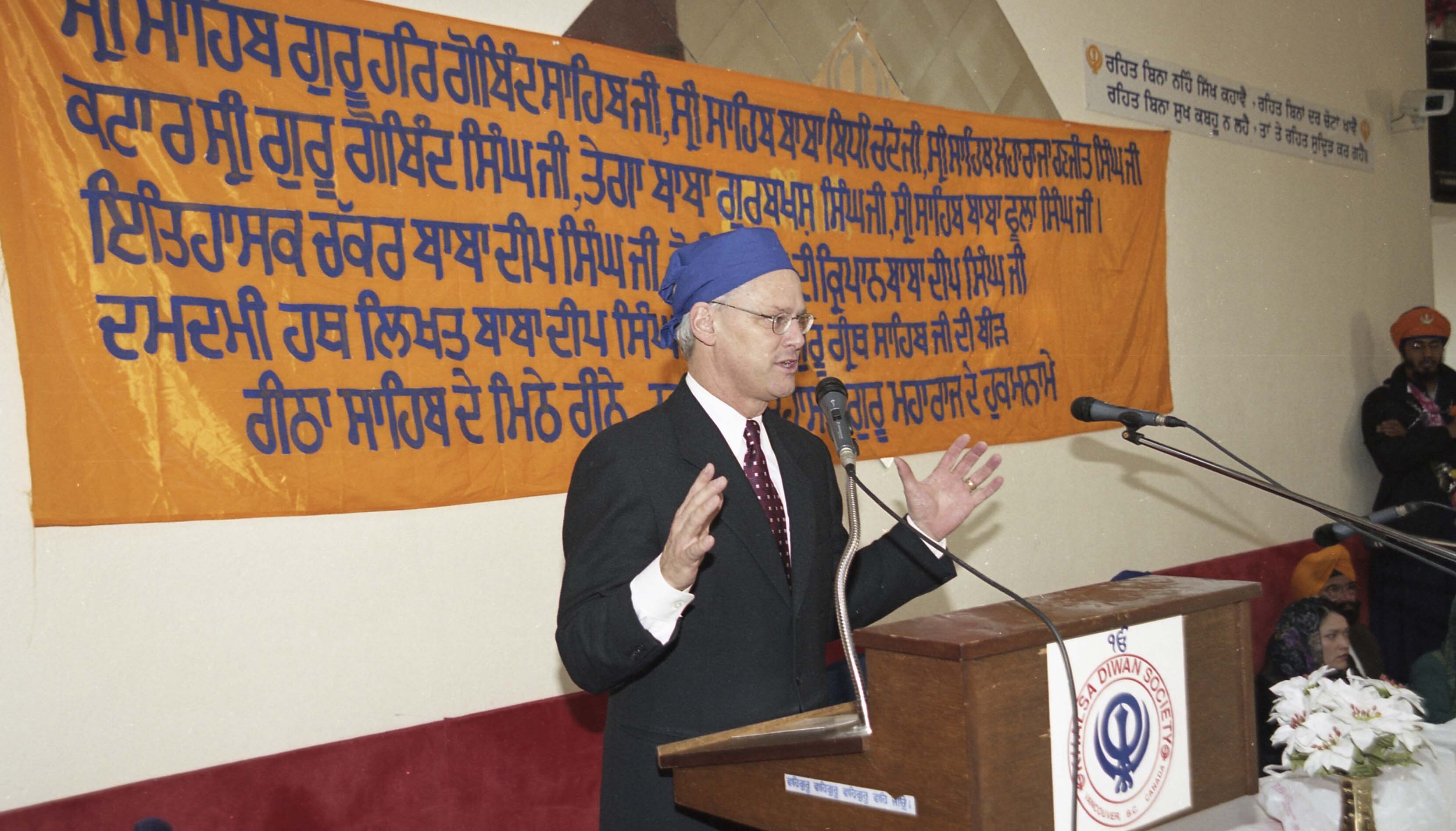
Photograph of Gordon Campbell addressing the audience at the Sikh Temple (gurdwara) located in Vancouver, British Columbia (B.C.). Individuals had gathered at the Sikh Temple for the Vaisakhi Nagar Kirtan, an annual event hosted and organized by the Khalsa Diwan Society in Vancouver.
Gordon Campbell was sworn in as British Columbia's 34th Premier on June 5, 2001. Campbell was elected leader of the B.C. Liberal Party in September 1993. He was elected to the B.C. Legislature in 1994 in a by-election to represent the riding of Vancouver-Quilchena and was re-elected in 1996 and 2001 for Vancouver-Point Grey. Campbell attended public school in Vancouver. After graduating he received a scholarship to Dartmouth College in New Hampshire. He worked his way through university in the dining hall and as the associate to the secretary of the college, and received his bachelor of arts degree. He later received a master's of business administration from Simon Fraser University. He was a secondary school teacher, basketball and track coach in Yola, Nigeria, working under the auspices of CUSO. He then became an assistant to former Vancouver mayor Art Phillips. From 1976 to 1981, he worked with Marathon Realty, where he became general manager of development. In 1981, he founded Citycore Development Corporation. In 1984, Campbell was elected to Vancouver City Council. From 1986 to 1993, he served as Mayor of Vancouver for three successive terms. From 2001 to 2011, Campbell served as Premier of British Columbia, and High Commissioner to the United Kingdom from 2011 to 2016. During his tenure as Premier, Campbell reduced taxes, restrained spending, revolutionized the measurement and management of regulations, and markedly improved the economy of the province. Among his recognitions and awards, Campbell received the Order of British Columbia as well as the Order of Canada. In 2014, he was presented an Honorary Doctorate of Laws from Thompson Rivers University. He was awarded both the Queen Elizabeth II Golden Jubilee Medal (2002) and the Diamond Jubilee Medal (2012) for his contributions to the province and country.
Vaisakhi is one of the most important festivals in Sikhi, marking the formation of the Khalsa in 1699 by the tenth guru, Guru Gobind Singh Ji. It is a time of renewal, gratitude, and unity, celebrated with processions, prayers, and acts of service. Beyond its significance in Sikh history, Vaisakhi is also a harvest festival in Punjab, observed with joy and thanksgiving. Additionally, Vaisakhi holds special significance for Hindus, as it marks the beginning of the solar new year and is celebrated in various regions of India under different names, such as Pohela Boishakh in Bengal and Puthandu in Tamil Nadu.
The Khalsa Diwan Society of Vancouver oversees the Vaisakhi celebrations in Vancouver. The Khalsa Diwan Society is a pioneer Sikh society, one of the oldest in Vancouver, formed on July 22, 1902 in British Columbia, Canada, formally established in 1906. In 1908, the Society purchased and built the first Sikh temple in Vancouver, which was located on West 2nd Avenue. This is believed to be the first Sikh temple in the whole of the American continent. This temple served the Sikh community until a new temple was occupied on April 25, 1970. The original temple was sold to build a bigger (present) temple located on Ross Street. The Khalsa Diwan Society has been a pioneer in raising Sikhi related issues and getting recognition for Sikhs in Canada. It continues to build a strong community based on Sikh values and principles. Every year the society organizes sports activities, including soccer and wrestling tournaments.
Gordon Campbell was sworn in as British Columbia's 34th Premier on June 5, 2001. Campbell was elected leader of the B.C. Liberal Party in September 1993. He was elected to the B.C. Legislature in 1994 in a by-election to represent the riding of Vancouver-Quilchena and was re-elected in 1996 and 2001 for Vancouver-Point Grey. Campbell attended public school in Vancouver. After graduating he received a scholarship to Dartmouth College in New Hampshire. He worked his way through university in the dining hall and as the associate to the secretary of the college, and received his bachelor of arts degree. He later received a master's of business administration from Simon Fraser University. He was a secondary school teacher, basketball and track coach in Yola, Nigeria, working under the auspices of CUSO. He then became an assistant to former Vancouver mayor Art Phillips. From 1976 to 1981, he worked with Marathon Realty, where he became general manager of development. In 1981, he founded Citycore Development Corporation. In 1984, Campbell was elected to Vancouver City Council. From 1986 to 1993, he served as Mayor of Vancouver for three successive terms. From 2001 to 2011, Campbell served as Premier of British Columbia, and High Commissioner to the United Kingdom from 2011 to 2016. During his tenure as Premier, Campbell reduced taxes, restrained spending, revolutionized the measurement and management of regulations, and markedly improved the economy of the province. Among his recognitions and awards, Campbell received the Order of British Columbia as well as the Order of Canada. In 2014, he was presented an Honorary Doctorate of Laws from Thompson Rivers University. He was awarded both the Queen Elizabeth II Golden Jubilee Medal (2002) and the Diamond Jubilee Medal (2012) for his contributions to the province and country.
Vaisakhi is one of the most important festivals in Sikhi, marking the formation of the Khalsa in 1699 by the tenth guru, Guru Gobind Singh Ji. It is a time of renewal, gratitude, and unity, celebrated with processions, prayers, and acts of service. Beyond its significance in Sikh history, Vaisakhi is also a harvest festival in Punjab, observed with joy and thanksgiving. Additionally, Vaisakhi holds special significance for Hindus, as it marks the beginning of the solar new year and is celebrated in various regions of India under different names, such as Pohela Boishakh in Bengal and Puthandu in Tamil Nadu.
The Khalsa Diwan Society of Vancouver oversees the Vaisakhi celebrations in Vancouver. The Khalsa Diwan Society is a pioneer Sikh society, one of the oldest in Vancouver, formed on July 22, 1902 in British Columbia, Canada, formally established in 1906. In 1908, the Society purchased and built the first Sikh temple in Vancouver, which was located on West 2nd Avenue. This is believed to be the first Sikh temple in the whole of the American continent. This temple served the Sikh community until a new temple was occupied on April 25, 1970. The original temple was sold to build a bigger (present) temple located on Ross Street. The Khalsa Diwan Society has been a pioneer in raising Sikhi related issues and getting recognition for Sikhs in Canada. It continues to build a strong community based on Sikh values and principles. Every year the society organizes sports activities, including soccer and wrestling tournaments.