
Name
2024_19_18_007-Service File.jpg
MIME type
image/jpeg
File size
770332
Width
3296
Height
2087
Media Use
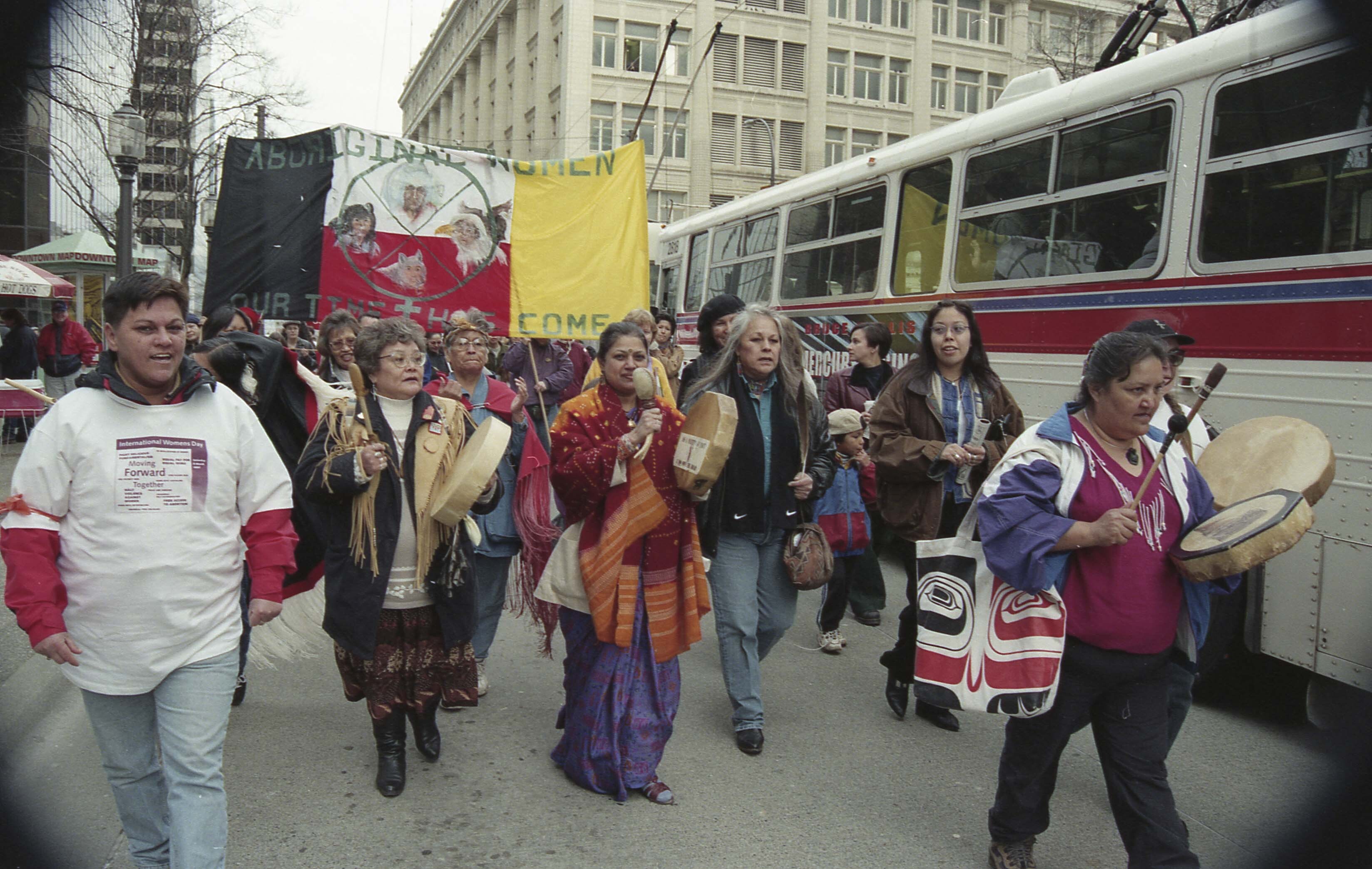
[Photograph of participants of the International Women's Day parade in Vancouver]
Details
Creators
Creator: Chandra Bodalia
Date Created
1998-03-08
Description
Photograph of a group of unidentified individuals, playing Indigenous drums and holding a banner, participating in the International Women's Day parade which took place in Vancouver, British Columbia (B.C.).
Indigenous drums occupy a central place in the cultures of First Nations, Métis and Inuit peoples in Canada. They are much more than just musical instruments; they are sacred objects, bearers of spirituality, history and cultural identity. Native American drums have been present in indigenous cultures across North America for thousands of years. Their precise origins are difficult to determine, as they are an integral part of oral and spiritual traditions passed down through generations. The materials used to make drums vary by region and nation, but the process of making them is always deeply respected and rooted in cultural practices. For Indigenous peoples in Canada, the drum is often considered the "heartbeat of Mother Earth." It is a sacred link between the physical and spiritual worlds. When the drum resonates, it calls forth the spirits and creates a connection between humans, ancestors, and the Creator. This resonance is believed to align the rhythm of human life with that of the Earth and the universe. Drums are used in a variety of settings, including religious ceremonies, powwows, healings, and community gatherings. Each nation has its own songs and rhythms associated with its spiritual and cultural traditions. Beyond their spiritual and cultural role, Indigenous drums are also powerful symbols of resistance and resilience for Indigenous peoples in Canada. For decades, colonial policies sought to erase Indigenous cultural traditions, including the use of drums, by banning ceremonies and forcing assimilation. However, Indigenous communities resisted these attempts by continuing to practice and pass on their musical and spiritual traditions. Today, drums are used at protests, Indigenous rights marches, and other public events to demand recognition and respect for Indigenous cultures. The beating of the drum is a reminder of the strength and vitality of Indigenous peoples, despite the historical and contemporary challenges they have faced.
International Women's Day (IWD) is a specific day dedicated to the advancement of women worldwide; celebrated annually on March 8, to honor the achievements of women across all aspects of life – social, economic, cultural, and political – while also advocating for gender equality. Originating from labor movements in the early 20th century, IWD has evolved into a globally recognized occasion marked by events, discussions, and initiatives advocating for inclusivity and equity. IWD was marked for the first time in 1911 in Austria, Denmark, Germany and Switzerland, on March 19, with more than one million women and men attending rallies.
Indigenous drums occupy a central place in the cultures of First Nations, Métis and Inuit peoples in Canada. They are much more than just musical instruments; they are sacred objects, bearers of spirituality, history and cultural identity. Native American drums have been present in indigenous cultures across North America for thousands of years. Their precise origins are difficult to determine, as they are an integral part of oral and spiritual traditions passed down through generations. The materials used to make drums vary by region and nation, but the process of making them is always deeply respected and rooted in cultural practices. For Indigenous peoples in Canada, the drum is often considered the "heartbeat of Mother Earth." It is a sacred link between the physical and spiritual worlds. When the drum resonates, it calls forth the spirits and creates a connection between humans, ancestors, and the Creator. This resonance is believed to align the rhythm of human life with that of the Earth and the universe. Drums are used in a variety of settings, including religious ceremonies, powwows, healings, and community gatherings. Each nation has its own songs and rhythms associated with its spiritual and cultural traditions. Beyond their spiritual and cultural role, Indigenous drums are also powerful symbols of resistance and resilience for Indigenous peoples in Canada. For decades, colonial policies sought to erase Indigenous cultural traditions, including the use of drums, by banning ceremonies and forcing assimilation. However, Indigenous communities resisted these attempts by continuing to practice and pass on their musical and spiritual traditions. Today, drums are used at protests, Indigenous rights marches, and other public events to demand recognition and respect for Indigenous cultures. The beating of the drum is a reminder of the strength and vitality of Indigenous peoples, despite the historical and contemporary challenges they have faced.
International Women's Day (IWD) is a specific day dedicated to the advancement of women worldwide; celebrated annually on March 8, to honor the achievements of women across all aspects of life – social, economic, cultural, and political – while also advocating for gender equality. Originating from labor movements in the early 20th century, IWD has evolved into a globally recognized occasion marked by events, discussions, and initiatives advocating for inclusivity and equity. IWD was marked for the first time in 1911 in Austria, Denmark, Germany and Switzerland, on March 19, with more than one million women and men attending rallies.
Note
https://www.internationalwomensday.com/About-IWD
https://www.artisanatautochtone.com/en/blogs/origines/l-origine-des-tambours-autochtones-et-leur-signification
Extent
1 photograph : col. negative
Rights
CC BY-NC-SA 4.0
Subjects
Subject (Topical)
Subject (Geographic)